
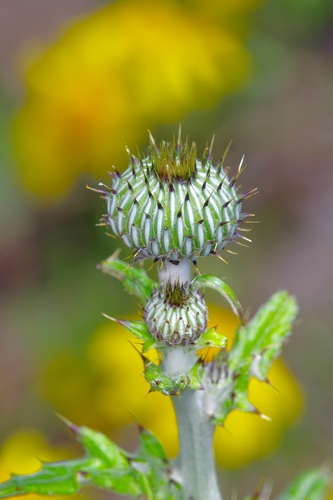


Texas Thistle
cirsium texanum
The Texas Thistle is a striking native wildflower celebrated for its resilient nature and immense wildlife value. Often dismissed as a mere weed due to its spiny defense, this plant plays a crucial ecological role in its native prairies and meadows. Throughout late spring and summer, it produces beautiful, globe-shaped lavender to deep pink flower heads that act as bustling hubs for local pollinators. Unlike non-native thistles, which can become aggressively invasive, the Texas Thistle is a well-behaved and vital member of the southern United States' ecosystem, offering abundant nourishment to insects and birds alike.
Habitat: Found in open prairies, pastures, roadsides, and disturbed fields across Texas and the southern United States.
This erect wildflower typically grows between 60 to 150 cm tall, displaying branched stems coated in fine, woolly white hairs. The deeply lobed, lance-shaped leaves are dark green above, lighter beneath, and armed with sharp, prominent spines along their margins. Perched atop these leafy stems are solitary, tufted flower heads, roughly 2.5 to 5 cm wide, featuring a dense cluster of pink-to-purple disc florets. Below each bloom sits a vase-shaped bract structure covered in sticky, white cobwebby filaments.
Category
PlantsRarity
Common
Danger
1/5 · Very low
Snaps
Be the first to snap!
American Goldfinches deliberately delay their nesting season until late summer to align with the seeding cycle of thistles.
The fluffy white down attached to the seeds is so soft that indigenous peoples and birds alike have used it as insulation and lining.
Unlike invasive European thistles, the native Texas Thistle rarely forms dense, aggressive monocultures and coexists peacefully with other native flora.
Armed with needle-sharp spines along leaf margins and stems to deter large herbivores from grazing on its foliage.
Utilizes a deep taproot and woolly hairs on its stems and leaves to lock in moisture and withstand hot, dry climates.
Synthesizes high volumes of nutrient-rich nectar specifically designed to attract and support large-bodied pollinators like bumblebees and butterflies.
As a photoautotrophic plant, it produces its own food via photosynthesis using sunlight, water, and carbon dioxide while drawing essential minerals from the soil.

Spinus tristis
Feeds on the seeds and harvests the fluffy down for soft nesting material.

Danaus plexippus
Adults feed on the sweet nectar, transferring pollen between flowers.

Bombus pensylvanicus
Collects large amounts of pollen and nectar from the purple flowers.
No trait badges are assigned for this object yet.
No aliases listed yet.
Collections for this object will appear here as more themes are added.
Danger
1/5 · Very low
No special safety notes yet.
Start with the whole plant, then compare leaf arrangement, leaf edges, stems and any flowers or fruit. Opposite leaves grow in pairs; alternate leaves come one at a time along the stem. These details tell you far more together than a single green leaf does. Plant Identifier: upload a photo and compare the visible details.
60-150 cm
1-2 years
As a photoautotrophic plant, it produces its own food via photosynthesis using sunlight, water, and carbon dioxide while drawing essential minerals from the soil.
Found in open prairies, pastures, roadsides, and disturbed fields across Texas and the southern United States.
Zoom in to split clusters and explore where this object has been snapped.
Recent snaps will appear here as new observations are added.
Take the discovery with you
Snap it with Snappit to identify it, learn what makes it special, and add the discovery to your collection.


















