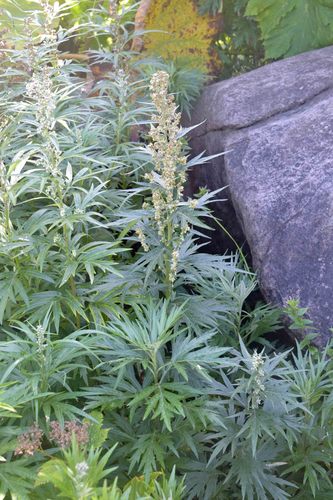


Tilesius Wormwood
artemisia tilesii
Artemisia tilesii, commonly known as Tilesius Wormwood, is a hardy perennial herb belonging to the sunflower family (Asteraceae). Native to cold, northern regions of North America and Siberia, this plant is well-adapted to harsh arctic and subarctic environments. It's known for its distinct aromatic foliage, often utilized in traditional medicine by indigenous communities for various ailments due to its rich array of secondary metabolites. Ecologically, it plays a role in stabilizing disturbed soils and providing forage for some wildlife in its rugged habitats, showcasing the resilience of life in extreme conditions.
Habitat: Found primarily in arctic and alpine tundra, rocky slopes, gravel bars, open woodlands, and disturbed areas such as roadsides and riverbanks.
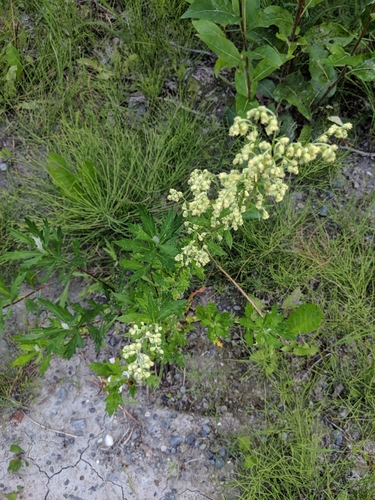
Tilesius Wormwood typically grows as a low-lying, often mat-forming plant, reaching heights of 10 to 40 cm. Its stems are erect to decumbent, usually densely covered in fine, silvery-white hairs, giving the plant a gray-green appearance. The leaves are deeply dissected, almost fern-like, with linear lobes, and also possess the characteristic silvery pubescence. Small, inconspicuous greenish-yellow flower heads, lacking ray florets, are clustered in terminal panicles, blooming in late summer.
Category
PlantsRarity
Common
Danger
1/5 · Very low
Snaps
2
Indigenous peoples across its range have traditionally used Artemisia tilesii for various medicinal purposes, including remedies for colds, headaches, and as a smudge for purification.
Its ability to grow in nutrient-poor, rocky, and disturbed soils makes it a pioneer species, playing an important role in ecological succession in harsh environments.
Like many Artemisia species, it produces a strong, distinctive aroma when crushed, which is a key identifying feature and a result of its unique chemical compounds.
The species name "tilesii" honors Wilhelm Gottfried von Tilesius von Tilenau, a German naturalist and artist who participated in the first Russian circumnavigation of the globe.
The plant produces specialized compounds that act as natural antifreeze, preventing cell damage during freezing temperatures and allowing it to survive harsh arctic winters.
Its leaves contain volatile aromatic compounds, including terpenes, which deter many herbivores from grazing and may also exhibit allelopathic properties, inhibiting the growth of competing plants.
Tilesius Wormwood spreads through underground rhizomes, enabling it to colonize new areas, survive disturbances, and form dense mats that help stabilize soils in its often-eroding habitats.
As a photosynthetic plant, Artemisia tilesii produces its own food by converting sunlight, carbon dioxide, and water into sugars, utilizing nutrients absorbed from the soil.
Insecta
Pollination service.
Urocitellus parryii
Herbivory.
_and_beneficial_bacteria_on_plant_performance_and_soil_fertility.webp&width=800)
Glomeromycota
Soil nutrient cycling and plant growth enhancement.
Noctuidae
Habitat and food for larvae.
No trait badges are assigned for this object yet.
No aliases listed yet.
Collections for this object will appear here as more themes are added.
Danger
1/5 · Very low
No special safety notes yet.
The easiest way to identify Tilesius Wormwood is to use the Snappit nature identifier app.
10-40 cm
0.05-0.5 kg
3-10 years
As a photosynthetic plant, Artemisia tilesii produces its own food by converting sunlight, carbon dioxide, and water into sugars, utilizing nutrients absorbed from the soil.
Found primarily in arctic and alpine tundra, rocky slopes, gravel bars, open woodlands, and disturbed areas such as roadsides and riverbanks.
Photosynthesis And Nutrient Absorption
Zoom in to split clusters and explore where this object has been snapped.
Jul 17, 2019
Gakona Historic DistrictPhoto attribution
(c) Alexandria 'Alex' Wenninger, some rights reserved (CC BY)
License: CC BY 4.0 ↗
Image may be shown cropped inside the card frame.
Take the discovery with you
Snap it with Snappit to identify it, learn what makes it special, and add the discovery to your collection.













.jpg&width=800)



_001.jpg&width=800)




