

Tree Lungwort
lobaria pulmonaria
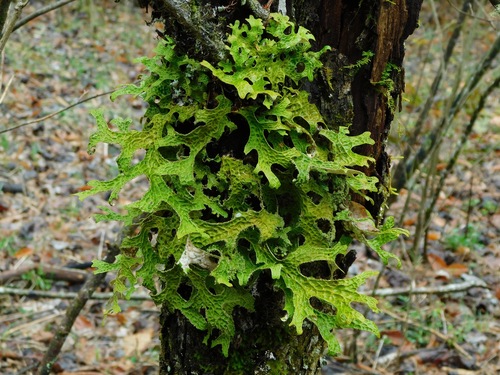
Tree Lungwort, or Lobaria pulmonaria, is a fascinating and beautiful species of large epiphytic lichen. Often found draped across the bark of mature deciduous trees in old-growth forests, this organism is actually a complex symbiotic partnership. It typically consists of an Ascomycete fungus, a green alga, and a cyanobacterium working together to survive and thrive. Its lung-like appearance historically made it a popular, though medically ineffective, folk remedy for respiratory ailments under the medieval Doctrine of Signatures. Today, it is highly valued by ecologists as a critical indicator species; its presence signifies unpolluted air and a healthy, undisturbed forest ecosystem.
Habitat: Found in humid old-growth forests, typically growing on the bark of mature deciduous trees.
This large, leafy (foliose) lichen is easily identified by its broad, lobed thallus that can grow up to 30 centimeters across. Its surface is deeply ridged and pitted, closely resembling the internal structure of mammalian lungs. Its color transforms dramatically depending on moisture levels: when wet, it turns a vibrant, leathery bright green as its photosynthetic algae become active, but when dry, it fades to a papery, brittle grayish-brown or pale olive. The undersides of the lobes are paler with scattered pale pockets called cyphellae and patches of root-like anchoring structures known as rhizines.
Category
FungiRarity
Common
Danger
1/5 · Very low
Snaps
1
Because it extracts moisture and nutrients directly from the air rather than soil, it is extremely vulnerable to pollution, acting as a natural canary in the coal mine for forest air quality.
It isn't just one organism, but a complex 'tripartite' partnership consisting of a fungus, a green algae, and a cyanobacterium all living as one.
Tree lungwort changes color like magic; it is a dull, papery grey when dry, but turns a vibrant, leathery bright green within seconds of absorbing rain.
Under the medieval 'Doctrine of Signatures,' healers believed that because this lichen looked like lung tissue, it could cure conditions like pneumonia and tuberculosis.
It hosts both green algae for photosynthesis and cyanobacteria for nitrogen fixation, giving it a massive ecological advantage.
Its extreme sensitivity to sulfur dioxide and other air pollutants makes it a highly reliable living monitor for air quality.
It can quickly absorb moisture from rain or mist, rapidly transforming from a dormant, brittle state into a vibrant, actively photosynthesizing organism.
As a symbiotic lichen, it produces its own food through the photosynthesis of its algal partners and fixes atmospheric nitrogen via its cyanobacteria.

Quercus petraea
Grows as an epiphyte on the bark of mature trees without parasitizing or harming them.
Limax cinereoniger
Grazed upon by specialized forest gastropods in damp woodland environments.

Fringilla coelebs
Birds harvest pieces of the lichen to weave into their nests for camouflage and structure.
No trait badges are assigned for this object yet.
No aliases listed yet.
Collections for this object will appear here as more themes are added.
Danger
1/5 · Very low
No special safety notes yet.
Compare the cap shape, the underside, the stem and base, and whether the fungus grows on wood or soil. Some fungi have gills, others pores or teeth. A cap seen only from above often hides the most useful features. Mushroom Identifier: upload a photo and compare the visible details.
5-30 cm
20-100 years
As a symbiotic lichen, it produces its own food through the photosynthesis of its algal partners and fixes atmospheric nitrogen via its cyanobacteria.
Found in humid old-growth forests, typically growing on the bark of mature deciduous trees.
Photosynthesis
Zoom in to split clusters and explore where this object has been snapped.

Alaska, US
You might spot Brown Bear, Common Merganser, and Sockeye Salmon.
View guide →

Alaska, US
You might spot Moose, Devil's Club, and Red-Berried Elder.
View guide →

New York, US
You might spot American Toad and Purple Pitcher Plant.
View guide →

Maine, US
You might spot Large-Leaved Lupine, Tree Lungwort, and Asian Bittersweet.
View guide →

New Hampshire, US
You might spot Common Shiner, Tree Lungwort, and Creek Chub.
View guide →

Washington, US
You might spot Broad-Leaved Stonecrop and Western Sword Fern.
View guide →
Take the discovery with you
Snap it with Snappit to identify it, learn what makes it special, and add the discovery to your collection.