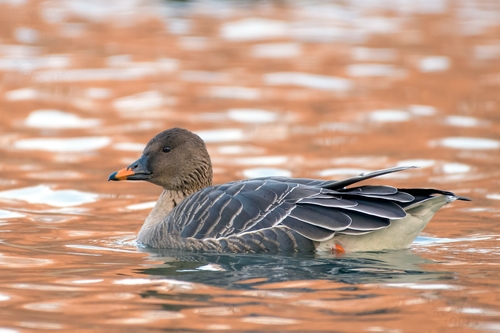


Tundra Bean Goose
anser serrirostris
The Tundra Bean Goose (Anser serrirostris) is a robust migratory waterfowl breeding across the vast, wind-swept expanses of the northern Russian tundra and wintering in milder climates of Europe and East Asia. Often distinguished by its tough, blocky bill and strong-willed demeanor, this species is highly social, forming massive, noisy flocks during migration and winter. Historically grouped with the Taiga Bean Goose, it is now widely recognized as its own distinct species, highly adapted to survive in harsh, open landscapes. Observing a flock of Tundra Bean Geese arriving at their wintering grounds is a spectacular natural event. Their resonant, honking calls echo across agricultural fields and wetlands, signaling the seasonal shift. These geese are incredibly resilient, navigating thousands of kilometers across continental flyways using precise, ancestral routes to find food and safety.
Habitat: Breeds in open wet tundra, shrubby lowlands, and arctic river valleys, while wintering in agricultural fields, grasslands, and freshwater wetlands.
This is a large, dark brown goose characterized by a heavy, thick-based black bill marked with a bright orange band near the tip. It features a dark, rounded head and a thick neck that contrasts with its paler, grayish-brown body. The upperparts are barred with pale feather edges, giving it a scaly appearance, while the legs and feet are a striking, bright orange. In flight, its broad, dark wings and white-tipped tail are highly visible, and its size is noticeably larger than a Greater White-fronted Goose but slightly more compact than its close relative, the Taiga Bean Goose.
Category
BirdsRarity
Common
Danger
1/5 · Very low
Snaps
Be the first to snap!
The Tundra Bean Goose was long considered the same species as the Taiga Bean Goose, but they are now split due to differences in bill shape, habitat preference, and vocalizations.
Their name 'Bean Goose' comes from their historic habit of foraging in harvested bean fields during their winter migration through Europe.
These geese form monogamous pair bonds that often last for life, and families migrate together, remaining as a tight-knit unit through the first winter.
Dense, waterproof plumage and thick layers of down provide exceptional insulation against sub-zero arctic temperatures.
Utilizes strong, sustained flapping flight to cross high mountain ranges and brave turbulent winds during long-distance migrations.
Possesses a specialized digestive system and tough bill that allow it to efficiently grind and extract nutrition from fibrous winter grasses and leftover agricultural grains.
Feeds primarily on a wide variety of plant material, grazing on grasses, sedges, and agricultural crops depending on the season.
Age differences: Goslings initially feed on high-protein insects and tender young plant shoots to fuel rapid growth before transitioning to a fully herbivorous diet.

Vulpes lagopus
Preys upon eggs and young goslings in the arctic nesting grounds.

Haliaeetus albicilla
Preys on adult and juvenile geese, particularly weak or injured individuals on wintering grounds.
Puccinellia phryganodes
An important forage plant consumed during the summer breeding season on the tundra.
No trait badges are assigned for this object yet.
No aliases listed yet.
Collections for this object will appear here as more themes are added.
Danger
1/5 · Very low
No special safety notes yet.
Compare the silhouette, bill shape, tail length, wing bars and markings around the eyes. The same small brown bird at your feeder can look quite different in breeding plumage, winter plumage or its first year. Bird Identifier: upload a photo and compare the visible details.
68+ cm
140+ cm
2+ kg
10+ years
75 km/h
Feeds primarily on a wide variety of plant material, grazing on grasses, sedges, and agricultural crops depending on the season.
Breeds in open wet tundra, shrubby lowlands, and arctic river valleys, while wintering in agricultural fields, grasslands, and freshwater wetlands.
Zoom in to split clusters and explore where this object has been snapped.
Recent snaps will appear here as new observations are added.
Take the discovery with you
Snap it with Snappit to identify it, learn what makes it special, and add the discovery to your collection.