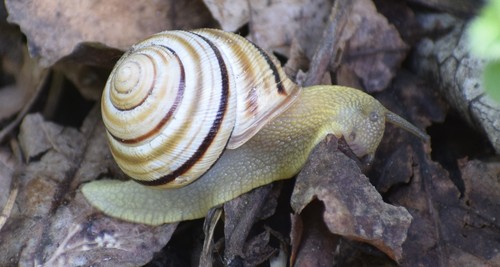


Vineyard Snail
caucasotachea vindobonensis
The Vineyard Snail (Caucasotachea vindobonensis) is a medium-sized land snail native to Central and Southeastern Europe. Known for its beautifully banded shell and preference for warm, sun-drenched environments, this species is commonly found in grasslands, vineyards, and light woodlands. Unlike many other land snails that strictly avoid the sun, the Vineyard Snail is remarkably heat-tolerant, often climbing plant stems during hot days to escape the scorching ground temperature. This charming gastropod plays a vital ecological role as a decomposer, recycling organic nutrients back into the soil. Its presence is often a key indicator of healthy calcareous grassland ecosystems, making it a favorite find for European nature enthusiasts.
Habitat: Typically found in warm, open habitats such as dry grasslands, vineyards, shrubby hillsides, and light deciduous forests with calcium-rich soils.
The shell of the Vineyard Snail is globular with a slightly pointed spire, measuring 2 to 3 cm in diameter. It features a pale yellow or whitish background, typically adorned with five distinct, dark brown spiral bands, though the upper bands can sometimes be faint. A key identifier is the aperture lip, which is characteristically brown or reddish-brown. The shell's surface also has fine, irregular growth lines, giving it a slightly textured appearance compared to the smoother shells of closely related Cepaea species.
Category
InvertebrateRarity
Common
Danger
1/5 · Very low
Snaps
Be the first to snap!
Despite its name, the Vineyard Snail is not a significant agricultural pest and is tolerated in vineyards as it feeds mostly on decaying matter.
Like many land snails, they are hermaphrodites, possessing both male and female reproductive organs, and use calcium-based love darts during courtship.
They use a tongue-like structure called a radula, covered in thousands of microscopic chitinous teeth, to scrape food off surfaces.
When threatened, they can retract entirely inside their shell and bubble a protective foam from their mantle to deter predators.
To survive extreme summer heat and prevent drying out, it climbs high onto plant stems or fence posts to enter a dormant state called aestivation.
It secretes a temporary, parchment-like barrier of dried mucus called an epiphragm to seal its shell opening, conserving moisture during dry periods.
Using specialized chemical receptors, it can actively detect and migrate toward calcium-rich substrates necessary for maintaining and repairing its sturdy shell.
Primarily feeds by scraping algae, lichens, and decaying plant material from rocks, soil, and plant stems using its specialized radula.

Turdus philomelos
The Song Thrush is a major predator of the Vineyard Snail, frequently breaking its shell against rocks to extract the soft body inside.
Lampyris noctiluca
Larvae of the Common Glow-worm actively hunt and feed on land snails like the Vineyard Snail, injecting them with paralyzing neurotoxins.
Helix pomatia
The Roman Snail often shares the same calcareous habitats and competes with the Vineyard Snail for limited food and calcium resources.
No trait badges are assigned for this object yet.
No aliases listed yet.
Collections for this object will appear here as more themes are added.
Danger
1/5 · Very low
No special safety notes yet.
Compare body symmetry, shells, segments, legs, tentacles and how the animal moves. Invertebrates span many unrelated groups, so start with body structure. Invertebrate Identifier: upload a photo and compare the visible details.
2-3 cm
0.002-0.007 kg
3-5 years
Primarily feeds by scraping algae, lichens, and decaying plant material from rocks, soil, and plant stems using its specialized radula.
Typically found in warm, open habitats such as dry grasslands, vineyards, shrubby hillsides, and light deciduous forests with calcium-rich soils.
Grazing
30-80
Zoom in to split clusters and explore where this object has been snapped.
Recent snaps will appear here as new observations are added.
Take the discovery with you
Snap it with Snappit to identify it, learn what makes it special, and add the discovery to your collection.