





Wallisia
wallisia
The Wallisia is a playful creature often seen frolicking in the sunshine! Its soft, furry coat makes it a favorite among children who love to learn about animals.
Habitat: Wallisia lives in lush forests where they can climb trees and find plenty of food.
The Wallisia is a small, agile mammal with soft, reddish-brown fur that shimmers with subtle green iridescence in direct sunlight. It has large, expressive dark eyes and prominent tufts of white fur around its ears, setting it apart from other arboreal creatures.
Category
MammalsRarity
Common
Danger
1/5 · Very low
Snaps
Be the first to snap!
Its sparkling fur isn't just pretty; it helps Wallisia camouflage among dappled forest light!
These clever mammals can remember the location of hundreds of buried food stashes!
Wallisia builds intricate nests high in trees, weaving leaves and twigs together for safety.
Wallisia communicates with squeaks and chirps, each sound meaning something different to its family.
Wallisia has uniquely padded paws with strong, retractable claws that help them maintain an incredibly secure grip on slick branches.
Wallisia can use its long, muscular tail as a dynamic counterweight, helping them balance perfectly while leaping between trees.
Wallisia has super-sensitive whiskers that help them detect tiny air currents, allowing agile navigation even in darkness.
Wallisia enjoys a varied menu of fruits, nuts, insects, and occasionally tiny birds and eggs.
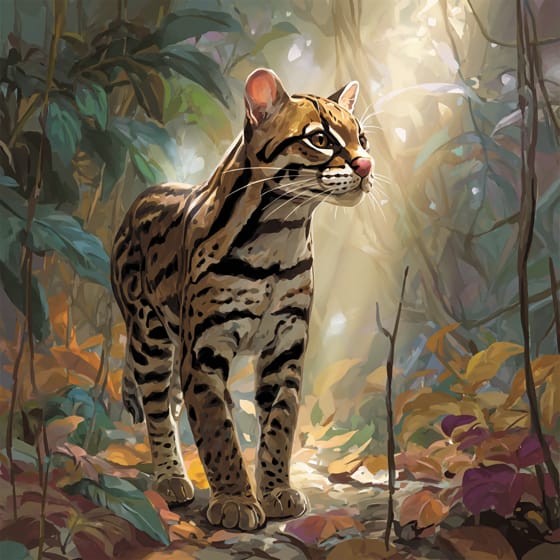
Leopardus pardalis
An agile predator, it preys on Wallisia through the trees.
Inga edulis
Consumes its sweet pods, helping disperse seeds widely.
Corallus hortulanus
This snake stealthily ambushes Wallisia in the branches.
Furry describes animals possessing a dense covering of soft hair or fur.
Social animals live in organized groups, cooperating for survival benefits such as foraging, defense, and raising offspring.
This trait characterizes organisms whose diet consists entirely or primarily of plant material.
Forest habitats are terrestrial environments dominated by dense tree cover, supporting a high diversity of plant and animal life.

Nocturnal animals are primarily active during the nighttime hours, typically resting or sleeping during the day.
Danger
1/5 · Very low
Always observe animals from a distance to keep both you and the animal safe.
The easiest way to identify Wallisia is to use the Snappit nature identifier app.
22-31 cm
0.6-1.4 kg
6-9 years
20 km/h
Wallisia enjoys a varied menu of fruits, nuts, insects, and occasionally tiny birds and eggs.
Wallisia lives in lush forests where they can climb trees and find plenty of food.
Foraging
Zoom in to split clusters and explore where this object has been snapped.
Recent snaps will appear here as new observations are added.
Take the discovery with you
Snap it with Snappit to identify it, learn what makes it special, and add the discovery to your collection.




.jpg&width=800)


.JPG&width=800)


.jpg&width=800)
