

Washboard
megalonaias nervosa
The Washboard (Megalonaias nervosa) is a remarkable and robust freshwater mussel native to the river systems of central North America, particularly the Mississippi River basin. Taking its common name from the distinct, heavy ridges on its shell that resemble an old-fashioned laundry washboard, this species is among the largest and longest-lived freshwater bivalves in North America. By quietly anchoring themselves in the riverbed, Washboards act as natural biological filters, drawing in water to feed on microscopic particles and significantly improving the water quality around them. Historically, their exceptionally thick shells made them a primary target during the pearl button industry boom of the late 19th century. Today, they remain a fascinating study in river ecology, notable for their complex lifecycle which involves a temporary parasitic stage where their microscopic larvae hitch a ride on the gills of specific host fish to disperse across the river system.
Habitat: Found partially buried in mud, sand, or gravel substrates at the bottom of medium to large rivers with moderate currents.
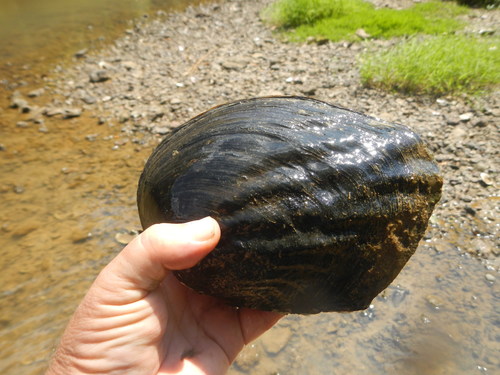
The Washboard mussel is easily identified by its exceptionally large, thick, and heavy shell, which can grow up to 12 inches across. The most distinguishing feature is the heavy, V-shaped corrugations or folds on the posterior half of the shell, giving it the appearance of a rugged washing board. The outer periostracum (skin of the shell) is typically dark brown or entirely black in older individuals, while younger mussels may have greenish-brown hues. Inside, the shell's nacre (mother-of-pearl) is predominantly white, though it can occasionally exhibit pinkish or iridescent purple patches.
Category
InvertebrateRarity
Common
Danger
1/5 · Very low
Snaps
Be the first to snap!
Because they are exceptionally efficient filter feeders, a healthy bed of Washboard mussels can actively clean and clarify millions of gallons of river water each day.
During the late 19th and early 20th centuries, the immensely thick shells of the Washboard were harvested by the millions and punched out to make pearl clothing buttons before the invention of plastic.
It gets its name from its deeply grooved shell, which looks remarkably like an antique laundry washboard.
Washboard mussels can live for over 60 years, spending nearly their entire adult lives anchored to a single spot on the riverbed.
Filters large volumes of river water to extract microscopic food, naturally purifying and clarifying the surrounding aquatic ecosystem in the process.
Releases microscopic larvae called glochidia that temporarily attach to the gills of specific host fish, allowing the immobile adult mussels to colonize new river areas.
Utilizes a strong, hatchet-shaped muscular foot to dig deep into gravel or mud, anchoring firmly against strong and unpredictable river currents.
Washboard mussels are filter feeders that continuously pump water through their bodies to extract microscopic plant and animal matter.
Age differences: Larval glochidia absorb nutrients from the blood and tissues of a host fish before dropping off to become filter-feeding adults.

Ictalurus punctatus
Microscopic larvae attach to the gills of the Channel Catfish to complete their development and travel safely across the river system.

Pomoxis annularis
White Crappie serves as another common fish host for Washboard glochidia.

Ondatra zibethicus
Muskrats are notable predators of adult mussels, often leaving piles of empty shells known as middens on riverbanks.
No trait badges are assigned for this object yet.
No aliases listed yet.
Collections for this object will appear here as more themes are added.
Danger
1/5 · Very low
No special safety notes yet.
Compare body symmetry, shells, segments, legs, tentacles and how the animal moves. Invertebrates span many unrelated groups, so start with body structure. Invertebrate Identifier: upload a photo and compare the visible details.
15-30 cm
0.5-2.5 kg
30-70 years
Washboard mussels are filter feeders that continuously pump water through their bodies to extract microscopic plant and animal matter.
Found partially buried in mud, sand, or gravel substrates at the bottom of medium to large rivers with moderate currents.
Filtering
10000-99000
Zoom in to split clusters and explore where this object has been snapped.
Recent snaps will appear here as new observations are added.
Take the discovery with you
Snap it with Snappit to identify it, learn what makes it special, and add the discovery to your collection.