

Wavy Turban
megastraea undosa
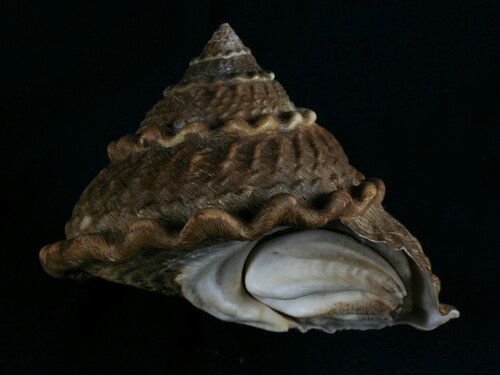
The Wavy Turban (Megastraea undosa) is a large, marine gastropod mollusk known for its heavy, beautifully sculpted shell. Found gliding slowly along the rocky subtidal reefs and kelp forests of the eastern Pacific, this snail plays a key role in its ecosystem by grazing on giant kelp and other algae. Its scientific name, undosa, translates to 'wavy,' highlighting the distinctive undulating ridges that decorate its robust shell.
Habitat: Found in shallow rocky reefs and kelp forests along the coast, spanning from the low intertidal zone down to depths of about 30 meters.
The Wavy Turban features a thick, conical shell that typically grows between 8 and 15 centimeters in diameter. Its exterior is marked by prominent, wavy spiral cords and is naturally a dull reddish-brown to gray, though it is frequently overgrown with pink coralline algae, bryozoans, and other marine life. A key identifier is its heavy, white calcareous operculum (trapdoor) which has several distinct, curved ridges. When flipped over, the shell's interior reveals a beautiful, iridescent pearly nacre.
Category
InvertebrateRarity
Common
Danger
1/5 · Very low
Snaps
Be the first to snap!
Because they host so many epiphytic organisms on their shells, a single Wavy Turban can carry its own miniature ecosystem of bryozoans, sponges, and small anemones.
The beautiful inner nacre (mother-of-pearl) of their shell has been used historically by Native American tribes, like the Chumash, for creating fishhooks, ornaments, and currency.
Their heavy, calcified trapdoor (operculum) is often referred to by beachcombers as a 'cat's eye' and is highly prized for jewelry-making.
Utilizes an exceptionally thick shell paired with a heavy, calcified operculum that acts as a tight-fitting door, sealing the snail safely inside away from predators.
The rough texture of its shell actively encourages the growth of crustose coralline algae and small invertebrates, rendering the snail nearly invisible against rocky reef backgrounds.
Possesses a specialized, file-like ribbon of teeth called a radula, which is strong enough to scrape and shred tough kelp holdfasts and stipes.
Grazes primarily on giant kelp and various species of brown and red algae found along rocky seafloors.
Macrocystis pyrifera
The Wavy Turban grazes extensively on the holdfasts and lower fronds of this giant algae species.
Enhydra lutris nereis
This marine mammal is a major predator, using rocks to crack open the snail's thick shell to access the meat.
Octopus bimaculatus
An efficient predator of rocky reefs that uses its arms and radula to drill into or pull apart the snail's operculum.
No trait badges are assigned for this object yet.
No aliases listed yet.
Collections for this object will appear here as more themes are added.
Danger
1/5 · Very low
No special safety notes yet.
Compare the overall shape, opening, spiral, ribs, hinge and surface sculpture. Beach shells often lose the colors and sharp edges they had on the living animal, so shape does most of the work. Seashell Identifier: upload a photo and compare the visible details.
8-15 cm
0.1-0.6 kg
10-30 years
Grazes primarily on giant kelp and various species of brown and red algae found along rocky seafloors.
Found in shallow rocky reefs and kelp forests along the coast, spanning from the low intertidal zone down to depths of about 30 meters.
Grazing
Zoom in to split clusters and explore where this object has been snapped.
Recent snaps will appear here as new observations are added.
Take the discovery with you
Snap it with Snappit to identify it, learn what makes it special, and add the discovery to your collection.