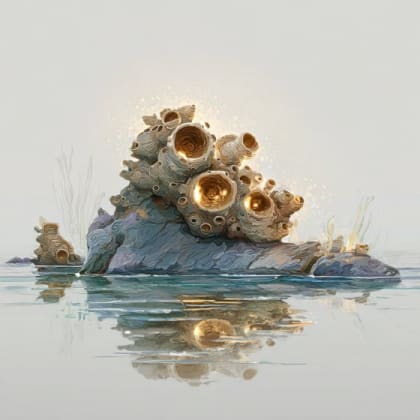
_-_Haminoeidae_-_Mollusc_shell.jpeg&width=800)





Blister Glassy-Bubble
haminoea vesicula
The Blister Glassy-Bubble is a small, colorful sea snail that glides gracefully over ocean floors. Its shiny, bubble-like shell can be spotted in various marine habitats, making it a fun find for young explorers!
Habitat: Shallow marine waters, often among seaweed and coral reefs.
The Blister Glassy-Bubble is a small, soft-bodied sea slug with a very thin, translucent, internal shell. Its body is typically yellowish-brown to greenish-grey, often mottled, making it look like a smooth, inflated bubble.
Category
InvertebrateRarity
Common
Danger
0/5 · No known danger
Snaps
Be the first to snap!
Blister Glassy-Bubbles lay their eggs in long, messy, jelly-like strings.
Its 'shell' is so thin it's mostly hidden inside its squishy body!
They belong to a group of amazing snails called 'bubble snails' or 'sea slugs'.
They leave a slime trail like land snails, but theirs helps them move underwater!
Blister Glassy-Bubble can release a foul-tasting chemical cloud to deter predators because it stores defensive compounds from its diet.
Blister Glassy-Bubble can quickly burrow into sandy or muddy seabeds, using its muscular foot to disappear from sight.
Blister Glassy-Bubble has specialized sensory organs on its head that help it find food and mates by detecting chemical trails.
This snail grazes on tiny algae and detritus found on the seabed.
Ulva intestinalis
Main food source
Cancer productus
A common predator

Nucella lamellosa
Predatory marine snail
Ophiodon elongatus
Feeds on bottom dwellers
Solitary animals live alone for most of their lives, only interacting with others for mating or parental care.
Colorful describes organisms or objects displaying a wide range of bright and distinct colors.
This trait characterizes organisms whose diet consists entirely or primarily of plant material.
Describes organisms that break down dead organic material, recycling nutrients back into the ecosystem.

This trait identifies organisms whose diet consists entirely or primarily of animal tissue.

Marine habitats encompass all saltwater environments of the Earth's oceans, supporting an immense diversity of aquatic life.
Danger
0/5 · No known danger
No special safety notes yet.
The easiest way to identify Blister Glassy-Bubble is to use the Snappit nature identifier app.
1-3 cm
less than 1g
0.5-1 year
This snail grazes on tiny algae and detritus found on the seabed.
Shallow marine waters, often among seaweed and coral reefs.
Grazing
Zoom in to split clusters and explore where this object has been snapped.
Recent snaps will appear here as new observations are added.
Take the discovery with you
Snap it with Snappit to identify it, learn what makes it special, and add the discovery to your collection.