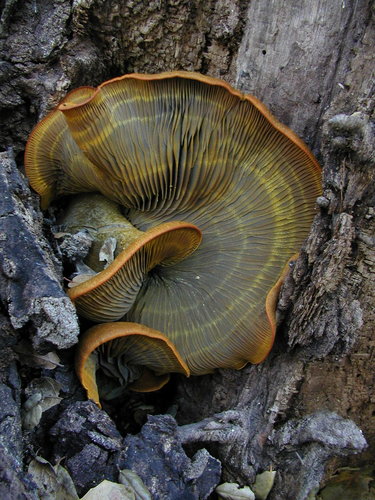


Western Jack-O'-Lantern
omphalotus olivascens
The Western Jack-O'-Lantern (Omphalotus olivascens) is a fascinating, large, fleshy mushroom native to the Pacific Coast of North America. Known for its brilliant but toxic nature, this mushroom captivates foragers and scientists alike due to its striking appearance and unique ecological traits. It is primarily saprobic, gaining nutrients by decomposing the dead wood of hardwood trees like oaks and eucalyptus. Despite its beauty, it is highly toxic to humans, containing illudin compounds that cause severe gastrointestinal distress if consumed.
Habitat: Found on decaying wood, stumps, or buried roots of hardwood trees, particularly oaks and eucalyptus.
This mushroom is characterized by a cap measuring 5 to 18 centimeters across, which is initially convex but flattens or becomes funnel-shaped with age. Its coloration ranges from olive-orange to bronze or yellowish-brown, often with metallic or olive overtones. The gills are deeply decurrent, running down the stout, solid stem, and they have a distinct sharp-edged appearance. In complete darkness, these gills emit a faint, ghostly green bioluminescent glow.
Category
FungiRarity
Common
Danger
1/5 · Very low
Snaps
Be the first to snap!
It is frequently mistaken for the delicious, edible chanterelle mushroom, making it a common culprit in wild mushroom poisonings along the US West Coast.
The chemical compound illudin S, extracted from Jack-O'-Lantern mushrooms, has been researched for its potential use in developing targeted anti-cancer drugs.
The glowing effect is caused by the same chemical pathway found in fireflies, though the fungal light shines constantly rather than flashing.
The gills of the mushroom emit a faint green glow in the dark due to a chemical reaction between the compound luciferin and the enzyme luciferase.
Produces powerful illudin toxins that serve as a chemical deterrent against various mammalian and insect predators.
Secretes robust extracellular enzymes that break down resilient wood compounds like lignin and cellulose, recycling nutrients back into the soil.
As a saprobic fungus, it feeds by secreting enzymes to externally digest dead hardwood before absorbing the rich organic nutrients.

Quercus agrifolia
Serves as a primary decomposer of dead wood for this dominant California hardwood tree.
Ariolimax columbianus
Feeds on the flesh and gills of the mushroom despite the presence of toxic illudin compounds.
No trait badges are assigned for this object yet.
No aliases listed yet.
Collections for this object will appear here as more themes are added.
Danger
1/5 · Very low
No special safety notes yet.
Compare the cap shape, the underside, the stem and base, and whether the fungus grows on wood or soil. Some fungi have gills, others pores or teeth. A cap seen only from above often hides the most useful features. Mushroom Identifier: upload a photo and compare the visible details.
5-18 cm
0.05-0.3 kg
As a saprobic fungus, it feeds by secreting enzymes to externally digest dead hardwood before absorbing the rich organic nutrients.
Found on decaying wood, stumps, or buried roots of hardwood trees, particularly oaks and eucalyptus.
Zoom in to split clusters and explore where this object has been snapped.
Recent snaps will appear here as new observations are added.

California, US
You might spot Western Fence Lizard and Pacific Poison Oak.
View guide →

California, US
You might spot Toyon, Mule Deer, and White Globe Lily.
View guide →

California, US
You might spot Mule Deer, Turkey, and Duck.
View guide →

California, US
You might spot Western Fence Lizard and California Poppy.
View guide →
Take the discovery with you
Snap it with Snappit to identify it, learn what makes it special, and add the discovery to your collection.