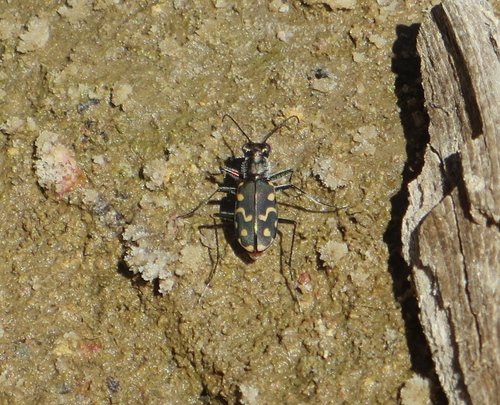


Wetsalts Tiger Beetle
cicindelidia hemorrhagica
The Wetsalts Tiger Beetle (Cicindelidia hemorrhagica) is a remarkable and ferocious micro-predator of the western North American alkaline and saline wetlands. True to the 'tiger' in its name, this beetle is a swift, agile hunter equipped with formidable mandibles and excellent eyesight, allowing it to chase down small insects with incredible efficiency. Its scientific name, hemorrhagica, hints at a hidden surprise: a vivid red or reddish-orange abdomen that flashes brightly when it takes flight. Thriving in harsh, sun-baked environments like desert salt flats and hot spring margins, this beetle has adapted to extreme conditions where few other insects can survive. Both the adults and their burrow-dwelling larvae play crucial roles in their local ecosystems by controlling populations of shore flies and other small arthropods. Spotting one of these quick-footed beetles darting across the shimmering salt crust is a thrilling experience for any nature enthusiast.
Habitat: Found on damp sand, mudflats, and salt-crusted soils near alkaline lakes, hot springs, and coastal estuaries in arid regions.
The Wetsalts Tiger Beetle measures approximately 10 to 15 millimeters in length and features a dark brown to blackish dorsal coloration, often accompanied by a subtle metallic sheen. Its elytra (wing covers) may be decorated with variable white markings, spots, or bands along the margins, though some individuals appear relatively unmarked. The most distinctive identifying feature is its bright reddish-orange abdomen, which is highly visible from below or when the beetle is in flight. It has a large head with prominent, bulging compound eyes and long, slender legs designed for rapid sprinting over open ground.
Category
InsectsRarity
Common
Danger
1/5 · Very low
Snaps
Be the first to snap!
The species name 'hemorrhagica' translates to 'bleeding', which references the beetle's startling blood-red abdomen.
Tiger beetles are so fast that their brains cannot keep up with the visual stream, forcing them to stop frequently to re-locate their prey.
To survive in scorching desert alkaline flats, these beetles often 'stilt' on their long legs to keep their bodies away from the hot soil.
When approached by a human, they often exhibit a distinct escape pattern: flying just a few feet ahead, landing, and immediately turning around to face the threat.
They can run so fast in pursuit of prey that their eyes cannot process the visual information quickly enough, causing temporary blindness until they pause to recalibrate.
When disturbed, they take to the air and expose their bright red abdomen, acting as a startle display to confuse or warn potential predators.
The larvae are formidable ambush predators that construct vertical tunnels in damp soil, anchoring themselves with specialized hooks to drag passing prey underground.
Both adults and larvae are aggressive predators that feed on a variety of small arthropods found in their extreme habitats.
Age differences: Larvae are sit-and-wait ambush predators from within burrows, while adults actively sprint and fly to chase down prey.
Ephydra hians
Feeds heavily on abundant flies near saline and alkaline water bodies.

Charadrius vociferus
Preyed upon by insectivorous birds foraging along shorelines and mudflats.
Proctacanthus micans
Large, predatory flies can snatch tiger beetles from the air or ground.
No trait badges are assigned for this object yet.
No aliases listed yet.
Collections for this object will appear here as more themes are added.
Danger
1/5 · Very low
No special safety notes yet.
Look for hard wing covers meeting in a line down the back, then compare the antennae, body shape, legs and markings. Metallic colors shift a lot with lighting. Beetle Identifier: upload a photo and compare the visible details.
1 cm
1-2 cm
0.0001-0.0003 kg
1-3 years
8 km/h
Both adults and larvae are aggressive predators that feed on a variety of small arthropods found in their extreme habitats.
Found on damp sand, mudflats, and salt-crusted soils near alkaline lakes, hot springs, and coastal estuaries in arid regions.
Zoom in to split clusters and explore where this object has been snapped.
Recent snaps will appear here as new observations are added.
Take the discovery with you
Snap it with Snappit to identify it, learn what makes it special, and add the discovery to your collection.