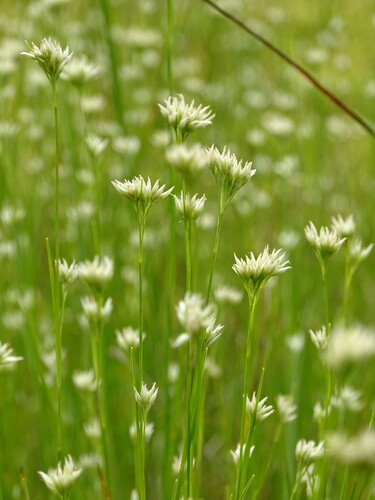


White Beak-Sedge
rhynchospora alba
The White Beak-Sedge (Rhynchospora alba) is an elegant, perennial sedge that thrives in the acidic, nutrient-poor environments of peat bogs and wet heaths. Recognizable by its pale, silvery-white cluster of spikelets, this slender plant stands out beautifully against the dark, damp mosses and peatlands it calls home. It plays an essential role in bog ecology, acting as a colonizer of open, wet mud and helping to stabilize the delicate peat matrix. Unlike many flashy wetland plants, the beauty of the White Beak-Sedge lies in its subtle, minimalist aesthetic. Its clusters of whitish spikelets eventually turn a warm, golden-brown as they mature in late summer, offering a shifting palette of color to keen-eyed bog explorers.
Habitat: Found in wet, acidic peat bogs, fens, and damp depressions within Sphagnum moss communities.
This slender, grass-like perennial grows in small tufts, reaching heights of 10 to 50 centimeters. Its most striking feature is the terminal cluster of pale, egg-shaped spikelets, which appear distinctly whitish or creamy-white during its peak summer blooming period. The leaves are narrow and channelled, measuring only about 1 to 2 millimeters wide. Beneath the white spikelets, one can observe small, leaf-like bracts that subtend the flower head, and as the plant transitions into autumn, the entire seed head matures into a light tan or brown hue.
Category
PlantsRarity
Common
Danger
1/5 · Very low
Snaps
1
Despite its grass-like appearance, it belongs to the sedge family (Cyperaceae), remembered by the botanical rhyme 'sedges have edges'.
Its pale white color is not from petals, but from specialized scales (bracts) that surround the tiny, inconspicuous flowers.
The name 'Rhynchospora' comes from the Greek words for 'snout' and 'seed', referring to the beak-like tubercle that tops each tiny nutlet.
Capable of thriving in highly acidic, nutrient-deficient bog soils where most other plant species would starve or perish.
Possesses specialized internal spongy tissues that transport oxygen from the leaves down to the roots submerged in waterlogged, anaerobic mud.
Efficiently recycles and stores essential nutrients in its underground rhizomes before the winter die-back, ensuring rapid growth in early spring.
As a photosynthetic plant, the White Beak-Sedge produces its own energy using sunlight, water, and carbon dioxide, while extracting minimal minerals from acidic peat.
Sphagnum magellanicum
Grows in close physical association with, and relies on the moisture retention of, Sphagnum moss to maintain its bog habitat.
Coenonympha tullia
Serves as a host plant and food source for the larvae of the Large Heath butterfly in wet bog ecosystems.
No trait badges are assigned for this object yet.
No aliases listed yet.
Collections for this object will appear here as more themes are added.
Danger
1/5 · Very low
No special safety notes yet.
The easiest way to identify White Beak-Sedge is to use the Snappit nature identifier app.
10-50 cm
0.005-0.05 kg
2-5 years
As a photosynthetic plant, the White Beak-Sedge produces its own energy using sunlight, water, and carbon dioxide, while extracting minimal minerals from acidic peat.
Found in wet, acidic peat bogs, fens, and damp depressions within Sphagnum moss communities.
Zoom in to split clusters and explore where this object has been snapped.
Take the discovery with you
Snap it with Snappit to identify it, learn what makes it special, and add the discovery to your collection.












.jpg&width=800)



_001.jpg&width=800)




