

White Pitcher Plant
sarracenia leucophylla
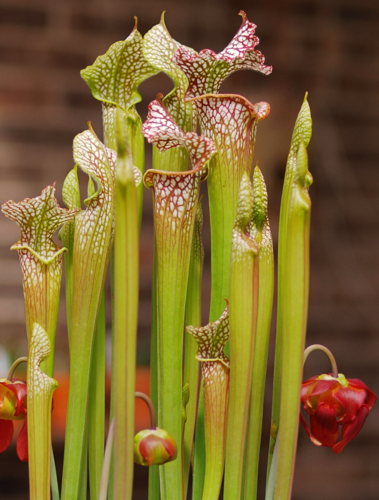
Sarracenia leucophylla, commonly known as the White Pitcher Plant, is a striking carnivorous plant renowned for its elegant, ghostly white-topped tubes laced with intricate red or green venation. Native to the damp pine savannas and bogs of the southeastern United States, it is a master of evolutionary deception. The plant's specialized leaves are shaped into tall, hollow pitfall traps designed to lure, catch, and digest insects. What makes this plant exceptionally captivating is its unique visual display and sweet scent, which mimic nectar-rich flowers to attract unsuspecting prey. As an insect falls into the slick interior, downward-pointing hairs prevent escape, allowing the plant's digestive fluids to slowly absorb vital nutrients. Beyond its deadly beauty, the White Pitcher Plant is a fascinating example of adaptation, thriving in acidic, nutrient-poor soils by efficiently supplementing its diet with animal protein.
Habitat: Found predominantly in moist, nutrient-poor sphagnum bogs, wet pine savannas, and seepage slopes along the Gulf Coast.
This species is easily recognized by its tall, upright, trumpet-shaped leaves (pitchers) that can reach up to 1 meter in height. The uppermost portion of the pitcher and the protective, ruffled umbrella-like hood are predominantly brilliant white, heavily intersected by a prominent, net-like network of vivid crimson, maroon, or bright green veins. The lower portions of the tube gracefully taper into a bright yellowish-green base. In early spring, the plant produces distinct, large dark red to maroon flowers that bloom on separate leafless stalks, drooping downwards with five long, strap-like petals.
Category
PlantsRarity
Common
Danger
1/5 · Very low
Snaps
Be the first to snap!
The bright white tops of the pitchers act as a visual lure, contrasting sharply against surrounding vegetation to mimic the appearance of a flower.
The plant relies heavily on natural, periodic wildfires to clear out competing vegetation and trees, allowing sunlight to reach the bog floor where it grows.
They often produce their largest, most vibrant and robust pitchers in late summer and early autumn to catch a final bounty of insects before winter dormancy.
To prevent trapping its own pollinators, the White Pitcher Plant blooms in early spring on tall stalks long before its deadly pitcher leaves fully open.
The interior walls of the pitcher are lined with slick, waxy scales and downward-pointing hairs, making it virtually impossible for trapped insects to climb back out.
The base of the pitcher contains a specialized fluid of digestive enzymes and symbiotic bacteria that quickly breaks down prey to absorb essential nutrients like nitrogen.
The rim and hood of the plant secrete sweet-smelling, intoxicating nectar that acts as a powerful bait, drawing hungry insects straight to the treacherous edge.
Supplements its nutrient-poor soil by trapping and digesting various insects and small arthropods to absorb essential minerals.
Age differences: Seedlings capture tiny organisms like springtails, graduating to larger insects like wasps and moths as their pitchers grow taller.
Exyra semicrocea
Caterpillars of this moth species exclusively feed on the inner tissue of the pitcher plant, often causing the upper tube to collapse.
Sarcophaga sarraceniae
This flesh fly safely navigates the pitcher's trap to lay eggs; its larvae then feed on the decaying insects inside the plant's fluid.
Bombus pensylvanicus
Visits the distinctive red flowers in early spring to gather pollen and nectar, inadvertently facilitating the plant's reproduction.
No trait badges are assigned for this object yet.
No aliases listed yet.
Collections for this object will appear here as more themes are added.
Danger
1/5 · Very low
No special safety notes yet.
Start with the whole plant, then compare leaf arrangement, leaf edges, stems and any flowers or fruit. Opposite leaves grow in pairs; alternate leaves come one at a time along the stem. These details tell you far more together than a single green leaf does. Plant Identifier: upload a photo and compare the visible details.
30-100 cm
10-30 years
Supplements its nutrient-poor soil by trapping and digesting various insects and small arthropods to absorb essential minerals.
Found predominantly in moist, nutrient-poor sphagnum bogs, wet pine savannas, and seepage slopes along the Gulf Coast.
Ambush
300-600
21-28 days
Zoom in to split clusters and explore where this object has been snapped.
Recent snaps will appear here as new observations are added.
Take the discovery with you
Snap it with Snappit to identify it, learn what makes it special, and add the discovery to your collection.