





dame's rocket
Hesperis matronalis
Dame's rocket is a colorful flower that blooms in spring and early summer. It has lovely purple, pink, or white petals and grows in clusters, making gardens and fields look beautiful!
Habitat: Urban areas, meadows
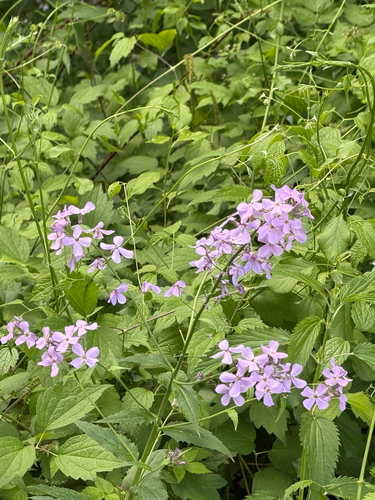
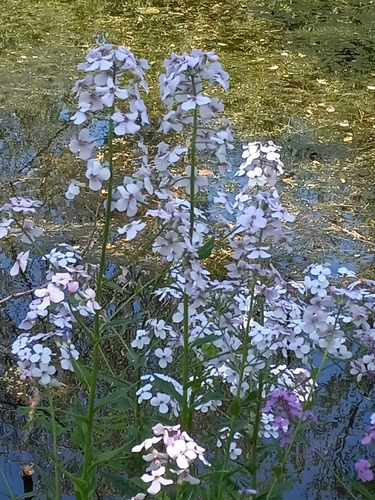
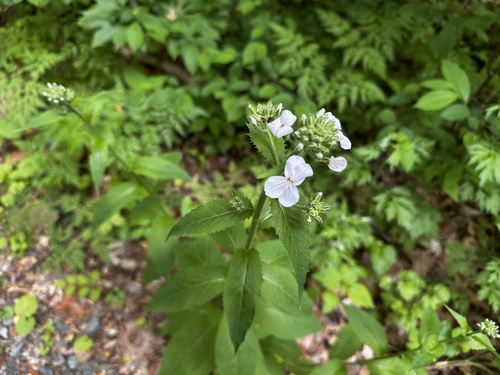
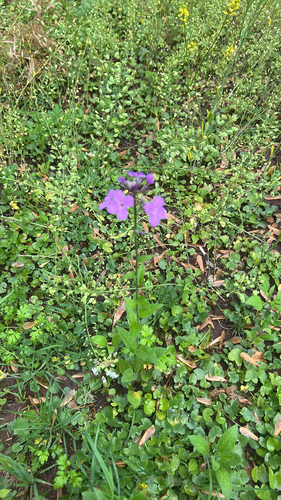
The dame's rocket has tall, branching stems topped with loose clusters of four-petaled flowers, often in shades of purple, pink, or white. Its lance-shaped leaves are sharply serrated, giving the plant a graceful yet wild appearance that can be distinguished from similar phlox flowers by its four petals.
Category
PlantsRarity
Common
Danger
1/5 · Very low
Snaps
147
Dame's rocket once had young leaves used in medieval salads!
Despite its beauty, it can outcompete native plants easily!
Its nighttime perfume is strongest, guiding moths in the dark!
This flower's seeds can stay viable in soil for years, waiting!
Dame's rocket releases a sweet, strong fragrance, especially at night, which helps it attract nocturnal pollinators like moths.
Dame's rocket seeds can remain viable in the soil for several years, helping it sprout when conditions are just right.
As a biennial, it dedicates its first year to growing a strong root system, which helps it store energy to burst into abundant bloom the second year.
Apis mellifera
collects nectar and pollen

Bombus impatiens
visits flowers for nectar
Hyles gallii
attracted by nighttime fragrance
Vanessa cardui
sips nectar from blooms
Flowering plants are any plants that produce flowers as part of their reproductive cycle.
Biennial plants complete their life cycle over two growing seasons, typically forming foliage in the first year and flowering/seeding in the second.
Cluster flowers are inflorescences where individual flowers are arranged closely together on a common stem.
Spring blooming plants produce their flowers during the spring season, often signifying the end of winter and the start of new growth.

Fragrant flowers emit a pleasant aroma, often to attract pollinators or for defense.

Colorful describes organisms or objects displaying a wide range of bright and distinct colors.

Grassland habitats are terrestrial biomes dominated by grasses and herbaceous plants, supporting a variety of grazing animals.

Describes plants that are particularly attractive and beneficial to a wide range of pollinating organisms.

This habitat trait indicates species that can coexist with humans in urban and suburban environments, utilizing man-made structures and green spaces.
Danger
1/5 · Very low
Do not eat any part of the plant without asking an adult first.
The easiest way to identify dame's rocket is to use the Snappit nature identifier app.
60-120 cm
30-60 cm
2-3 cm
Late spring to early summer
Yes
Mild
Biennial
Zoom in to split clusters and explore where this object has been snapped.
May 28, 2026
Lebanon Green Historic DistrictPhoto attribution
(c) Sawyer Baran, some rights reserved (CC BY)
License: CC BY 4.0 ↗
Image may be shown cropped inside the card frame.
May 17, 2026
Lehigh Valley ZooPhoto attribution
(c) Aleks, some rights reserved (CC BY)
License: CC BY 4.0 ↗
Image may be shown cropped inside the card frame.
May 14, 2026
Frelinghuysen ArboretumPhoto attribution
(c) gwt2102, some rights reserved (CC BY)
License: CC BY 4.0 ↗
Image may be shown cropped inside the card frame.
May 6, 2026
Duke GardensPhoto attribution
no rights reserved
License: CC0 1.0 ↗
Image may be shown cropped inside the card frame.

New York, US
You might spot Sundial Lupine, Spotted Horsemint, and New Jersey Tea.
View guide →

Massachusetts, US
You might spot Eastern White Pine and Common Eastern Bumble Bee.
View guide →

Illinois, US
You might spot Common Eastern Bumble Bee and Brown-Belted Bumble Bee.
View guide →

Connecticut, US
You might spot Striped Wintergreen and Common Eastern Bumble Bee.
View guide →

Massachusetts, US
You might spot Common Eastern Bumble Bee and Eastern Skunk Cabbage.
View guide →

Ohio, US
You might spot Large White Trillium, Fire Pink, and Christmas Fern.
View guide →
Take the discovery with you
Snap it with Snappit to identify it, learn what makes it special, and add the discovery to your collection.







.jpg&width=800)


_001.jpg&width=800)




