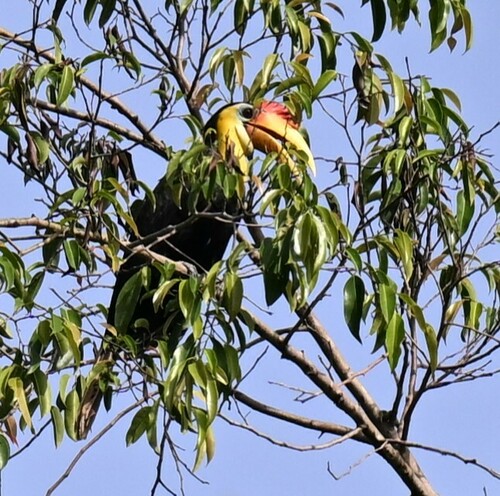


Wrinkled Hornbill
rhabdotorrhinus corrugatus
The Wrinkled Hornbill is a stunning and enigmatic bird native to the ancient rainforests of Southeast Asia. A medium-sized member of the hornbill family, it is revered for its dramatic appearance, featuring a prominent, textured bill and striking facial coloration. These birds play a vital ecological role as 'farmers of the forest,' traversing large expanses of canopy to forage for fruits and subsequently dispersing seeds that maintain forest diversity. Sadly, due to extensive logging and habitat destruction, they are becoming an increasingly rare sight in their native lowland habitats. Spotting a pair of these magnificent birds gliding over the canopy is a remarkable experience for any avid birder or naturalist.
Habitat: Found primarily in primary evergreen lowland forests, peat swamp forests, and dense lower montane forests of Southeast Asia.
Wrinkled Hornbills exhibit strong sexual dimorphism. Males are instantly recognizable by their bold yellow and red bills topped with a prominent, reddish wrinkled casque, pale yellow cheeks and throat, and bright blue orbital skin. Females are noticeably smaller, with primarily black bills and casques, a black head and neck, and blue skin around the eyes and throat. Both sexes share black body plumage and a mostly white tail that frequently takes on a yellow or reddish hue due to staining from preen gland oils. Their wings are broad, allowing for powerful, steady flight across the forest canopy.
Category
BirdsRarity
Common
Danger
1/5 · Very low
Snaps
Be the first to snap!
During the months-long nesting period, the female completely sheds and regrows her flight feathers while safely sealed inside her tree cavity.
The male's casque, the hollow structure on top of its upper mandible, has deep ridges and wrinkles that give the species its common name.
Their naturally white tail feathers are rarely seen in pristine condition; they intentionally dye them yellow or orange using colored oils from a gland near the base of their tail.
Females seal themselves inside tree cavities using mud and feces, leaving only a narrow slit for the male to deliver food, providing ultimate protection against predators during incubation.
With a wide gape and highly mobile foraging habits, they swallow large fruits whole and regurgitate or excrete the seeds intact across vast distances, propagating the forest.
They actively rub colored oils secreted from their uropygial gland onto their white tail feathers, giving them a distinct yellow or orange cosmetic coloration.
They are primarily frugivorous, heavily favoring wild figs and lipid-rich fruits, but will actively hunt small animals to supplement their diet during the breeding season.
Age differences: Chicks require a higher intake of protein for growth, so parents increase the proportion of insects and small vertebrates delivered to the nest.
Ficus benjamina
The hornbill relies on the fig tree for its primary food source, while the tree depends on the bird to disperse its seeds.
Neofelis diardi
A primary predator of adult hornbills and their chicks, capable of climbing high into the canopy.

Buceros rhinoceros
Competes with the Wrinkled Hornbill for the same large tree cavities required for nesting.
No trait badges are assigned for this object yet.
No aliases listed yet.
Collections for this object will appear here as more themes are added.
Danger
1/5 · Very low
No special safety notes yet.
Compare the silhouette, bill shape, tail length, wing bars and markings around the eyes. The same small brown bird at your feeder can look quite different in breeding plumage, winter plumage or its first year. Bird Identifier: upload a photo and compare the visible details.
65-82 cm
110-130 cm
1.3-1.7 kg
20-30 years
45 km/h
They are primarily frugivorous, heavily favoring wild figs and lipid-rich fruits, but will actively hunt small animals to supplement their diet during the breeding season.
Found primarily in primary evergreen lowland forests, peat swamp forests, and dense lower montane forests of Southeast Asia.
Zoom in to split clusters and explore where this object has been snapped.
Recent snaps will appear here as new observations are added.
Take the discovery with you
Snap it with Snappit to identify it, learn what makes it special, and add the discovery to your collection.