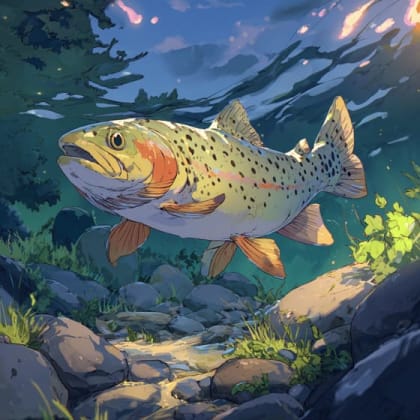




Xingu River ray
Potamotrygon leopoldi
The Xingu River ray is a beautiful fish that lives in the rivers of Brazil. It has a flat body and a long tail, making it look like a flying saucer swimming in the water!
Habitat: Freshwater rivers
The Xingu River ray is a striking freshwater ray with a flattened, circular disc-shaped body. Its velvety black skin is adorned with vibrant, irregularly shaped yellow or orange spots, creating a unique and eye-catching pattern that distinguishes it.
Category
FishRarity
Common
Danger
2/5 · Low
Snaps
Be the first to snap!
Each Xingu River ray has unique spot patterns, like a fingerprint!
Their bodies contain cartilage, not bones, making them super flexible!
They are also known as the "Black Devil Ray" due to their dark color!
Unlike ocean rays, these rays live their whole lives in freshwater rivers!
Xingu River ray can 'see' electric fields generated by prey hidden in the substrate because of special sensors, helping them hunt.
Xingu River ray has a sharp, venomous barb on its tail that helps them defend against predators if threatened.
Xingu River ray has a flat, disc-shaped body that helps them glide silently along riverbeds and hide effectively.
Tiny bugs, worms, and small fish are what this ray loves to eat from the riverbed!
Chironomus riparius
Their larvae are a common food source in riverbeds.
Macrobrachium amazonicum
These small crustaceans are a favorite meal for the ray.
Pseudoplatystoma corruscans
Juvenile rays can become prey for larger predatory catfish.
Marked with spots or patches of a different color.
Solitary animals live alone for most of their lives, only interacting with others for mating or parental care.
Colorful describes organisms or objects displaying a wide range of bright and distinct colors.
Gliding animals move through the air by launching themselves and maintaining flight with specialized body structures, without flapping wings.

This trait identifies organisms whose diet consists entirely or primarily of animal tissue.

This trait describes organisms capable of generating electric fields or electric shocks.

Freshwater habitats include non-saline aquatic environments such as rivers, lakes, ponds, and wetlands, vital for numerous species.

Endangered status indicates a species is at a very high risk of extinction in the wild in the near future.
No aliases listed yet.
Danger
2/5 · Low
Always watch from a distance and never touch wild fish in the water.
The easiest way to identify Xingu River ray is to use the Snappit nature identifier app.
20-70 cm
1-3 kg
8-15 years
Tiny bugs, worms, and small fish are what this ray loves to eat from the riverbed!
8 km/h
Freshwater rivers
Foraging
Zoom in to split clusters and explore where this object has been snapped.
Recent snaps will appear here as new observations are added.
Take the discovery with you
Snap it with Snappit to identify it, learn what makes it special, and add the discovery to your collection.