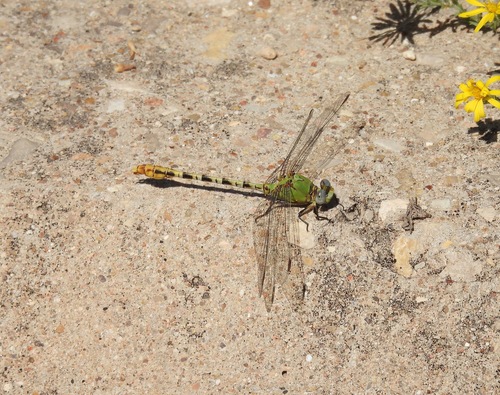


Yellow-Legged Ringtail
erpetogomphus crotalinus
The Yellow-Legged Ringtail (Erpetogomphus crotalinus) is a striking species of clubtail dragonfly, known for its distinctive coloration and agile flight. These fascinating insects are powerful aerial predators, playing a crucial role in controlling populations of smaller flying insects within their ecosystems. As adults, they are often observed patrolling sunny stretches along clear, flowing rivers and streams, exhibiting impressive acrobatic displays while hunting or defending their territories. Their life cycle, transitioning from an aquatic nymph to a winged adult, showcases a remarkable metamorphosis that connects both terrestrial and aquatic habitats, contributing significantly to the biodiversity of freshwater systems and highlighting nature's intricate balance.
Habitat: This species is primarily found along clear, moderate to swift-flowing rivers and streams with sandy or gravelly bottoms, often with emergent vegetation along the banks.
The Yellow-Legged Ringtail is a medium-sized dragonfly, typically characterized by a dark body adorned with bright yellow markings. Its most distinguishing feature is its legs, which are predominantly yellow, especially the tibiae. The abdomen is dark with yellow rings or spots on each segment, giving it a 'ringtail' appearance. The thorax is dark with intricate yellow stripes, and the eyes are often greenish or bluish. Its wings are clear and translucent, and like other clubtails, the abdomen widens slightly towards the tip, resembling a small club.
Category
InsectsRarity
Common
Danger
1/5 · Very low
Snaps
Be the first to snap!
Adult Yellow-Legged Ringtails are territorial, with males often perching and patrolling specific sections of a stream to defend against rivals and attract mates.
Dragonflies can fly backwards, hover, and turn in mid-air, making them one of the most agile fliers in the insect world.
Dragonfly nymphs can spend several years underwater before emerging as adults, undergoing multiple molts.
Their large compound eyes provide nearly 360-degree vision, essential for hunting and detecting predators with exceptional motion perception.
Adult Yellow-Legged Ringtails are highly skilled aerial hunters, capable of rapidly pursuing and capturing other flying insects mid-air using their spiny legs as a basket.
They possess exceptional flight capabilities, allowing for sudden changes in direction, hovering, and rapid acceleration, crucial for both hunting and evading predators.
The aquatic nymphs are cryptic bottom-dwellers, ambushing prey from the substrate of streams and rivers, adapting perfectly to their underwater environment before emerging as adults.
Both adult and nymph stages are predatory insectivores. Adults capture flying insects in flight, while nymphs prey on smaller aquatic invertebrates from ambush.
Age differences: Nymphs are aquatic predators, feeding on a variety of smaller aquatic invertebrates. Adults are aerial predators, feeding exclusively on flying insects.
Culex pipiens
Major food source for adult dragonflies
Ephemeroptera larvae
Prey for aquatic nymphs
Megaceryle alcyon
Predator of adult dragonflies

Micropterus salmoides
Predator of aquatic nymphs
No trait badges are assigned for this object yet.
No aliases listed yet.
Collections for this object will appear here as more themes are added.
Danger
1/5 · Very low
No special safety notes yet.
Compare wing shape and resting posture, where the eyes sit, body markings and the tail segments. Males and females can look very different in color. Dragonfly Identifier: upload a photo and compare the visible details.
4-5 cm
6-8 cm
0.0005-0.001 kg
1-2 years
45 km/h
Both adult and nymph stages are predatory insectivores. Adults capture flying insects in flight, while nymphs prey on smaller aquatic invertebrates from ambush.
This species is primarily found along clear, moderate to swift-flowing rivers and streams with sandy or gravelly bottoms, often with emergent vegetation along the banks.
Zoom in to split clusters and explore where this object has been snapped.
Recent snaps will appear here as new observations are added.
Take the discovery with you
Snap it with Snappit to identify it, learn what makes it special, and add the discovery to your collection.