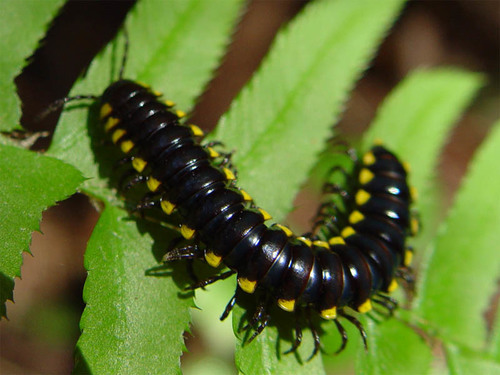


Yellow-Spotted Millipede
harpaphe haydeniana
The Yellow-Spotted Millipede, scientifically known as Harpaphe haydeniana, is a striking and vital component of forest ecosystems in the Pacific Northwest of North America. Commonly referred to as the almond-scented millipede or cyanide millipede, this fascinating arthropod is famous for its dramatic defense mechanism: when threatened, it secretes hydrogen cyanide, producing a distinct odor reminiscent of toasted almonds. This toxic secretion, coupled with its stark black and yellow warning coloration, effectively deters most potential predators like birds and small mammals. Beyond its impressive chemical defenses, the Yellow-Spotted Millipede is a crucial ecological engineer. As a detritivore, it spends its days burrowing through leaf litter and decaying wood, breaking down dead plant material and recycling vital nutrients back into the soil. Its presence is a key indicator of a healthy, moist woodland environment, making it a familiar and treasured find for nature enthusiasts exploring the damp, shaded trails of coastal forests.
Habitat: Found in moist, mature coniferous and mixed forests of the Pacific Northwest, typically hiding under leaf litter, decaying logs, and mossy forest floor debris.
Harpaphe haydeniana features a distinctive, elongated, and slightly flattened segmented body that typically ranges from 4 to 5 centimeters in length. The dorsal surface is a glossy, deep black or dark brown, providing a stark visual contrast to the bright, lemon-yellow patches located along the lateral edges (the paranota) of each body segment. It possesses approximately 20 body segments, with most segments bearing two pairs of short, pale legs hidden underneath its armored plates. The head is equipped with short, club-like antennae used for navigating its dark environment. This aposematic (warning) coloration serves as a clear visual indicator to predators of its toxic chemical defenses.
Category
AnimalRarity
Common
Danger
1/5 · Very low
Snaps
3
A single Yellow-Spotted Millipede can produce enough hydrogen cyanide to kill a small bird or mouse, proving its bright warning colors are a very honest threat.
Despite the name 'millipede,' meaning a thousand legs, this species typically only has around 60 to 80 legs, with two pairs on most of its body segments.
The Yellow-Spotted Millipede smells strongly of toasted almonds due to the hydrogen cyanide gas it produces when it feels threatened.
When they hatch, baby millipedes only have a few body segments and three pairs of legs, adding more segments and legs each time they molt as they grow.
When threatened, it exudes a fluid containing hydrogen cyanide from specialized pores, creating a highly toxic chemical defense that smells strongly of bitter almonds.
Its striking, high-contrast black body with bright yellow spots serves as a stark visual warning to predators that it is toxic and unpalatable.
Its specialized digestive system is highly adapted to breaking down tough decaying plant matter, significantly accelerating decomposition and enriching forest soils.
This millipede feeds primarily on decaying plant material, playing a crucial role in breaking down forest floor debris and cycling nutrients.
Age differences: Nymphs consume softer, more decomposed organic matter and fungi, while mature adults possess stronger mouthparts to process tougher leaf litter and woody debris.
Promecognathus laevissimus
A specialized predator that possesses a resistance to the millipede's toxic cyanide secretions.
Pseudotsuga menziesii
Provides a critical service by breaking down the shed needles and woody debris of this dominant forest canopy tree.
Turdus migratorius
Some birds use the millipede's toxic secretions by rubbing the arthropod on their feathers to repel lice and mites, an act called 'anting'.
No trait badges are assigned for this object yet.
No aliases listed yet.
Collections for this object will appear here as more themes are added.
Danger
1/5 · Very low
No special safety notes yet.
Start with body shape, legs or fins, fur, feathers or scales, and standout markings. Then weigh size, habitat and where you saw it. Young animals and seasonal coats can look very different from familiar adults. Animal Identifier: upload a photo and compare the visible details.
4-5 cm
0.001-0.005 kg
2-3 years
This millipede feeds primarily on decaying plant material, playing a crucial role in breaking down forest floor debris and cycling nutrients.
Found in moist, mature coniferous and mixed forests of the Pacific Northwest, typically hiding under leaf litter, decaying logs, and mossy forest floor debris.
Foraging
50-300
Zoom in to split clusters and explore where this object has been snapped.

Washington, US
You might spot Pacific Tree Frog and Long-Toed Salamander.
View guide →

California, US
You might spot Western Fence Lizard and Pacific Poison Oak.
View guide →

Alaska, US
You might spot Bald Eagle, Salmonberry, and Ochre Sea Star.
View guide →

Oregon, US
You might spot Northern Phlox, Marbled Wild-Ginger, and Pacific Trillium.
View guide →
Take the discovery with you
Snap it with Snappit to identify it, learn what makes it special, and add the discovery to your collection.