


Zulu Giant
stapelia gigantea
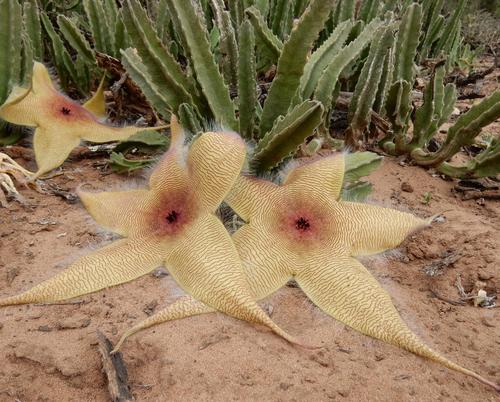
The Zulu Giant (Stapelia gigantea) is a remarkable stem succulent famous for producing some of the largest, most bizarre flowers in the plant kingdom. Native to the arid regions of southeastern Africa, this clump-forming perennial features thick, upright, four-angled green stems that resemble cacti but lack true spines. It is highly celebrated for its extraordinary evolutionary adaptation: generating massive star-shaped blossoms that mimic the appearance and foul odor of decaying meat.
Habitat: Typically found growing in the dry, rocky soils of subtropical savannas, thorn scrubs, and arid valleys, often tucked under the shade of larger shrubs to escape the intense midday sun.
This succulent forms dense clumps of erect, velvety green stems measuring 10 to 30 centimeters in height. The real spectacle is the flower: a colossal five-pointed star reaching up to 40 centimeters in diameter. These blooms are pale yellow to tan, intricately patterned with fine, transverse reddish-purple lines, and fringed with silky white hairs along the margins. The center of the flower features a deep, dark purple cup containing the reproductive organs.
Category
PlantsRarity
Common
Danger
1/5 · Very low
Snaps
Be the first to snap!
Despite attracting flies to lay eggs with its convincing rot scent, the hatched maggots inevitably starve as the flower offers no actual meat.
Its enormous star-shaped flower can measure larger than a standard dinner plate, earning it the species name 'gigantea'.
The plant's ribbed stems help cast shadow on itself, reducing transpiration and keeping the plant cool in blistering heat.
Emits a strong, pungent scent mimicking rotting flesh to attract carrion-feeding insects like flies for pollination.
Utilizes thick, fleshy, ribbed stems to store water efficiently, allowing it to withstand long periods of severe drought.
Features specialized pollen sacs called pollinia that stick to visiting flies, ensuring efficient genetic transfer.
As an autotrophic plant, the Zulu Giant produces its own organic compounds and energy through photosynthesis using sunlight, water, and carbon dioxide.
Lucilia sericata
Attracted by the carrion scent, this fly acts as a major pollinator while attempting to lay eggs on the petals.
Calliphora vicina
Lured by the flower's appearance and odor, it inadvertently transfers pollen while searching for oviposition sites.
Pseudococcus longispinus
Sucks sap from the succulent stems, which can weaken the plant and cause soot mold infections.
No trait badges are assigned for this object yet.
No aliases listed yet.
Collections for this object will appear here as more themes are added.
Danger
1/5 · Very low
No special safety notes yet.
Start with the whole plant, then compare leaf arrangement, leaf edges, stems and any flowers or fruit. Opposite leaves grow in pairs; alternate leaves come one at a time along the stem. These details tell you far more together than a single green leaf does. Plant Identifier: upload a photo and compare the visible details.
10-30 cm
0.2-3 kg
10-30 years
As an autotrophic plant, the Zulu Giant produces its own organic compounds and energy through photosynthesis using sunlight, water, and carbon dioxide.
Typically found growing in the dry, rocky soils of subtropical savannas, thorn scrubs, and arid valleys, often tucked under the shade of larger shrubs to escape the intense midday sun.
None
Zoom in to split clusters and explore where this object has been snapped.
Recent snaps will appear here as new observations are added.
Take the discovery with you
Snap it with Snappit to identify it, learn what makes it special, and add the discovery to your collection.


















