
Snappit logo
Snappit
Get App
Generic illustration, not a photograph of this venueIllustration
ParkAkita, Japan

Akita Prefectural Koizumigata Park

Koizumigata is the kind of park where different generations can happily choose different speeds.

About

Koizumigata is the kind of park where different generations can happily choose different speeds. One person can linger over iris petals, another can follow water through a Japanese garden, and children can spend their energy on the lawns and play areas. Beyond those carefully arranged spaces, the larger waterside landscape has a quieter character: reeds, open water and wooded margins invite you to stop and look.

The park spreads around Ogata and Megata in Akita’s Kanaashi district. Make the Park Center your first reference point rather than trying to cover everything at once. The iris garden and Suishin-en make a satisfying garden-focused visit; the fountain plaza and play areas suit a more active family afternoon. The waterside areas by Ogata offer another, separate reason to return.

Suishin-en is part of this park, with its own gate and seasonal opening hours. Its ponds and waterfalls are a designed landscape, while Megata’s wetland plant community has protected natural significance. Looking at both makes the visit more interesting: which parts were shaped for a view, and which are living habitat?

Before setting out, read the [current park notices](https://koizumigatakouen.wixsite.com/koizumigatapark). The 19 October 2026 check found path works affecting some cycling-road and parking areas through 30 October. The October newsletter also says the fountain is off until the following spring. Choose a garden or lawn outing instead of promising children water play. Planning to visit? Download the Snappit app to identify the wildlife you spot in real-time.

Suishin-en opened in April 1979. Its design by Rokuro Taji brings a sequence of water features into a relatively compact garden, making it rewarding to walk slowly and revisit a view from another angle.

What to do here

Combine Suishin-en with the iris garden, or choose the recreation area for play and a picnic. Add an Ogata waterside visit only if time, conditions and everyone’s energy allow.

Seasonal info

For 2026, check the dated autumn notice below. Shorter daylight, cold wind, wet leaves, snow and ice can change the practical length of a visit.

Accessibility

Maps locate toilets and parking but do not certify a continuous step-free route. Ask the Park Center about the exact entrance, surfaces, gradients, bridge crossings and toilet fittings you need.

Don't miss

1

Suishin-en’s ponds, streams and waterfalls

2

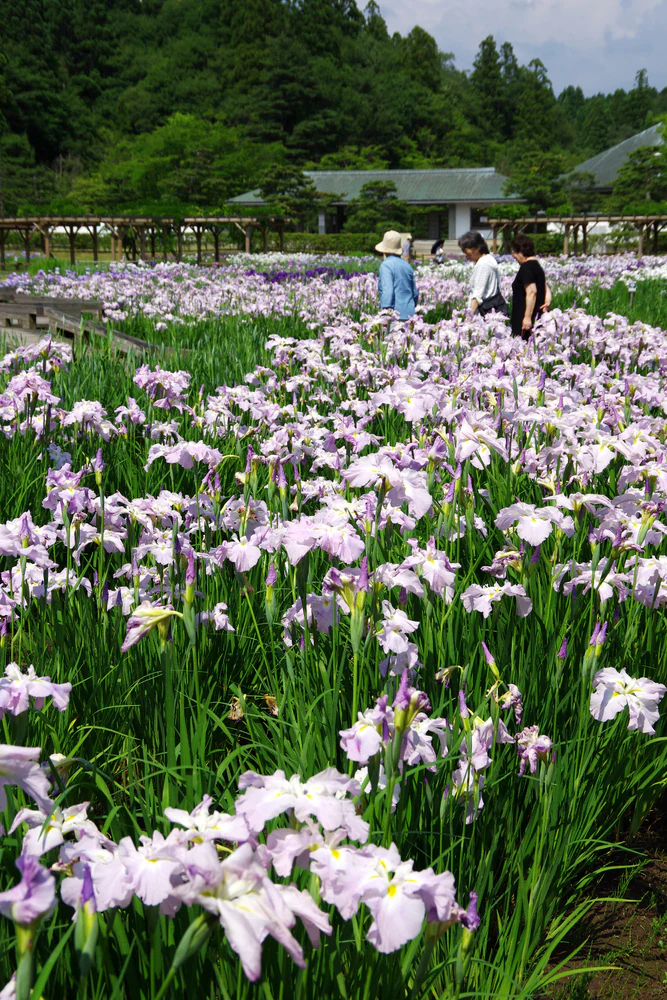
Cultivated Japanese irises near the Park Center

3

Lawns, large play equipment and the Green Slope

4

Ogata’s open water and Megata’s wetland character

Dense pale-purple and white irises fill the foreground; visitors walk among the beds, with garden buildings and green trees behind them.

Cultivated Japanese irises at Koizumigata Park, in an Akita City photograph. The capture date is unknown; this is not a current bloom report.

Photo: Akita City, Koizumigata Park, https://www.city.akita.lg.jp/shisei/koho/1003658/1003015.html . CC BY 4.0, https://creativecommons.org/licenses/by/4.0/ . No changes. · Creative Commons 1 · Creative Commons 2

Walks and routes

Irises and Suishin-en

Start at the Park Center and locate the iris garden, marked 22 on the official park map. After exploring its open paths, go to Suishin-en, marked 23. Inside, the garden map places the main gate and rest building beside the lower pond. Follow open paths towards the upper pond and waterfall views, turning back whenever you wish. This is a flexible garden outing rather than a prescribed complete circuit.

Allow 60–120 minutes, including flower and rest stops; editorial estimate.

Confirm the garden approach and crossings before choosing this outing with wheels or limited balance.

A lawn-and-play afternoon

Choose a base near the fountain plaza, marked 3, and the nearby multipurpose lawn, marked 5. From there, decide whether the Green Slope and large play equipment suit your group. Keep the outing compact: a snack, one play session and a short look at the landscape can be plenty. Meet back at an obvious landmark before anyone explores farther.

Allow 60–90 minutes, or 2–3 hours with a picnic; editorial estimate.

Grass, sloping ground and play areas need separate assessment from paved approaches.

A short Ogata waterside watch

Use the map to choose either Waterside Plaza, marked 12, or Ogata Plaza, marked 13. These are distinct from the garden-and-play cluster. Stay in an open public viewing area and watch the water, then return by your chosen approach. Do not turn this into an assumed lake circuit: roads, habitat edges and the return journey need their own planning.

Allow 20–40 minutes at one waterside stop, plus access time; editorial estimate.

Confirm the specific parking-to-viewpoint route and usable toilet before travelling.

Things to try

A flower detective game

Choose two iris flowers you can see from the path. Compare their colour, shape and the way the petals hang. Sketch one detail instead of picking anything. The cultivated beds are a good place to discover that flowers sharing a familiar name can look surprisingly different. If the bloom has finished, draw the leaves and imagine how the scene changes.

Follow the water with your eyes

In Suishin-en, pause at a safe path edge and look for still water, a narrow stream and falling water. Ask children which makes the strongest reflection and which makes the loudest sound. Stay on the paths and bridges; the exercise works without touching the water or stepping onto stones outside the visitor route.

Keep a tiny wildlife notebook

At an open waterside stop, spend five minutes noting what birds do: swimming, resting, diving or flying. A drawing of a silhouette is enough. Keep your distance and avoid playback, feeding or chasing. The historical bird study makes a useful reminder that wetland and open water can attract different birds; it cannot tell you what will appear today.

Make the picnic the pause

Pick an open lawn space that does not interfere with games or reserved use. Share a snack, check everyone’s energy and choose whether the next stop is play, a garden or home. Bring your own supplies. For cooking, use only an authorized BBQ area under current instructions, extinguish everything properly and take food waste away.

Wildlife and habitats

Japanese iris: a cultivated display

The iris garden is planted with hanashōbu, Japanese iris, in many garden varieties. Enjoy the beds as a cultivated collection rather than a wild wetland population. Use labels for individual cultivar names and keep flowers attached.

Whooper swan: a historical winter association

The museum’s 2007 study records whooper swans at Ogata during the colder part of the year. That makes the open water a sensible place to look from shore, with binoculars, but it is not a report that birds have arrived this season. Never feed or pursue them.

Little grebe: a patient waterside search

Little grebes were recorded at Megata in the same museum study. Watch from an existing public path or viewpoint and enjoy whatever appears. Do not enter reeds to find a bird or nest; this historical record does not guarantee a present sighting.

More plants to notice

Hydrangeas in the health-and-exercise area and mizubasho in Suishin-en add different leaf and flower shapes. Follow current signs and labels, and do not infer a species or cultivar solely from a distant flower colour. The park also warns about damaged black pines: those are trees to give space, not approach for a close-up.

Stories and discoveries

A garden name taken from a poem

The characters for water and heart in Suishin-en were selected from a poem by Ishikawa Rikinōsuke, a figure celebrated for his agricultural work in Akita. The name gives a gentle theme for your visit: notice how moving water can change the feel of a place.

The protected feature is a plant community

The prefectural heritage register names Megata Wetland Plant Community as the natural monument. Its value lies in a living wetland system, not simply a scenic patch of water. Enjoy it from permitted routes, leaving plants and the ground beneath them undisturbed.

Two water landscapes, different bird lives

A museum study published in 2007 compared the park’s habitats over six years. It described Megata’s reed-rich wetland and Ogata’s broader open water as supporting contrasting bird use. This is historical background for looking carefully, not a current survey or a guarantee of abundance.

When to visit

Spring: garden reopening and fresh growth

Suishin-en’s standard season starts on 1 April. Look for fresh foliage, the planted cherry trees marked on the park map and the garden’s mizubasho area. Flowering varies with the year; a reopening date is not a bloom forecast.

Early summer: the iris visit

The operator describes flowering beginning around mid-June and continuing for roughly a month. Choose a current bloom report over a fixed annual date. Carry rain protection and watch wet paths. Hydrangeas are also described around the health-and-exercise area, offering another seasonal stop.

Autumn 2026: a dated evening option

Suishin-en’s announced light-up dates are 23, 24, 30 and 31 October, and 6 and 7 November 2026, from 17:00 to 19:00, with free entry. Bad weather can cancel it. Bring warm layers, confirm the notice that day and remain on the event’s open route. These dates do not establish a future year’s programme.

Winter: choose a smaller outing

Suishin-en is normally closed from 1 December through 31 March. A waterside visit may still appeal if safe public access is available, but snow, ice and wind can make standing still uncomfortable. Check toilets and parking first, use grippy footwear and never walk onto frozen water.

Getting there and practical advice

By train

The operator gives roughly 20 minutes on foot from JR Oiwake Station, served by the Ōu Main Line and Oga Line. Treat that as an approach estimate, with more time needed for your chosen part of the park. Check the current train timetable and return connection; the entire station-to-destination route has not been assessed for step-free travel.

By car

The published approach from central Akita follows Route 7 towards Noshiro and takes about 30 minutes in ordinary conditions. The operator estimates about 10 minutes from Showa-Oga-hanto IC or 15 from Akita-kita IC. Choose parking for your intended area using the official map. Some parking was affected by works at the October 2026 check; follow on-site directions.

Garden and center hours

Suishin-en is free: normally 09:00–17:00 in April–May and September–October, 09:00–18:00 in June–August, and 09:00–16:00 in November. It closes December–March. The Park Center lists 09:00–17:00 from 4 January to 28 December. Special events and temporary restrictions can alter access.

Toilets, baby care and practical help

Use the official map to locate toilets near your chosen stop. The Park Center is the useful first contact for local conditions, and advertises nursing and baby-changing facilities. Call 018-873-5272 if you need precise details before travelling. Its address is 21 Ushiroyachi, Kanaashi Niozaki, Akita, 010-0124. Bring drinking water and essentials rather than relying on a shop being open.

Paid extras and dogs

The iris garden is free; tennis and some equipment hire are paid separately. The dog run has its own reception, vaccination-document requirements and child-entry restrictions. The October 2026 notice lists ¥400 for one dog; confirm the current price and rules before use. Outside its designated off-lead area, keep your dog leashed and remove waste.

BBQs and organized activities

The operator lists a free BBQ area with cooking hearths and water. That does not make all lawns cooking spaces. Check current use instructions, fire conditions and any permission needed for a group or organized activity. A location photo shoot or overnight event may also need separate arrangements.

Plan one confirmed route

Start with the experience you most want: a reachable flower-bed view, the garden entrance or a lawn-side rest. Ask the manager about the complete trip from parking or station to that point, including surface, slope, steps, bridge width, resting places and the return. The schematic map alone cannot answer those questions.

Check the facilities you actually need

Toilet symbols and baby-changing provision do not establish accessible toilet dimensions or transfer arrangements. Verify the specific facility and its current opening. Wet ground, leaves, snow and temporary works may change an otherwise manageable visit; leaving time to turn back is more useful than committing to a full circuit.

Bear precautions apply here

The park reports patrols and sound-based bear precautions. Check the latest local information before choosing a wooded route, travel together and make your presence known as advised. Keep food and scraps packed away. If you see a bear, do not approach or run; back away calmly and seek a safe building or vehicle if close by.

Trees, works and shared paths

Blue tape and warning signs mark trees with branch-fall risk; give them space, especially in wind. Respect construction barriers even if a path looks passable. Be alert for cyclists and vehicles at crossings. Electric kickboards are prohibited on park paths.

Water and play

Supervise children beside ponds, channels and wetland edges. Use play equipment only when open and suitable for the child. When the fountain operates, the manager advises shoes or sandals because surfaces can be slippery. Water play there does not make the ponds swimming areas. In cold weather, stay off ice.

Sources and useful links

Wildlife you might spot

3

Each card links to a full Explore page with photos, traits, and fun facts.

We are still adding species preview cards for this place.

Snap map for this place

Start with the big picture, then zoom in to explore individual wildlife observations around this place.

Loading map…

Good to know before you go

Save the official park map and check current signs on arrival.

Bring drinking water, a picnic mat and a bag for every scrap of rubbish.

For birdwatching, pack binoculars rather than food for wildlife.

Keep a short return option, especially with small children or changing weather.

Frequently asked questions

No. It is the Japanese garden within Koizumigata Park. Its own seasonal hours and winter closure do not describe the operating hours of every outdoor park area.
That is the prefecture’s published cycling-road length, not a verified walk around both waterbodies. Partial path works were posted at the research check. Use an open, signed route and do not improvise through barriers or wetland.
The October 2026 newsletter says it is suspended from October until the following spring. Its general warm-season timetable is mainly weekends and holidays, subject to weather and maintenance. Check the new season’s schedule before travelling for water play.
Do not assume so. The October newsletter reports a past one-night camping event at Ogata Plaza; that is not permission for ordinary overnight stays. Ask the manager about any specifically advertised future event.
The Park Center advertises a nursing room, nappy changing and a baby seat. Plan these stops during the center’s opening hours and ask staff for the facility you need.
Yes, the official park map marks Akita Prefectural Museum beside the garden area. It is separately operated: check its own opening calendar and allow additional time rather than folding it into a short park walk.

Recent snaps at this place

Recent snaps will appear here as new observations are added.

View all ›

Take the discovery with you

Exploring Akita Prefectural Koizumigata Park?

Identify the wildlife you spot, learn as you go, and keep a collection of the adventure.

  1. 1Spot it
  2. 2Snap it
  3. 3Keep the discovery
