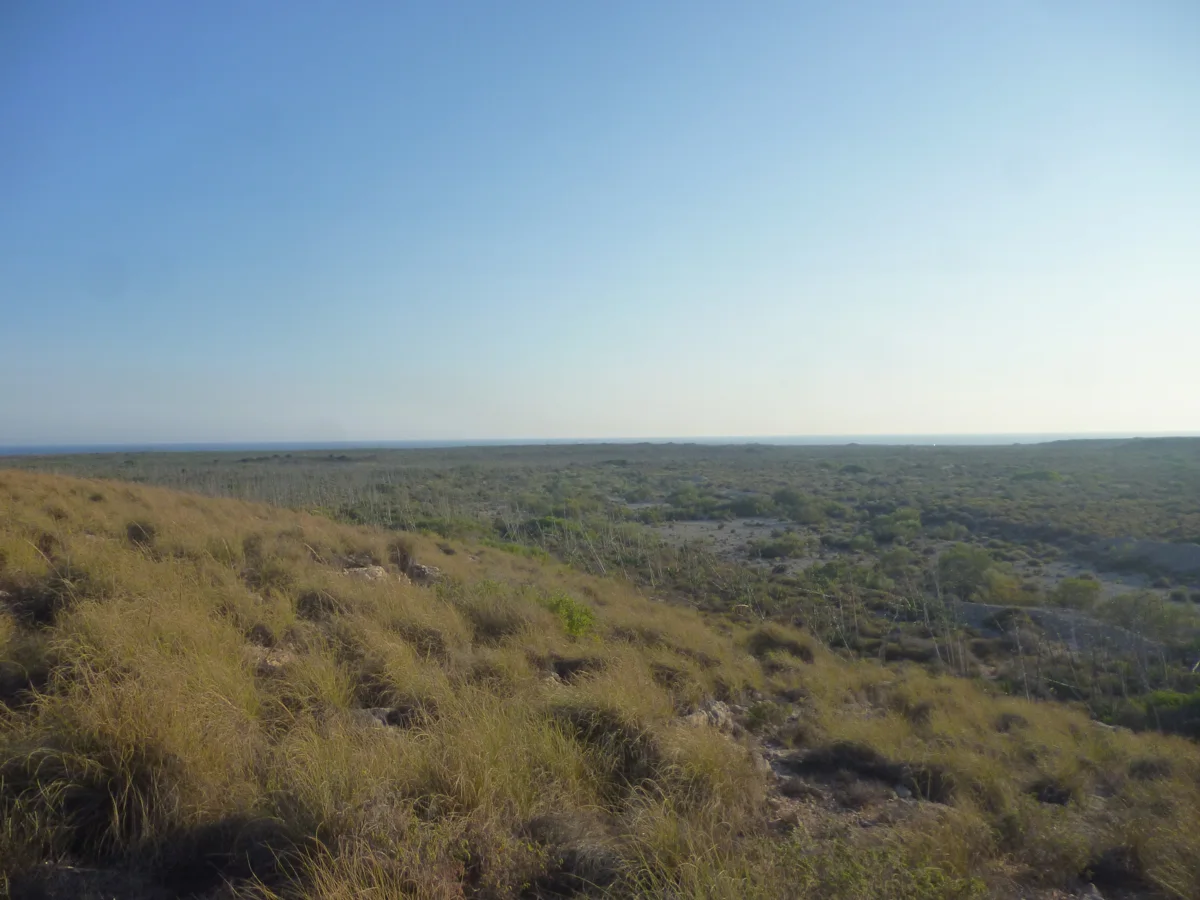
Cabo de Gata rewards a slower look. The pale, open ground near Las Amoladeras can seem almost empty until you notice the rounded thorn bushes, the different shapes of drought-resistant leaves and the channels that carry water after heavy rain. Farther along the coast, dark volcanic rocks meet the sea; at the salt pans, shallow water creates a very different world for birds.
Start at the Las Amoladeras visitor centre on the AL-3115 between Retamar and Pujaire. Its exhibition connects the volcanic mountains, coastal steppe, dunes, salt pans and marine habitats, with human history woven through them. It is a useful first stop for families because you can choose a small theme to follow outdoors rather than trying to identify everything at once.
For a short introduction, pair the centre with the separate Las Amoladeras viewpoint nearby. Look across the scrub towards the rambla and the inland mountains. The large, cushion-like azufaifo bushes are especially interesting: their tangled branches shelter a whole community of life. Use the signed access to each place; do not turn the road between them into an improvised walking route.
The park continues well beyond this gateway, across parts of Almería, Níjar and Carboneras and into protected Mediterranean waters. The salt pans and Las Sirenas suit a western-coast outing. Los Escullos and La Isleta del Moro offer a separate short coastal walk; Rodalquilar adds a botanical garden and mining geology. Mesa Roldán, nearer Carboneras, makes sense as a northern visit of its own.
Choose one of these combinations and leave room to stop. A drive between scattered sights can consume the day, while a single quiet viewpoint may give you time to see wind moving through a palm, a bird feeding or layers of rock that tell very different stories. Don't forget to bring the Snappit nature identification app along to scan local species.
The coast has long supported fishing, grazing, small-scale farming, salt production and craftwork. Water wheels, cisterns, watchtowers and the former mining buildings at Rodalquilar help explain how people worked in a dry and exposed landscape. Las Amoladeras introduces these human stories alongside the habitats.
The natural park was declared by a decree dated 23 December 1987. Its later international recognition includes UNESCO Biosphere Reserve and Global Geopark status. At Rodalquilar, the Casa de los Volcanes occupies a former gold-processing building associated with an operation that closed in 1966; today it gives a useful indoor introduction to the geology behind the scenery.