Snappit logo
Snappit
Get App
Generic illustration, not a photograph of this venueIllustration
ParkCentral Spain, Spain

El Capricho Gardens

Start at the main gate on Paseo de la Alameda de Osuna and give yourself time to look around.

About

Start at the main gate on Paseo de la Alameda de Osuna and give yourself time to look around. A straight approach draws you towards the Plaza de los Emperadores and the palace, while the garden beyond offers smaller discoveries: a columned temple, a lakeside pavilion and a miniature fort. This is a good place to walk slowly, compare details and let children choose the next thing to investigate.

The changes of style are part of the pleasure. The French parterre puts clipped hedges and straight lines on show; the English-style landscape uses curving paths, trees and water to create a looser sequence of views. An older Italian garden also belongs to the estate, although access to that section needs checking with staff.

Make the garden itself the main event. Allow roughly two hours for a first visit, with food before or afterwards. A bunker tour needs its own reservation, and a view of the palace does not include admission to its interior. Those separate arrangements matter more here than trying to tick off every building. Be ready to snap and learn! Get the Snappit app to identify any nature species you find here.

María Josefa Alonso Pimentel, duchess of Osuna, shaped El Capricho as a country retreat where gardening, art and entertainment belonged together. The main garden developed in the late eighteenth and early nineteenth centuries. Its small ornamental buildings were designed to surprise visitors as well as give them places to gather. A very different chapter arrived during the Civil War: the grounds housed the Republican Army of the Centre headquarters, with a substantial underground bunker built in 1937. The city acquired the estate in 1974 and restored the garden over subsequent decades.

What to do here

Follow the palace approach to the Plaza de los Emperadores, enjoy the parterre from the open paths and then use the municipal map to choose a few waterside and architectural stops. The Templete de Baco, Casa de Cañas beside the lake and Casino de Baile make a satisfying longer wander.

Seasonal info

Ordinary opening is 09: 00–21:00 from April through September and 09:00–18:30 from October through March, on Saturdays, Sundays and public holidays only. The garden closes on 25 December and 1 January. Weather alerts can close parts or all of the grounds, so check before travelling.

Accessibility

The city describes the garden as partially accessible, with most main areas and routes usable by people with reduced mobility. Start by asking staff which entrance and paths suit your wheelchair, walking aid or pushchair. The temple has steps, and the separately booked bunker has a 57-step access stair and is not accessible to people with mobility difficulties.

Don't miss

1

The palace-facing parterre and the Plaza de los Emperadores

2

The lake and Casa de Cañas pavilion

3

The columned Templete de Baco, viewed from the garden paths

4

Lilacs, Judas trees and the contrast between clipped hedges and mature trees

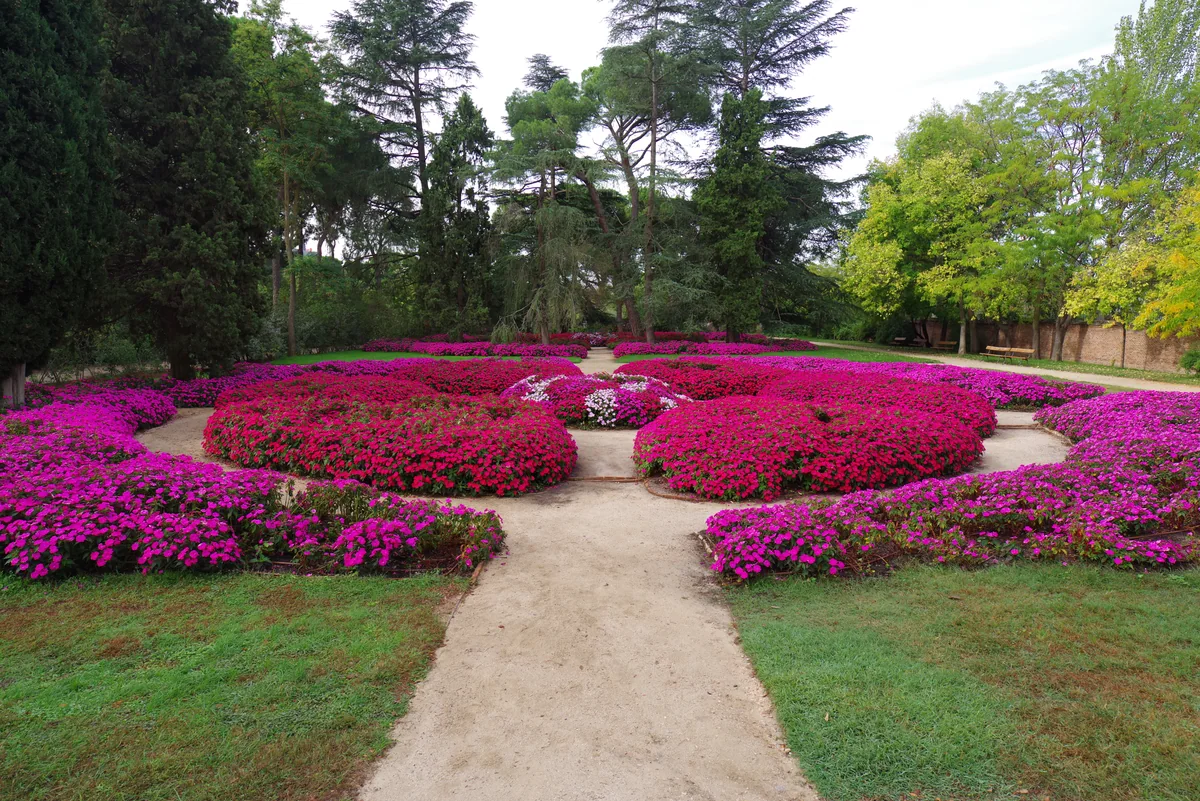
Curving beds of vivid pink, red and white flowers surround pale paths, with tall trees, grass and benches beyond.

Flower beds beside the Casino de Baile in El Capricho, photographed on 11 October 2026. The display is a seasonal part of the historic garden.

Jardines del casino de baile - Parque de El Capricho - Madrid 01.jpg — Javier Perez Montes / Wikimedia Commons / CC BY-SA 4.0 International · Creative Commons 1 · Creative Commons 2

Walks and routes

A short visit: the main approach and parterre

From the main gate, follow the central approach towards the Plaza de los Emperadores and the parterre facing the palace. Take time to compare the broad straight view with the smaller planted compartments. Return by the open main paths when you have had enough; allow 45–60 minutes with pauses.

This keeps the visit around the main garden areas rather than adding the temple platform or bunker. Ask gate staff which path surfaces and connections will work for your mobility needs.


A short visit: the main approach and parterre

A longer wander: the municipal garden circuit

Use the black recommended itinerary on the official services map for a broader walk. It connects the main approach and palace surroundings with the Templete de Baco, the northern garden, the lake and Casa de Cañas, then the Casino de Baile and the return towards the entrance. Allow 1½–2 hours for the whole visit, stopping at whichever features interest you most.

The map marks an itinerary, not a fully accessible circuit. Some paths are earth-surfaced and the temple itself stands on steps. Choose the main-path alternatives with staff rather than assuming every branch suits wheels.

A longer wander: the municipal garden circuit

With an hour to spare

Keep to the main approach, Plaza de los Emperadores and the palace-facing parterre. Leave time to return through the same entrance. One or two quiet pauses will give you a better feel for the place than rushing around the entire garden.

A relaxed two-hour visit

Follow the broader municipal circuit, pausing at the temple, lake and Casino de Baile. Add plant-spotting or a sketch rather than extra distance. Have your meal outside the garden before or after the visit.

Garden plus a reserved bunker tour

Make this plan only after your bunker place is confirmed. Be at the entrance turnstiles at least 10 minutes before the booked start, carrying the reservation proof and the adult identification required by the programme. Allow the published 50 minutes for the tour and a separate garden walk afterwards or beforehand.

Things to try

Play garden-design detective

Find one straight view and one curving path. Which reveals its destination immediately, and which makes you wait? Compare the clipped parterre with the more irregular planting around the water. This works just as well as a conversation as it does as a sketching exercise.

Make a small nature notebook

Choose a leaf shape, a patch of bark and a bird you can already see. Draw or photograph each from the path, then add one thing you noticed. You do not need to identify everything to make a satisfying record of the visit.

Look for reflections

At an open lakeside path, compare the shape of a pavilion or tree with its reflection. A few careful photographs can tell the story of the garden without chasing every viewpoint. Keep back from the edge and leave the path clear for other visitors.

Keep a flexible plan

After rain, choose the shorter main-path visit if staff confirm it is suitable. In strong wind or an official closure, postpone the garden rather than trying another gate. A bunker booking is not a weather-proof fallback: park closure or post-storm tree checks can cancel the tour.

Wildlife and habitats

Judas tree

Look for broadly rounded leaves with a heart-shaped base. In flower, pink-purple clusters can appear directly on older branches and even the trunk. El Capricho’s Judas-tree planting is one of its characteristic spring features.

Common lilac

The lilac planting is worth pausing beside when it flowers: notice the clusters of small, scented blooms and the heart-shaped leaves. Enjoy the scent without pulling branches towards you.

Italian cypress

Compare an evergreen cypress with nearby trees that lose their leaves. The municipal garden walk identifies old cypresses around the Plaza de los Cipreses, close to the entrance approach.

Honey locust

Leaves divided into many small leaflets give this tree a fine-textured look. Some forms carry strong branched thorns, so keep hands clear and observe rather than handling the branches.

Sweet mock orange

When in bloom, this shrub has cream-white flowers with a strong scent. The flowers are an easier first clue than the name: it is an ornamental shrub, not an orange tree.

Laurustinus

Look for a dense evergreen shrub with glossy oval leaves and clusters of small pale flowers when in season. Its later dark fruits are for observing, not eating.

Common blackbird

Watch quietly near shrubs and leaf litter for a bird moving in short hops. Adult males are black with an orange-yellow bill; females are brown. A pause in one place is more useful than following it into the planting.

Red squirrel

Scan trunks and branches for a small, agile climber with a long tail. Let it move at its own pace, and use binoculars or a camera zoom instead of approaching or offering food.

The plants below are documented as part of the cultivated garden; the blackbird and red squirrel are free-living animals recorded by Madrid Ambiental. Use these clues to slow down and look, without expecting every species on every visit. Stay on the paths, leave plants untouched and never feed or lure wildlife.

Stories and discoveries

A building for watching bees

The Abejero was created as a place to observe bees and their work. It is a reminder that this pleasure garden also reflected curiosity about the natural world. Its historical role does not mean visitors can enter it or see an active bee display today.

The temple once had a roof

The Templete de Baco began with a dome, removed around 1810 and never rebuilt. Looking at its open columns today, it is easy to miss that change. Enjoy the view from below if the stepped platform does not suit your visit.

Two restored garden landmarks

The city announced completion of work on the fort and Casino de Baile in April 2026. They are useful stops for looking closely at the garden’s architecture; restoration completion does not itself make their interiors part of an ordinary walk.

When to visit

Spring: flowers and fresh growth

Lilac and Judas-tree planting gives spring particular appeal. Flowering shifts with the weather, so enjoy whatever stage you find rather than planning around a guaranteed peak weekend.

Summer: shorten the hot part of the day

Use the early opening or a cooler part of the day, carry water and pause under trees where the paths allow. Longer opening hours do not mean the midday heat will suit everyone.

Autumn: colour and structure

Look at leaf shapes, seedpods and the contrast between evergreen planting and trees losing their leaves. From October the 18:30 closing time makes an earlier start helpful.

Winter: architecture and evergreens

The buildings, clipped lines and evergreen trees give a winter walk plenty to notice. Dress for a slow outdoor visit and check both the holiday closures and the weather alert before travelling.

Getting there and practical advice

Opening and admission

The garden is free, with a maximum capacity of 1,000 visitors. It opens on Saturdays, Sundays and public holidays: 09:00–21:00 from 1 April to 30 September; 09:00–18:30 from 1 October to 31 March. It is closed on 25 December and 1 January. Allow time for any queue and for leaving before closing.

Toilets

The municipal services map marks public toilets beside the Casino de Baile. Ask staff whether they are open and whether the approach and cubicle meet your access needs; the map does not establish an accessible toilet specification.

Water and places to pause

The larger municipal map marks benches and drinking-water points, separately from ornamental fountains. Bring your own drinking water, especially on a warm day, and check that a drinking point is working before relying on it.

Food and play

Eating and ball games are prohibited, and bicycles and roller skates cannot enter. Plan food outside and bring a camera, sketchbook or simple observation challenge instead of sports equipment.

Palace and garden buildings

Plan to see the palace and ornamental buildings from the paths. The latest municipal palace announcement forecast autumn 2026, but this guide has no confirmed public opening day or interior visiting arrangements. Check the current notice if an interior visit is important to you.

Bunker bookings

Use the official Pasea Madrid booking service for released tour dates. At the 17 October 2026 check, the linked programme still showed the ended April–June season and next-season dates were unconfirmed. Do not travel expecting a walk-in underground tour.

Metro and bus

El Capricho station on Metro line 5 is the usual rail starting point; continue on foot to the garden’s main entrance at Paseo de la Alameda de Osuna, 25. The operator lists nearby EMT buses 101, 105 and 151. Check the current journey planner and service notices, especially if you depend on lifts or a particular bus stop.

Driving or arriving by bicycle

The official tourism listing identifies free parking, but a space is not guaranteed. Navigate to the garden entrance rather than the similarly named sports facility. If you arrive by bicycle, arrange to leave it outside: bicycles are not admitted to the garden.

Main garden paths

The municipal description is “partially accessible” and says most principal areas and routes are accessible. The site plan also shows earth surfaces. Ask about the main-gate arrangement, the firmest route, wet-weather conditions and a suitable return before committing to the longer circuit.

Temple, maze and lower garden

The temple’s podium has five steps. You can appreciate the building from the surrounding permitted paths without treating the platform as essential. Maze entry is not assumed, and the lower Italian garden had restricted access during restoration in August 2025; confirm its present arrangement with staff.

The underground bunker

The operator lists a 57-step access stair and does not permit access for people unable to manage it, people with mobility difficulties or those with serious heart or respiratory conditions. It also advises against the tour for people with claustrophobia. Read the current conditions before booking; they mention possible insects and spiders and a cool interior, about 15°C. Wear suitable shoes and bring a layer. Food, drinks and smoking are prohibited inside.

Sources and useful links

Wildlife you might spot

8

Each card links to a full Explore page with photos, traits, and fun facts.

Snap map for this place

Start with the big picture, then zoom in to explore individual wildlife observations around this place.

Loading map…

Good to know before you go

Check the opening day and weather notices before setting off. A weekday is not an ordinary walk-in visiting day.

Use the main garden entrance at Paseo de la Alameda de Osuna, 25. Entry is free, but the 1,000-person capacity can mean a wait.

Eat before you enter or after you leave. Eating, ball games, bicycles and roller skates are not allowed inside.

Leave pets at home, even if they would be on a lead. If you use an assistance dog, contact the garden about the appropriate access arrangements.

Book the bunker separately through Pasea Madrid and check the dates actually on offer; an old seasonal timetable is not a current reservation.

Wear comfortable shoes and bring drinking water. Use the main paths in wet weather and keep children close beside the water.

Follow barriers around buildings, the maze and restoration areas. Ask whether the Italian garden is open before heading into that section.

Observe birds and squirrels quietly, without feeding them. Photograph plants in place and leave flowers, leaves and seedpods where they are.

Frequently asked questions

Ordinary garden admission is free and subject to a maximum capacity of 1,000 people. Join the entrance arrangements in place at the gate. Booked guided activities, particularly the bunker, have separate reservations.
Ordinary public access is on Saturdays, Sundays and public holidays. Madrid Ambiental sometimes runs pre-booked guided garden visits on weekdays; use a specifically confirmed activity booking rather than assuming the gates will be open.
No. Eating, ball games, bicycles and roller skates are prohibited inside the historic garden. Plan a food break outside and make this a walking-and-looking visit.
No. The underground visit is a free, separately reserved Pasea Madrid activity. The published 2026 first season ended on 28 June; at the 17 October 2026 check, the official tourism page still marked the next season’s dates as unconfirmed. Check for a new release before planning around it.
Do not rely on an interior visit without a current opening notice. A municipal announcement forecast an autumn 2026 opening, but a public opening date and visiting arrangements were not confirmed in the sources checked for this guide. The suggested walk enjoys the building from outside.
Treat the maze as a historic garden feature and follow the access signs. This guide does not assume it is open for entry. Children can instead compare leaf shapes, count columns or sketch a pavilion from the public paths.
No single accessibility label covers every part. The main garden is described as partially accessible; ask about a suitable path and toilet access before your visit. The temple platform has steps, and the bunker tour is not accessible to people with mobility difficulties.

Recent snaps at this place

Recent snaps will appear here as new observations are added.

View all ›

Take the discovery with you

Exploring El Capricho Gardens?

Identify the wildlife you spot, learn as you go, and keep a collection of the adventure.

  1. 1Spot it
  2. 2Snap it
  3. 3Keep the discovery