
Snappit logo
Snappit
Get App
Generic illustration, not a photograph of this venueIllustration
ParkKanto, Japan

Hitachi Seaside Park

Hitachi Seaside Park is a place to give one view plenty of time.

About

Hitachi Seaside Park is a place to give one view plenty of time. At Miharashi Hill, paths thread through a planted hillside, and the colour changes the whole character of the walk. Spring brings the low blue flowers of nemophila; later in the year, rounded kochia plants make a very different landscape. Walk slowly, turn around occasionally, and notice how the foreground and skyline shift as you climb.

These are separate seasonal displays. After the nemophila finishes, the hill is replanted with kochia, which grows green through summer before its foliage turns red in autumn. The red is leaf colour, not a field of red flowers. Between the main displays, planting work and young plants are part of the view. A photograph from April is a lovely reason to plan a spring visit, but it will not tell you what the hill looks like in October.

For a first outing, use the West Entrance, also called Nishiguchi Tsubasa no Gate, and make the hill and Miharashi no Sato at its foot the centre of your visit. The approach to the hill is about 950 m each way, so the entrance is not the viewpoint. Give yourselves two or three hours for the approach, a chosen hill path, photographs and a rest. There is no need to add every other area just because it appears on the map.

The wider park rewards another kind of attention. Pine woods, coastal plants and spring-fed habitat sit alongside gardens and family attractions. The Dune Observation Path preserves dune landforms and vegetation, while the Nature House introduces the Sawada spring environment. Those are worthwhile additions when the paths are open, but they need their own time. Check restrictions before leaving the main outing, and let a picnic or a café stop be the finish if everyone has already had a good day. Eager to name that creature? Identify any animal you find during your visit using the Snappit app.

The park opened on October 5, 1991, on part of land previously used as an airfield and then a military firing and bombing range. The former range was returned to Japan in 1973, and the national-government park developed in stages. Today its flower gardens and recreation areas sit within a landscape that also retains coastal dunes, woods and spring-fed habitat.

What to do here

Walk from the West Entrance to Miharashi Hill, choose a comfortable section of its paths, then pause among the fields and traditional houses at Miharashi no Sato. In spring, make time for the separate narcissus or tulip gardens if they are flowering. Add a nature stop only after checking which paths are open.

Seasonal info

The hill changes from spring nemophila to summer-green and autumn-red kochia, then winter preparation for the following spring. Other gardens have their own calendars: narcissus generally comes earlier than the main blue display, and tulips are usually at their best in mid- to late April. Use the live flower report to choose the day’s stops.

Accessibility

Ask for the barrier-free map at the gate. Miharashi Hill rises about 25 m from its entrance to the top, with some steep or long slopes; the lower views can be the whole visit. The forest’s unpaved paths and the stairs down to the Sawada spring deck make different demands. Free wheelchair and stroller loans are available at gates, subject to availability and without reservations.

Don't miss

1

Miharashi Hill’s changing seasonal planting and open coastal outlook

2

Spring narcissus and tulips in separate West Entrance gardens

3

Traditional houses and seasonal fields at Miharashi no Sato

4

Coastal vegetation along an open section of the Dune Observation Path

Walks and routes

West Entrance to the seasonal hill

Start at the West Entrance and follow the pedestrian signs for Miharashi Hill. The mapped approach is about 950 m one way, so the approach and return alone total about 1.9 km. At the hill, choose how far to climb rather than trying every path. Spend time at Miharashi no Sato below it, then return towards the West Entrance, with a rest on the way. Allow 2–3 hours; the full distance depends on your hill path and stops.

Ask staff to show the recommended barrier-free approach and a suitable lower viewing path. The hill includes steep sections, and its roughly 25 m rise is additional to the approach. Crowds may make turning or stopping harder. Do not assume every house entrance at Miharashi no Sato has an easy ramp.
West Entrance to the seasonal hill

A separate look at the dunes

The Dune Observation Path is a separate choice, nearest the Seabreeze Entrance, or Kaihin-guchi Kaze no Gate. Ask which section is open, then follow that public path for a closer look at low coastal plants and the shape of the sand. Allow 60–90 minutes for a short visit and return, with travel across the park added separately. This works well as the main nature stop rather than the last item on an already full day.

Check the barrier-free map and ask staff about the exact path surface and gradients before setting out. The dune area is not one uniformly paved, level route.

A separate look at the dunes

A relaxed half-day around the hill

Start with the flower report and a toilet stop at the West Entrance. Walk to the hill, take your chosen path, and pause at Miharashi no Sato before heading back. Add one flowering garden or a café stop if you have the energy. Allow 2–3 hours inside the park, with travel and any substantial meal added separately.

A longer day with one nature addition

Give the hill its own unhurried visit, then have lunch before choosing either the Nature House or an open dune-area section. Check the transfer and return-gate plan before committing. The park is large enough that one worthwhile extra is usually a better family plan than crossing it repeatedly. Allow 4–5 hours overall and keep some time in reserve for queues.

Things to try

Let the West Entrance gardens set the pace

If the hill is your main spring goal, save time for one smaller garden on the same side of the park. Narcissus in Suisen Garden usually comes from late March to mid-April; the tulips in Tamago no Mori Flower Garden usually follow in mid- to late April. Compare a few flower shapes and colours rather than trying to see every bed. Their peaks do not necessarily coincide.

Slow down at Miharashi no Sato

At the foot of the hill, the traditional houses and cultivated fields change the scale of the outing. Look at the buildings from the open visitor areas and notice which crops or flowers are growing. This is an easy place to shift from collecting panoramic photographs to looking closely at a smaller scene.

Ask what is happening around Sawada spring

The Sawada Spring Water Nature House introduces the local wetland environment. The operator lists guided visits to an otherwise restricted middle section on weekends and public holidays from April to November; confirm the day’s programme and participation arrangements before making a tour essential. The deck by the spring head involves stairs. Stay within the areas open to ordinary visitors.

Shorten the walk when the weather turns

In light rain, a short garden visit with a stop at an open café or rest building may be enough. The Nature House is an option for learning about the park, but reaching it still involves outdoor travel. In strong wind, thunderstorms or heavy rain, postpone the exposed hill and dunes and follow staff directions. Do not rely on a closed building for shelter.

Wildlife and habitats

Nemophila: look beyond the blue carpet

In spring, pause beside the path to look at one of the small, pale-centred blue flowers. The park uses the cultivar called Insignis Blue. The plants are annual bedding flowers, so the spring view depends on cultivation and the season’s weather.

Kochia: the shape stays, the foliage changes

Watch how the rounded plants form repeated shapes across the hill. Their autumn display comes from changing foliage. The park says its special ornamental cultivar grows into that rounded form without clipping; it is grown for display, so leave it untouched and do not collect seeds or treat it as food.

Sea bindweed: a plant that travels along the sand

On an open dune path, look for low trailing stems and thick, glossy leaves. Pale pink flowers add another clue in the flowering season, which the park lists as early June to early July. Watch from the path: a plant that seems small above ground can have long spreading stems below the sand.

Japanese black pine: the coastal woodland backdrop

Black pine is part of the park’s existing woodland. Look for dark, fissured bark and pairs of needles on a safely visible branch, then compare the overall canopy with the open flower beds. The nature forest also contains red pine, so a label is more useful than assuming every pine is the same species.

Four plants, two very different settings

The hill displays are cultivated and renewed by gardeners. The dune and woodland plants belong to the park’s coastal habitat. Use the following as things to notice in the right season, leaving flowers, cones and other natural material where they are. Check access restrictions before seeking out the nature areas.

Stories and discoveries

The famous hill is replanted

Nemophila and kochia do not simply change colour into each other. They are different plants used in succession. After autumn’s kochia, the hill is prepared for nemophila, with protective white sheets becoming part of the winter scene.

Sand and spring water share the landscape

The coastal setting is more varied than it first appears. Sand carried by river, sea and wind helped form the dunes; water stored underground also feeds the spring habitat. A flower-garden visit and a nature visit reveal different parts of the same park.

When to visit

Spring: choose between successive flower peaks

Late March to mid-April usually brings narcissus; mid- to late April brings tulips; mid-April to early May is the usual nemophila period. These are broad calendars, with different beds peaking at different times. Pick one main target and use the current flower report for the rest.

Summer: green kochia and a shorter walk

The summer hill has growing green kochia. The park also lists sunflowers around mid-August, currently in beds near the BMX course, so check the current location rather than relying on older photographs of Miharashi no Sato. Keep the outing flexible around heat, shade and water breaks.

Autumn: foliage on the hill, flowers at its foot

Kochia usually moves through mixed green and red in early October, red around mid-October, then brown and gold later in the month. Cosmos normally flowers at the foot of the hill through October. The two displays can overlap, but weather decides their best days.

Winter: see the work between displays

After the kochia is removed, the hill is prepared for next spring’s nemophila and may be covered with protective sheets. Choose winter for the wider park and its current planting, rather than expecting a blue or red hill. Closing time is earlier, and the New Year and February closures matter when planning a trip.

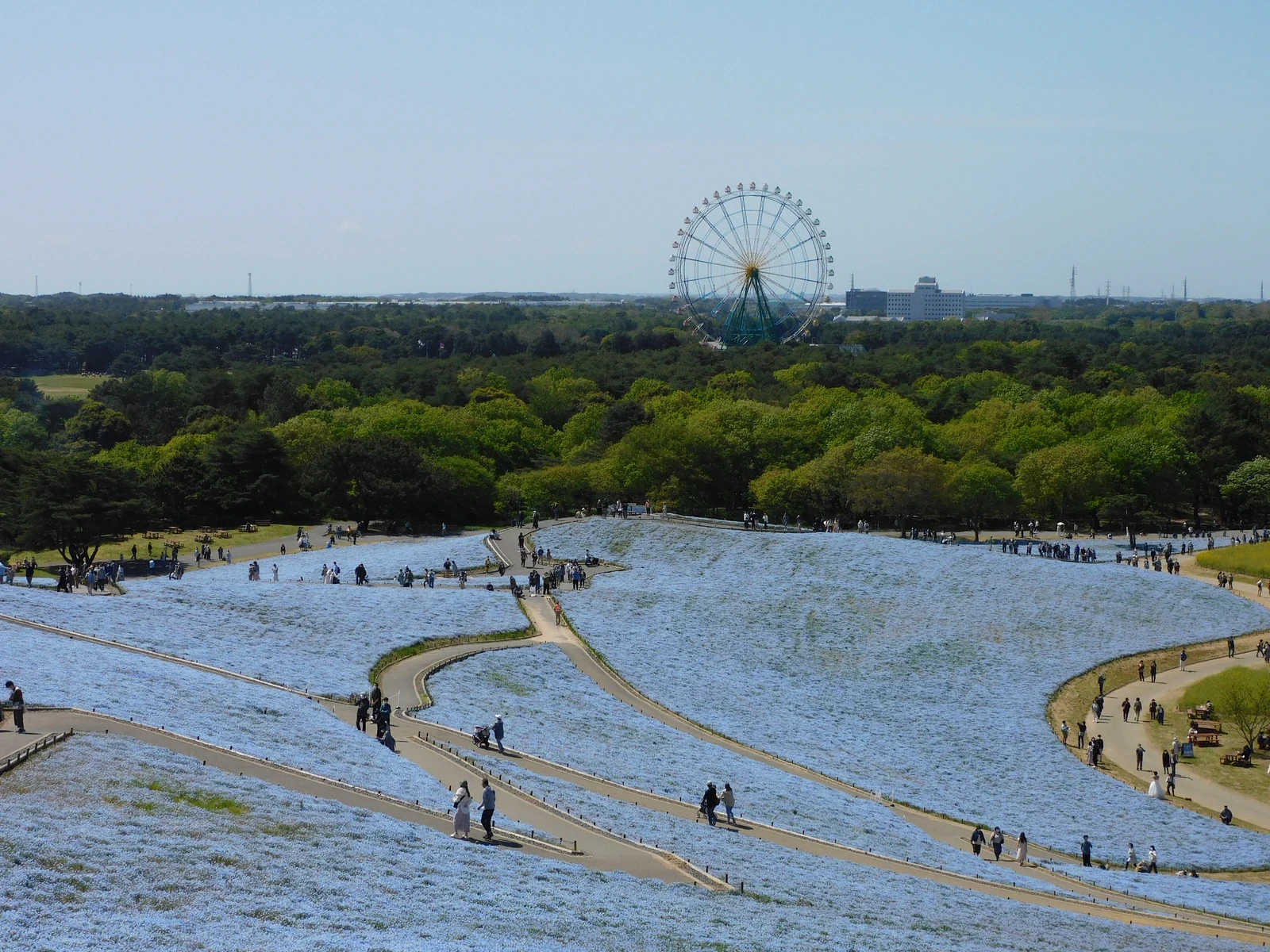
Paths and visitors cross pale-blue flower-covered slopes; woodland and a Ferris wheel stretch across the background.

Paths weave through the nemophila-covered slopes of Hitachi Seaside Park, with the Ferris wheel beyond, in April 2021.

Nemophila and Ferris Wheel in Hitachi Seaside Park.jpg — Miyuki Meinaka, CC BY-SA 4.0 (https://creativecommons.org/licenses/by-sa/4.0). Source: https://commons.wikimedia.org/wiki/File:Nemophila_and_Ferris_Wheel_in_Hitachi_Seaside_Park.jpg. Proportionally reduced to a 1600-pixel long edge without upscaling; recompressed as WebP quality 92, method 6. No crop, retouching, added text or colour changes. EXIF omitted. · Creative Commons 1 · Creative Commons 2

Getting there and practical advice

Opening hours and closed days

The published hours are 09:30–17:00 from March 1–July 17 and September 1–October 31; 09:30–18:00 from July 18–August 31; and 09:30–16:30 from November 1 to the end of February. Tuesdays are normally closed, with holiday adjustments. Daily-opening periods are March 26–May 31, July 21–August 31, October 1–31, December 25–30 and January 2–7. December 31 and January 1 are closed, as is the Monday–Friday week containing February’s first Tuesday. Check your exact date for changes.

Admission and other charges

Ordinary one-day admission is ¥450 for high-school age and older, or ¥210 for ages 65 and over; junior-high age and younger enter free. In 2026 the seasonal surcharge periods are April 3–May 6 and October 9–November 3, when those paid admission rates total ¥800 and ¥560 respectively. Ordinary-car parking is ¥600 per day. Rides and internal transport cost extra. Check the latest prices and seasonal dates before travel.

Food, toilets and places to pause

Bring lunch or check the day’s cafés. Options include Kinen no Mori Rest House and Lakeside Café on the west side, and Glass House in the dune area. Use the map to find the nearest open toilet and baby-care room before a longer walk. The Terrace House is unavailable September 9–November 11, 2026, although its nursing room remains usable; the notice directs visitors to the West Entrance rest shelter or the tent beside Lakeside Café.

The Seaside Train and bicycles

The Seaside Train’s one-day ticket is listed at ¥600 for ages three and over. It can reduce walking between areas, but stops and routes change seasonally and queues can be long. Some vehicles accept a wheelchair with the rider seated; ask staff about boarding and space. Bicycles use their own designated course and parking areas, so they are a way between attractions rather than a way to ride through flower paths.

Train to Katsuta, then bus to the West Entrance

Use JR Katsuta Station, then the east-exit bus stop 2 for Kaihin Koen Nishiguchi, the park’s West Entrance stop. The operator gives about 15 minutes for this bus leg in ordinary conditions. Check the current Ibaraki Kotsu timetable and return departures; peak flower traffic can change the journey. Katsuta Station is not a short walk from the park.

Choose West Parking for the hill

Set your destination to West Parking for this outing. The West Entrance rotary is for buses and taxis, and ordinary cars cannot enter it. South Parking serves the Central and South Entrances, while Seabreeze Entrance Parking suits the dune side. Follow the current traffic directions rather than assuming the closest motorway exit will be quickest on a busy day.

A taxi can simplify the station connection

The park lists about 15 minutes by taxi from Katsuta Station’s east side to the West Entrance in ordinary traffic. Confirm a fare and a return pickup plan locally. Keep extra time for the station connection during nemophila and kochia peaks.

The lower hill is a worthwhile destination

Use the park’s recommended barrier-free route rather than the shortest-looking path. The access booklet warns of steep or long sections on Miharashi Hill and about 25 m of rise to the top. It also notes that benches on the hill are only at the viewing platform. Plan a rest before climbing and ask staff where a lower-level visit will work best.

Nature paths have specific barriers

The Nature Forest has uneven, unpaved ground and roots that make wheelchair movement difficult. The spring-head deck at Sawada is reached by stairs with a handrail on one side. Some traditional-house ramps are steep. Describe your mobility needs to staff before choosing any of these extras.

Ask about equipment and the nearest suitable toilet

Gates lend wheelchairs, strollers and walking-support carts free of charge, without reservations and while stock lasts. Main toilet locations include accessible facilities; use the barrier-free map to check the equipment you need. For questions before travelling, contact the park office on 029-265-9001.

Check these notices before choosing extras

As checked on October 16, 2026, the park still listed fallen-tree restrictions dating from August 12 in the Nature Forest and August 13 in the dune area. Ask staff which paths have reopened. The Seaside Train also has a route-change notice for October 6–November 3. Green Studio is restricted to event participants on November 15, 2026. These are individual path, service and building notices, so use the day’s advice to plan your route.

An early opening on two October dates

The park announced an 08:30 opening for October 17 and 18, 2026 because of expected crowds. This is a two-day exception, not the normal opening time. Check new announcements for any other date.

Sources and useful links

Wildlife you might spot

4

Each card links to a full Explore page with photos, traits, and fun facts.

We are still adding species preview cards for this place.

Snap map for this place

Start with the big picture, then zoom in to explore individual wildlife observations around this place.

Loading map…

Good to know before you go

Choose your date by the flower report, not by a single photograph. Spring nemophila and autumn-red kochia are different visits.

Use the West Entrance for this hill-focused outing. Keep energy for the roughly 950 m return approach after you have explored the hill.

Check the closure notices before adding woodland or dunes. An August 2026 fallen-tree notice was still listed on October 16, with the dune reopening date undecided.

Bring water, sun protection and a windproof layer. The hill can feel exposed, and a shorter walk is a better choice in summer heat or strong wind.

Look up the return bus before entering. Peak-season road traffic, entrance queues and the park train can all take longer than expected.

Stay on visitor paths and outside the planting beds. Do not pick plants or catch animals; cycling routes are for bicycles, not walking shortcuts.

Bring a picnic if that makes the day easier. Check open rest areas rather than relying on the Terrace House during its September 9–November 11, 2026 restriction.

Keep photo stops clear of through traffic and respect other visitors’ privacy. Drones are prohibited; contact the park before planning a commercial or organized shoot.

Frequently asked questions

No. The main hill is replanted between the spring nemophila display and the later kochia season. Kochia is green in summer and normally turns red around mid-October. Check the current flower report, particularly near a changeover.
The West Entrance is the usual choice for this outing. The official guide map gives about 950 m from there to the hill, compared with 1,100 m from the Central Entrance and 1,700 m from the South Entrance. Those distances do not include climbing or exploring the hill.
No. Enjoy the planting from the lower paths and turn back when it suits your group. The summit approach adds slopes, and busy periods can limit movement. Ask gate staff which route suits your wheelchair, stroller or walking needs.
No. Pleasure Garden attractions, bicycle rental and the Seaside Train have separate charges. Decide whether you want a flower-and-nature outing, rides, or a longer day combining both before choosing tickets.
There is no swimming beach or swimming pool inside the park. A seasonal children’s water-play area is a separate facility. Do not treat a dune walk or a sea view as access to a bathing beach.
Yes. Packed lunches are welcome. Choose an open lawn, bench or permitted rest space, take your rubbish away and leave flower beds and paths clear.

Recent snaps at this place

Recent snaps will appear here as new observations are added.

View all ›

Take the discovery with you

Exploring Hitachi Seaside Park?

Identify the wildlife you spot, learn as you go, and keep a collection of the adventure.

  1. 1Spot it
  2. 2Snap it
  3. 3Keep the discovery
