Snappit logo
Snappit
Get App
Generic illustration, not a photograph of this venueIllustration
ParkShikoku, Japan

Makino Botanical Garden

Makino Botanical Garden is a place to slow down and look closely.

About

Makino Botanical Garden is a place to slow down and look closely. Spread across the slopes of Godaisan in Kochi City, its roughly eight hectares bring together planted landscapes, a botanical museum and a conservatory. You can make a satisfying first visit in a couple of hours, or give the garden half a day with children. The hills are part of its character, so choosing a route matters more than trying to see every corner.

Begin with the Tosa Ecology Garden near the Main Gate. Tosa is the historic name for Kochi, and this planting introduces the prefecture’s habitats in miniature: cool mountain vegetation gives way to lower hills, settled landscapes, wetlands and the coast. Read a few labels rather than racing past them. A plant that looks unremarkable at first can become interesting once you know the conditions it grows in. These are carefully arranged living collections, offering a useful introduction before exploring Kochi’s wider countryside.

The Exhibition Hall gives those plants a human story. Tomitarō Makino grew up in Sakawa, west of Kochi City, and turned a childhood fascination into a lifetime of botanical study. His drawings, notebooks and recreated study help explain how patient observation becomes science. Outside, the courtyard brings together plants he named or drew. Look at a botanical illustration, then compare it with a living leaf: the tiny differences are often the point. Hiroshi Naitō’s timber-rich memorial buildings make this an especially pleasant place to pause between outdoor sections.

Continue toward the South Garden for a change of scale. Old stonework recalls land once belonging to neighbouring Chikurinji Temple, while the anniversary garden uses ponds and streams among ornamental plantings. The conservatory then shifts from dry-country plants to lush foliage and a water garden. At its entrance, the Green Tower evokes the hollow of a huge tree, with roots spreading down the walls. It is a good finale for children who have had enough quiet label-reading.

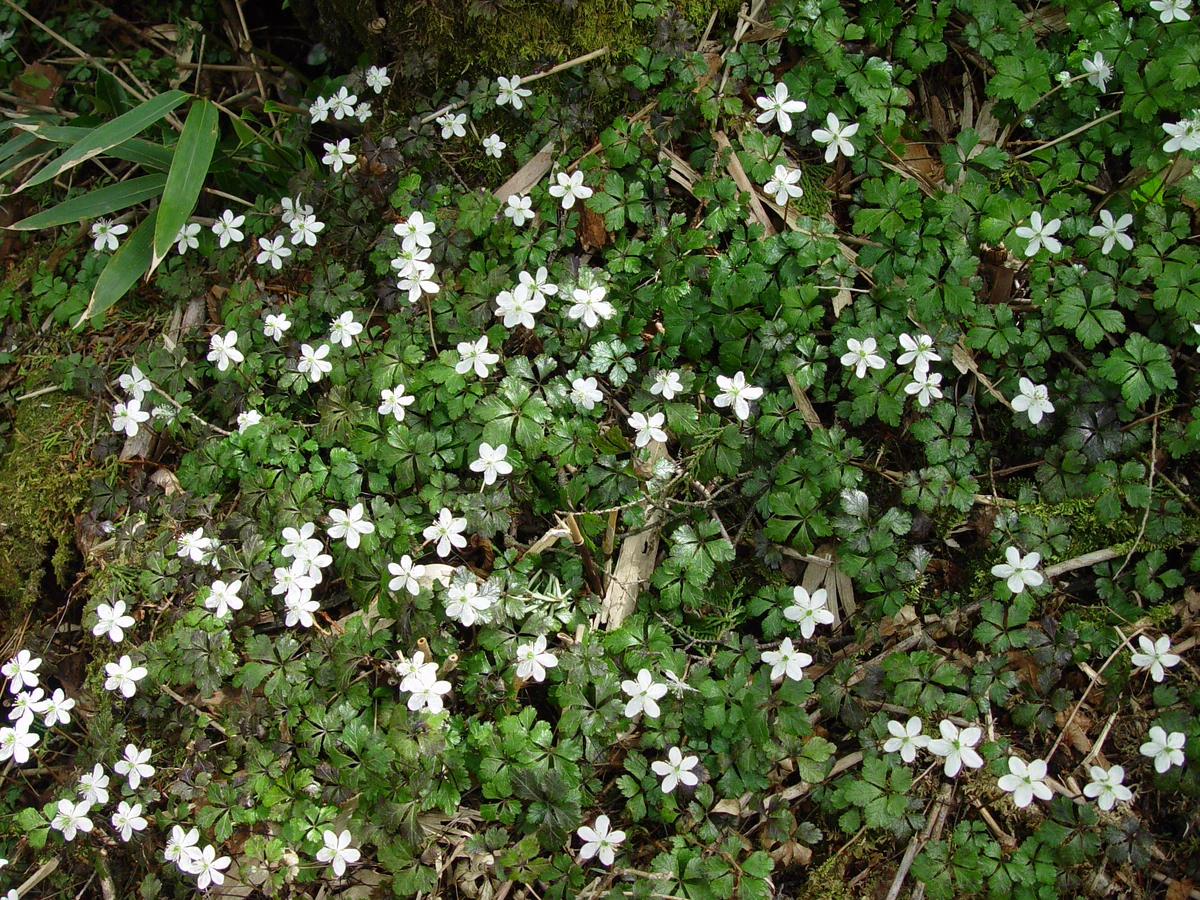
One small plant ties the visit together: baika-ōren, Coptis quinquefolia. Makino loved this woodland flower from his home region, and its divided leaf inspired the garden’s logo. The apparent white petals are actually sepals; the true petals are much smaller and yellow. Don't forget to bring the Snappit nature identification app along to scan local species.

The garden opened in April 1958, the year after Tomitarō Makino’s death, to celebrate his contribution to botany. Born in Sakawa in 1862, Makino taught himself about plants before gaining access to the University of Tokyo’s botany department in 1884. He helped establish modern Japanese plant taxonomy, named more than 1,500 new species and other plant taxa, and published his illustrated flora in 1940. The museum makes his work approachable through the tools, drawings and records behind that achievement. The garden expanded with the memorial buildings in 1999 and continues to combine public enjoyment with research, conservation and education.


What to do here

Follow the first-visit course from the Main Gate through the Tosa Ecology Garden, memorial buildings and connecting path to the conservatory, finishing at the Middle Gate. Add the South Garden’s stepped detour only if it suits your group. For children, trade some museum time for Fumufumu Plaza’s sensory planting and a lawn break at Konkon-yama Plaza.

Seasonal info

Flowering changes with the weather. Use the current ‘Plants to See Now’ guide rather than treating calendar dates as promises. In summer, alternate outdoor sections with indoor breaks. Check the opening notice during typhoons and after severe weather, when safety inspections can delay reopening.

Accessibility

The hillside includes slopes, steps and narrow sections. The standard first-visit course has steps on its South Garden detour. Ask for the wheelchair-and-stroller route in the Makino QR Guide; ramps and lifts serve key buildings, but route choice still matters. Free loan wheelchairs and strollers are limited and cannot be reserved.

Don't miss

1

Kochi’s mountain-to-coast plant communities, recreated in the Tosa Ecology Garden

2

Makino’s life, drawings and plant-filled Exhibition Hall courtyard

3

The conservatory’s root-lined Green Tower, dry-country plants and water garden

4

Fumufumu Plaza’s sensory planting and an optional Konkon-yama lawn break

Small white flowers rise above glossy, divided green leaves on a woodland floor mixed with moss, fallen twigs and dry leaves.

Baika-ōren (Coptis quinquefolia), a plant featured in Makino Botanical Garden’s interpretation of Tomitarō Makino, photographed on Mount Nagiso in May 2002. This is an offsite comparison photograph.

© Alpsdake / Wikimedia Commons / CC BY-SA 3.0. Coptis_quinquefolia_in_Mount_Nagiso.jpg. Source: https://commons.wikimedia.org/wiki/File:Coptis_quinquefolia_in_Mount_Nagiso.jpg. License: https://creativecommons.org/licenses/by-sa/3.0/. Proportional downsampling to fit 1200 × 1200 pixels without enlargement; WebP quality 92, method 6. No crop, retouch, recoloring or added text. EXIF omitted. Source EXIF modification date 2002-05-06; no editing software field displayed. Source rendering retained without restoration claims. · Creative Commons

Walks and routes

The first-visit walk

Allow about two hours for this approximately 1.5 km course. Enter at the Main Gate, enjoy the Ecology Garden and memorial buildings, then follow the connecting path toward the South Garden and conservatory. Finish at the Middle Gate. The overall direction is gently downhill, but the detour to the Makino statue and anniversary garden includes steps.

To avoid that stepped detour, stay on the connecting path and ask staff to point out the current suitable way to the conservatory and Middle Gate. Use the dedicated QR route if travelling with wheels.

The first-visit walk

A longer family visit

The garden’s approximately 2 km family course allows three to four hours. Add Konkon-yama Plaza and Fumufumu Plaza before the Exhibition Hall, then continue to the conservatory. Give the lawn and indoor reading corner as much time as the flowers; this works better as a relaxed outing than a checklist.

Follow the garden’s wheelchair-and-stroller course, remembering that the terrain still rises and falls. If that is too much, stay in the North Garden using the Main Gate, or the South Garden using the Middle Gate.

A longer family visit

A half-day with children

Arrive with time for a leisurely morning, choose the family course and let the sensory garden set the pace. Pause for lunch in a marked picnic area or use the restaurant, then decide whether everyone still wants the conservatory. Save the shop for the end rather than carrying purchases around the slopes.

A shorter, satisfying visit

Allow around 60–90 minutes and choose one side of the garden. Use the Main Gate for the memorial buildings and nearby planting, or the Middle Gate for the conservatory and South Garden. Leave the full walk for another day if hills, heat or tired legs would spoil it.

Things to try

Three-plant detectives

Let each person choose one photograph from the current flowering map. When you find the plant, name one detail that the photograph did not show: leaf shape, branching, seedpods or scale. A short list keeps the game fun for younger children.

A scent-and-texture comparison

At Fumufumu Plaza, follow the interactive-area instructions and compare two plants that signs invite you to touch. Can you describe their textures without saying simply “soft” or “rough”? Keep this game inside the designated sensory planting, and do not taste plants.

Try Makino’s patient looking

Choose one museum drawing, notice how it shows a leaf or flower, then make your own quick pencil sketch of a plant outdoors. Add one question beside the sketch. The aim is to notice something, not produce a perfect picture.

Two habitats, two solutions

In the conservatory, compare a plant in the dryland section with one in the lush jungle section. Look for differences in leaf size, thickness and overall shape. Discuss what each plant seems equipped to cope with, then read its label together.

A rainy-day museum-and-architecture visit

The official rainy-day course takes about 90 minutes, concentrating on the main building, covered connection and Exhibition Hall. You still need rain protection between the car park and entrance. Enjoy the courtyard from under the eaves, choose a theatre screening if available and take care where surfaces are wet. The conservatory can be a separate addition if the weather allows the outdoor transfer.

Wildlife and habitats

In winter, ask about baika-ōren along the main-building corridor or in the Tosa Ecology Garden. Its small white flowers repay a close look: identify the sepals, then look for the tiny yellow petals. The garden’s usual flowering window is mid-December to mid-February, subject to the season.

In early summer, look for orange-red flowers with dark spots and strongly curled-back tips. The garden lists tiger lilies in the Ecology Garden, around the Exhibition Hall and in the anniversary-garden area. Late June to early July is its usual flowering window.

Ask whether round-leaved sundew is on display in the conservatory. Its sticky leaf hairs catch insects, giving you a very different plant strategy to compare with the larger tropical foliage.

These are cultivated collections. Displays move and flowers come and go, so use the labels and current flowering map to choose what to look for on the day.

Stories and discoveries

A museum that continues outdoors

The Exhibition Hall’s courtyard connects botanical drawings with living plants associated with Makino. It is a chance to shift between the detail a scientist chose to draw and the much busier appearance of a whole plant.

Rain is part of the architecture

The memorial building’s broad roof collects rainwater and directs it into planted water containers. On a rainy day, noticing that system gives the buildings a second story alongside the museum displays.

When to visit

Winter: small flowers and close looking

Make baika-ōren a focus if the flowering report recommends it, then spend longer with the museum. The New Year closure interrupts the winter season, and the February orchid exhibition has a different admission price.

Spring: leave room for the outdoor gardens

The anniversary garden’s cherries and other changing flowers reward an unhurried wander. Check whether a seasonal flower show is running at Konkon-yama Plaza, and add time rather than trying to fit it into a short traverse.

Summer: begin early and pause often

Make a short outdoor plant hunt, such as the early-summer tiger lilies, then rest before continuing. Carry water and protect yourself from the sun; do not treat a humid conservatory as a cooling break.

Autumn: follow the week’s recommendations

Look beyond peak flower colour to fruit, seedpods and changing leaves. The current flowering map is a better starting point than expecting the whole garden to turn colour at once.

Getting there and practical advice

Food and a seated pause

C.L. Garden restaurant is in the Plant Research and Exchange Center; Café Arbre is in the main building. Allow extra time at lunch. For a picnic, follow the map’s designated areas.

Baby care and rest

Nursing rooms are in the main building and Plant Research and Exchange Center, with changing facilities in designated multipurpose toilets. Ask for the nearest suitable room when you arrive.

Maps in your pocket

The Makino QR Guide has English, Japanese, Chinese and Korean interpretation. It runs in a browser without installing an app. Pick up the paper flowering map as well if you would rather put your phone away.

From Kochi Station

Take the MY-Yu sightseeing bus from Tosa Terrace by JR Kochi Station’s south exit; the garden gives a journey time of about 30 minutes. Check the current timetable and your return departure before beginning the walk. Tell a taxi company whether you need the Main Gate or Middle Gate.

By car

The garden estimates about 20 minutes from Kochi IC or Harimayabashi. Parking is free. Its navigation advice is to set Chikurinji as the destination because some systems stop their directions too early when given the garden’s name; follow garden signs on arrival.

Choose the path before the detour

Use the QR Guide’s wheelchair-and-stroller option to avoid steps and stone paving. Tell staff your needs before leaving the entrance, including whether steep slopes are difficult. Skip a side path if its return climb would be tiring.

Lifts and a shorter plan

The main building, conservatory and Plant Research and Exchange Center have lifts. A visit centred on one garden section can be more comfortable than a complete traverse; ask staff which entrance and facilities best fit your plans.

Hours and ordinary admission

Checked 16 October 2026: open 09:00–17:00, with last entry at 16:30. Standard adult admission is ¥850; high-school students and younger enter free.

Dates to check before travelling

The annual closure is 27 December–1 January. Upcoming listed maintenance closures are 26 October and 30 November 2026, then 25 January 2027. Later dates are published on the visitor-information page. Recheck before travelling.

February 2027 orchid-show pricing

From 6 to 28 February 2027, adult admission rises to ¥1,700 throughout the garden, even if you do not visit the orchid show. High-school students and younger remain free. Annual passes are accepted; ordinary advance and invitation tickets are excluded, without difference-payment exchange or refund. Check the official notice before buying ahead.

18 October 2026 story session cancelled

The children’s “Makino-sensei no Ohanashi” story session planned for 18 October 2026 has been cancelled. This notice concerns that session, not a closure of the garden.

Sources and useful links

Wildlife you might spot

2

Each card links to a full Explore page with photos, traits, and fun facts.

Snap map for this place

Start with the big picture, then zoom in to explore individual wildlife observations around this place.

Loading map…

Good to know before you go

Pick up the current flowering map and choose three plants to find together.

Wear shoes with grip; take particular care on wet paths and stone steps.

Start at the Main Gate for the generally downhill traverse, then plan your return transport from the correct exit.

Bring water and build in a seated break before anyone gets tired.

Use marked picnic areas for a picnic blanket, and take your rubbish home.

Touch plants only where sensory-garden signs or staff invite you to do so. Do not collect elsewhere.

Check the dated closure list and special-event admission before travelling.

Observe no-photo signs. Ask the garden about permission and fees before commercial or income-generating photography.

Frequently asked questions

Individual visitors do not need an admission reservation. Workshops and special guided activities may have separate arrangements; check the event listing.
Some South Garden detours use steps. Choose the dedicated family route or the QR Guide’s wheelchair-and-stroller option, and ask staff about any diversions.
Yes. Use the garden map’s picnic symbols to find places for a blanket; benches can also be used for eating. Take all picnic rubbish home.
The usual garden admission covers the conservatory. During 6–28 February 2027, the orchid-show admission applies to the whole garden even if you skip the show.
It is a research collection rather than a walk-in visitor attraction. Academic or educational visits require prior arrangements.
Pets cannot enter; assistance dogs are permitted.

Recent snaps at this place

Recent snaps will appear here as new observations are added.

View all ›

Take the discovery with you

Exploring Makino Botanical Garden?

Identify the wildlife you spot, learn as you go, and keep a collection of the adventure.

  1. 1Spot it
  2. 2Snap it
  3. 3Keep the discovery