Snappit logo
Snappit
Get App
Generic illustration, not a photograph of this venueIllustration
ParkKR

Mungyeongsaejae Provincial Park

Mungyeongsaejae is best understood as a road through a landscape.

About

Mungyeongsaejae is best understood as a road through a landscape. From the Mungyeong visitor area, Juheulgwan opens the journey into a valley of old lodging sites and administrative landmarks. Jogokgwan tightens the scene between wooded slopes; Joryeonggwan marks the high pass toward Chungcheongbuk-do. Choose your turnaround before you leave.

The gates and old-road remains belong to the pass’s history; the open film set is a modern production space. Park walking does not require a film-set ticket. As checked on October 18, 2026, the ecological maze’s official page still announces closure for landscape-lighting works, so omit it until reopening is confirmed. Enhance your adventure: download the Snappit app to identify the local species you encounter.

The pass formed part of the Yeongnam Daero, the overland corridor linking southeastern Korea with the capital region. Scholars heading to the civil-service examinations were among its travelers, alongside officials and ordinary road users. Defenses were strengthened during the era of the Japanese invasions of the late sixteenth century and afterward: the city dates the second gate to 1594 and the first and third gates to 1708. The area became a provincial park in 1981. Its interest lies in the combined landscape of road, defenses, resting places and stories, rather than in three isolated monuments.

What to do here

Follow the main pass road for gates, valley views and historical stops. Choose a first-gate outing with the Old Road Museum or a longer second-gate return; add the film set if screen scenery interests you.

Seasonal info

Summer rain can change a gentle-looking valley walk into a slippery outing, while shaded stretches can hold ice in winter. Mountain fire controls are issued separately from the park’s general opening information. Ask about your exact route before taking a mountain-side branch, particularly in the dry season.

Accessibility

The main road suits a lower-intensity outing better than a summit trail, but distance, uphill travel and outdoor surfaces matter. The operator lists wheelchair and stroller facilities; confirm equipment and the usable stretch before arrival.

Don't miss

1

Juheulgwan’s gate and mountain backdrop at the beginning of the old road.

2

Jogokgwan and the pine grove described by the city behind the second gate.

3

Roadside history at Joryeongwon’s lodging-site remains and Gyogwijeong pavilion.

4

A separate, optional film-set visit to compare screen architecture with the historic pass.

Walks and routes

Entrance area to Juheulgwan and back

Walk from the main visitor area toward the first gate, pause for the view of the gate beneath the mountains, then return on the same approach. This is the easiest plan to combine with the Old Road Museum. Stop at the first gate rather than letting the next attraction quietly turn a short outing into a long hike.

Keep the return distance within your comfortable range. Confirm the current surface and any works at the visitor office; wheelchair or stroller availability does not establish that every building entrance is step-free.
Entrance area to Juheulgwan and back

Juheulgwan to Jogokgwan and back

The city’s route diagram gives 3 km from the first gate to the second, so retracing it is about 6 km between those gates. The published 50-minute outward figure is moving time, not a relaxed sightseeing allowance. Make time for the lodging-site and pavilion stops and for the changing valley scenery. The approach from the parking or bus area is additional.

Choose this only if everyone can manage sustained outdoor walking and the return. Shortening the walk before the second gate is straightforward because you retrace the same main road.

Juheulgwan to Jogokgwan and back

All three gates, returning to Juheulgwan

The operator’s diagram adds 3.5 km between the second and third gates: about 6.5 km one way from the first gate, or about 13 km if you retrace the road. Its two outward timing labels total two hours, without sightseeing. Treat the distances as approximate; the same tourism text has inconsistent intermediate figures. Start with a generous daylight margin, take a proper break, and keep enough energy for the entire descent.

This is a long outdoor walk even though it follows the pass road. It is not a verified barrier-free itinerary, and the lower visitor shuttle must not be assumed to cover the full route.

All three gates, returning to Juheulgwan

A balanced half-day

Start with the first gate and decide whether the second-gate return fits your group’s pace. Put the longer walking section first, then visit the Old Road Museum if time and opening hours allow. Have lunch after returning to the lower visitor area rather than depending on a particular upper-road outlet. If film scenery is your main interest, exchange the longer walk for the set; do not simply add every attraction.

Things to try

Read the roadside, not just the gates

Joryeongwon’s remains recall accommodation for people moving along the road. Gyogwijeong marks the place associated with outgoing and incoming provincial governors handing over their official seal; the present pavilion is a reconstruction. Pair those stops with the old fire-warning stone, whose Hangul inscription makes forest protection part of the road’s history. These are good reasons to slow down between gates rather than treating the path as a race.

An optional screen-history detour

The open set stands behind the first gate in Yongsa Valley. It began as a Goryeo-period filming location in 2000 and was rebuilt with Joseon-period scenery in 2008. Palace entrances, residential settings and market streets are stage environments, not an intact royal capital. Allow roughly an extra hour if you enjoy that distinction. Filming or maintenance can affect what you may enter, so follow staff directions.

Old Road Museum

The museum gives the walk context through travel objects, journey accounts, paintings and local heritage. It lists free entry, 09:00–18:00 in March–October and 09:00–17:00 in November–February, with admission completed 30 minutes before closing. Regular closures are January 1, Seollal day and Chuseok day. Check its page before substituting it for a wet walk.

Natural Ecology Museum

Near the visitor approach, this separate indoor option interprets regional ecology and natural history using exhibits and dioramas. General museum entry is free; experiences are separately managed. Published hours are 09:00–18:00 in March–October and 09:00–17:00 in November–February, with last entry one hour before closing and the same three holiday closures. Exhibited specimens do not establish that those animals are living in the park today.

Wildlife and habitats

Pine

The city specifically describes a pine grove behind the second gate. Enjoy its evergreen canopy as part of the wooded pass landscape. Pinus is the pine genus; use individual tree labels to identify a particular species. Keep to the path rather than entering the grove to inspect or collect cones, bark or branches.

Mandarin Duck

The operator’s ecological-maze introduction lists Mandarin Duck, Aix galericulata, in its bird-viewing enclosure. That is a captive-display association, not a promise of wild ducks along the pass. The maze is currently listed as closed, and the present bird inventory has not been confirmed. Do not enter a closed area or plan a birdwatching trip around this older display description.

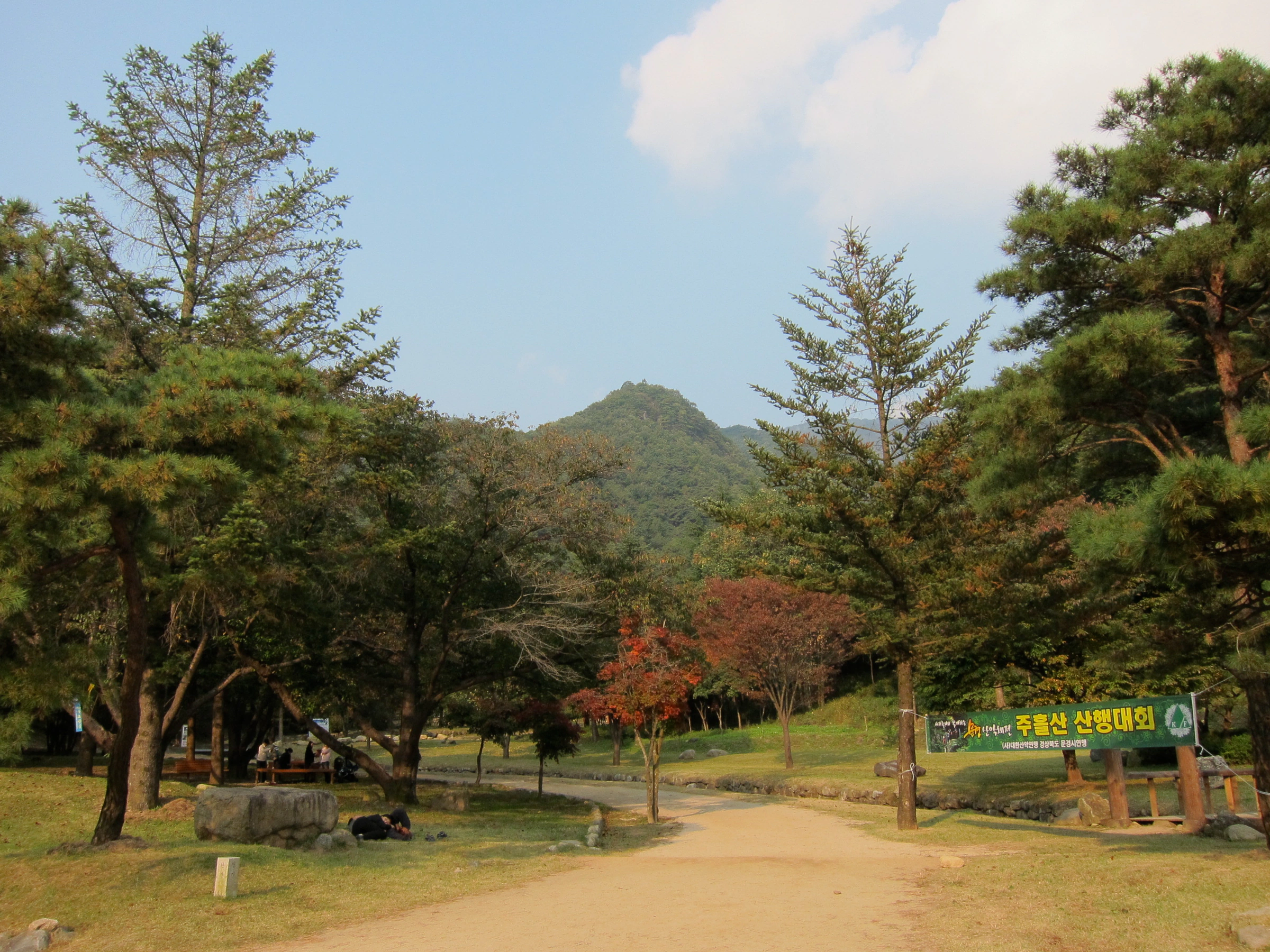
A broad dirt path curves between pine and autumn-colored trees toward a wooded ridge, with a few resting visitors and a Korean hiking-event banner at the right.

Woodland and mountain scenery at Mungyeongsaejae, photographed on October 17, 2010. The precise path and distant peak are not identified; the banner belongs to the historical scene. “Mountains” by Eugene Kim (eekim) / Flickr, CC BY 2.0. Unmodified original.

“Mountains” by Eugene Kim (eekim), CC BY 2.0. · Creative Commons 1 · Creative Commons 2

Stories and discoveries

The pass is a watershed

The third-gate area sits at the divide between the Nakdong River system to the south and the Namhan River system to the north. That physical divide helps explain why the road’s crossing mattered so much for travel and defense. If you plan to cross the pass, check where you will emerge and how to get back before leaving the familiar approach road.

A name with several stories

The city presents several explanations for Saejae, including a pass difficult even for birds to cross, a place of silver grass, a pass between other passes, or a newly made route. Treat these as interpretations handed down around the place rather than choosing one as a proven etymology.

When to visit

Spring and autumn

Use these seasons for a walking-first visit in comfortable weather. In dry periods, check current fire restrictions before leaving the main pass road. Ask the park office which specific routes are affected by the current season’s controls before setting out.

Summer

Set off early, carry water and expect humidity. After prolonged rain, choose a shorter out-and-back or a museum visit. Keep away from fast water and slippery stream edges; the presence of waterfalls or springs in a sightseeing list does not make them swimming places.

Winter

Work around short daylight and the earlier closing time of indoor attractions. Warm layers and footwear with good grip matter more than reaching the final gate. Turn around if ice makes the return uncertain; the old road will still be here on a milder day.

Getting there and practical advice

Opening and paid extras

The park lists no fixed entry-time restriction, but daylight walking is the sensible plan. The film set publishes 09:00–18:00 in March–October and 09:00–17:00 in November–February; it closes on January 1 and the actual days of Seollal and Chuseok, with additional closures possible. Standard individual admission is ₩2,000 for adults aged 19–64, ₩1,000 for ages 13–18, and ₩500 for ages 7–12. Check exemptions or discounts at the ticket desk.

Shuttle and parking

The electric shuttle is a separate service, with a published adult fare of ₩2,000 one way. Ask about the day’s route, last departure and boarding arrangements before relying on it. For parking, the dedicated park page says free while the general city tariff still lists charges. Confirm the applicable arrangement with the parking office on 054-571-4358; do not use an old tariff as a firm trip cost.

The maze is currently a closed component

The ecological maze is a designed area of themed mazes, ponds and planting within the visitor complex. Its official notice still says closed for landscape-lighting construction, without a reopening date. Although older accounts describe admission charges, the operator says general entry became free on January 1, 2024. Normal published hours do not override the closure notice.

Arriving by rail or intercity bus

Use the Mungyeong side for the walking plans here. The official access guide lists buses 10-3, 21 and 21-2 from KTX Mungyeong Station toward the park, with an approximate 15-minute ride. From Mungyeong’s intercity bus stop it lists 10-3 and 21; from Jeomchon Intercity Bus Terminal, the listed 21 departure stop is across from Homeplus. Mungyeong Station, Mungyeong’s bus stop and Jeomchon are distinct places. Check the current timetable and final return service rather than relying on the approximate ride times.

Driving and the last part of the journey

The park office address is 932 Saejae-ro, Mungyeong-eup, Mungyeong-si. Navigate to the main visitor parking on the Mungyeong side rather than a remote mountain trailhead. Allow time to walk from your actual parking space through the visitor approach. The city’s access page states that municipal buses became free in January 2025; reconfirm service arrangements before travel.

Plan a usable section

If gradient, balance or stamina is a concern, make the entrance and first gate your initial goal. Ask the office on 054-571-0709 about equipment loan conditions, accessible toilets, building thresholds and the surface after recent weather. Take a companion if assistance is needed. Ask specifically about slopes, steps and an uninterrupted usable route between your arrival point and your chosen destination.

Sources and useful links

Wildlife you might spot

2

Each card links to a full Explore page with photos, traits, and fun facts.

Snap map for this place

Start with the big picture, then zoom in to explore individual wildlife observations around this place.

Loading map…

Good to know before you go

Pick a turnaround time as well as a destination, especially when catching a return bus or train.

Carry drinking water and a snack; a named historical spring is not a guarantee of potable water today.

Do not climb gate walls or move stones at historic sites, even where older descriptions mention wish-making cairns.

Ask the parking office about current charges: official web pages disagree.

Keep the maze off your plan until its operator confirms reopening.

Frequently asked questions

The operator lists park entry as free. Film-set admission and the electric shuttle are separate purchases. The two museums in this guide list free general entry, while individual experiences may charge.
No. The first gate works well as a short destination, and the second-gate return is already a meaningful walk. Reaching the third gate is a longer commitment, especially if you must return to the same entrance.
The park’s visitor information says pets are not admitted. If you travel with an assistance animal, ask the operator about the applicable arrangements rather than assuming a general pet rule settles your case.
Its official page, checked October 18, 2026, says it is closed for landscape-lighting construction. That page also says maze admission became free in 2024. Confirm reopening on 054-550-8385 before adding it to a visit.
Only with a separately checked onward route and transport plan. Crossing beyond the third gate changes your arrival side and may enter another management area; it is not a loop back to the Mungyeong entrance.

Recent snaps at this place

Recent snaps will appear here as new observations are added.

View all ›

Take the discovery with you

Exploring Mungyeongsaejae Provincial Park?

Identify the wildlife you spot, learn as you go, and keep a collection of the adventure.

  1. 1Spot it
  2. 2Snap it
  3. 3Keep the discovery