Snappit logo
Snappit
Get App
Generic illustration, not a photograph of this venueIllustration
ParkKR

Sangumburi Crater

Sangumburi rewards a slower look.

About

Sangumburi rewards a slower look. From outside, the low rise gives little warning of the hollow beyond it; at the viewpoint, the land drops into a large bowl of trees and grass. Then turn outward for a very different view across the surrounding countryside. It works well as a short nature stop in an eastern-Jeju day, especially if you want volcanic scenery without setting aside hours for a mountain walk. The visitor grounds are privately managed beside a protected natural monument. Keep to the designated paths and viewpoints, leaving the crater’s interior undisturbed. Don't forget to bring the Snappit nature identification app along to scan local species.

The protected feature’s formal heritage name is 제주 산굼부리 분화구, or Sangumburi Crater, Jeju. It became a Natural Monument on 21 June 1979. The Jeju word gumburi refers to a volcanic crater. Its conservation value includes both the unusual landform and the plant communities sheltered within it; the heritage register lists Sangumburi Co., Ltd. and Jeju Special Self-Governing Province as managers.

What to do here

Head first for the crater viewpoint so you understand the landscape before lingering along the grassland paths. Read the interpretation, look across the bowl, then choose how much more walking you want. Stay within the open visitor grounds; a crater circumference quoted in a description is not a promise of a complete walkable rim circuit.

Seasonal info

The grassland changes through the year: green growth, autumn plumes, then a more subdued winter scene. Spring maintenance can remove old grass, so a photograph from another season is a poor guide to what you will see. July and August have the shorter published closing time, just like winter.

Accessibility

A wheelchair route to the upper grounds is described by the operator, which says a companion is needed on sloping sections. Korea Tourism Organization separately flags steps at the observation platform. Ask staff for the current step-free route and exactly which crater view it reaches before buying tickets.

Don't miss

1

A wooded crater seen from designated viewpoints

2

Silver-grass scenery beside the visitor paths

3

Open views over Jeju’s inland countryside

4

Interpretation of the crater’s contrasting vegetation

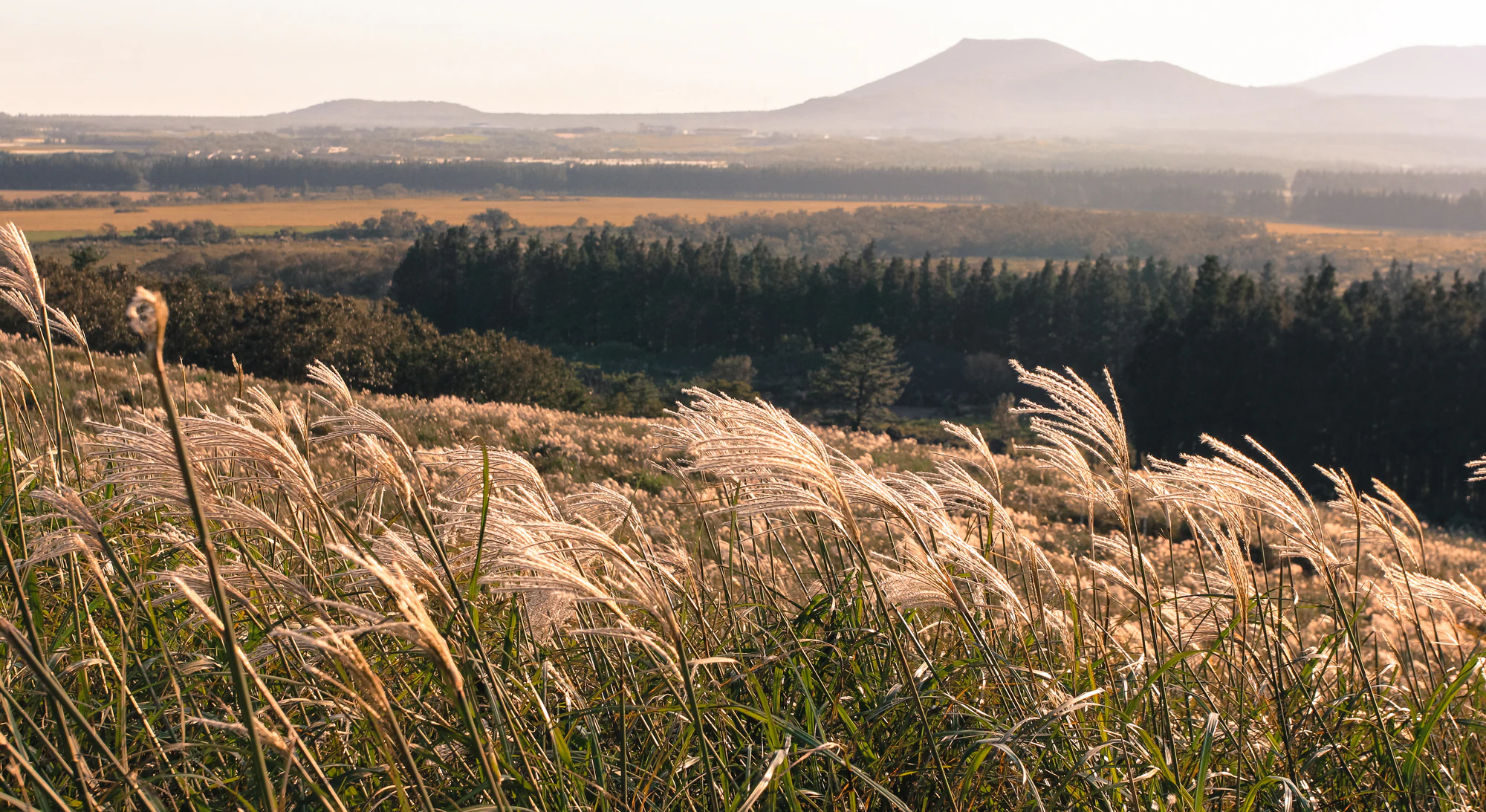
Sunlit silver-grass plumes fill the foreground, with fields, dark woodland and hazy hills beyond.

Silver grass near Sangumburi, photographed on 19 September 2012 according to the photographer. Fields, woodland and hazy hills lie beyond the grass; this is not a view into the crater bowl. Historical seasonal scene, not evidence of current bloom, weather or access. “Sangumburi Crater” by whyyan, Flickr source, CC BY 2.0. Original file used unchanged.

“Sangumburi Crater” by whyyan, CC BY 2.0. · Creative Commons 1 · Creative Commons 2

Walks and routes

Crater viewpoint and return

For the simplest visit, follow the entrance signs to the designated crater viewpoint, spend time with the interpretation and return by the open visitor paths. Use the staff-directed alternative if stairs are unsuitable. The highlight is the contrast between the shallow climb outside and the deep, wooded hollow inside. Allow roughly an hour including stops, choosing the signed return path that suits your group.


Crater viewpoint and return

Add the grassland paths

After the crater viewpoint, spend another 15–30 minutes on the open paths beside the silver-grass landscape before returning to the entrance. Let the current signs determine the path sequence: this suggestion does not trace the entire crater rim. If the grass is moving too strongly for comfortable walking or the weather is closing in, keep the return short.

Add the grassland paths

A relaxed one-hour visit

Start with the practicalities: check the return transport, use the toilet and ask which viewpoint path is suitable for your group. Walk up without rushing, give the crater your attention before taking grassland photographs, then return with time to spare. If interpretation is your main interest, ask about the session first and adjust the order around it. Families can keep the outing short by choosing a return time before everyone gets tired; the extra grassland wander is optional.

Things to try

Join an interpretation session

The operator’s 2026 programme lists starts at 09:30, 10:30, 11:00, 13:00, 14:00, 15:00 and 16:00, with any programme days off announced separately. Ask at the entrance about that day’s meeting point, language, duration and participation arrangements. Additional sessions may be possible if an interpreter is available; do not build a tight onward journey around an unconfirmed request. Check the 2026 programme.

Photograph the grass from the path

Try a low angle that puts the feathery grass heads against the sky, then a wider frame including the fields and wooded hills beyond. Moving grass suits short bursts of photographs; wait for a brief lull rather than walking off the path for a better angle. Keep bags and tripods out of the walking line. If the distant view disappears into haze, concentrate on the nearby textures instead.

When wind or rain changes the plan

Sangumburi is primarily an outdoor visit. If conditions worsen, shorten the path portion and follow staff directions; the rest pavilion should not be treated as a storm shelter. If the crater view is hidden or the upper grounds are unsafe, move this stop to a clearer period and use an indoor stop already on your itinerary. Check weather-related restrictions before setting out, and follow any closure at the entrance.

Wildlife and habitats

Miscanthus (silver-grass group)

Silver grass is the easiest plant feature to appreciate beside the paths, particularly when its plumes catch the light. The operator also records natural grass communities inside the crater. Enjoy the visitor grassland without assuming that every patch has the same planting or maintenance history. Miscanthus is a group of grasses; the distant landscape view is best enjoyed without trying to identify every individual plant.

Camellias

Camellias are recorded within the crater’s evergreen woodland. They help explain why the sheltered vegetation differs from the exposed grassland outside. Treat them as part of the habitat story rather than a guaranteed close-up flower stop: the records concern plants within a protected bowl, and you should not leave the visitor area to find them.

Stories and discoveries

A deep hollow above a low rise

The Academy of Korean Studies describes a crater about 635 metres wide and 132 metres deep. These are landform dimensions, not the distance you will walk or the height you must climb. You may encounter the word “maar” on older interpretation and tourism pages. A 2016 geological study instead identified a pit crater, and the academy’s updated account explains collapse after magma withdrawal. The useful picture is a broad depression formed as the ground subsided, rather than a simple explosion story. Read the geological study’s abstract.

Why the two sides look different

The crater’s vegetation changes with exposure, moisture and depth. Its northern inner slope faces toward the sun and supports warm-temperate evergreen woodland; the more shaded southern side has extensive deciduous woodland. The operator records camellias beneath the evergreen trees and silver-grass communities in more open areas. It also describes planted Japanese cedar around parts of the outer ridge, so not every tree stand is an untouched remnant. From the visitor viewpoints, enjoy the pattern of woodland and grassland as a whole; individual plants deep in the bowl may be too far away to identify.

When to visit

Autumn: plan around the grass

Make the grassland paths a priority when the plumes are showing well. Their appearance varies with growth and weather, so ask about conditions if this is the main reason for your trip. Leave enough daylight and admission time to see the crater too; a late photo stop should not push the return beyond closing.

Spring and summer: expect a different landscape

In spring, new growth and grass maintenance can change the view substantially. The operator scheduled maintenance to begin on 8 March in 2026; that is a dated example, not a recurring date to use in future years. In summer, favour a comfortable part of the day, carry water and sun protection, and remember that the published last-entry time is 17:00 in July and August.

Winter: give the weather priority

Choose the visit for the landform and quieter grassland colours rather than expecting autumn plumes in perfect condition. Bring warm layers, and ask about slippery sections after frost or snow. On a day with poor footing or strong gusts, postponing the short walk is more sensible than trying to squeeze it into the itinerary.

Getting there and practical advice

Admission and opening hours

Checked on 18 October 2026: individual admission is KRW 7,000 for adults and university students, KRW 6,000 for children aged four and above and teenagers, and KRW 5,000 for eligible seniors aged 65+, Jeju residents, veterans and visitors with disabilities. Bring the required identification for concession admission; it applies to the eligible visitor. Groups of at least 20 have separate rates. March–June and September–October: 09:00–18:40, last entry 18:00. July–August and November–February: 09:00–17:40, last entry 17:00. Weather can change closing times. Check the operator’s admission guide.

Toilets, rentals and a rest stop

Parking and toilets are listed by the official tourism services. The operator also describes free luggage lockers, loan wheelchairs and a shaded rest pavilion; ask about availability when you arrive rather than relying on an old inventory count. Have water with you before heading up. If you need a wheelchair, confirm availability, any identification requirement and whether a companion can assist on the slope.

Getting to the visitor entrance

Use 768 Bijarim-ro, Jocheon-eup, Jeju-si, Jeju Special Self-Governing Province for navigation. Save the Korean venue name, 산굼부리, to show a driver or search a bus planner. For public transport, use the official Jeju bus journey and stop search, checking both directions and the day’s timetable before you leave. Match the stop and road side to your actual destination; an attraction pin is not a safe crossing point. A taxi pickup is easier to coordinate if you agree on the entrance meeting place in advance.

Choose the upper-ground route carefully

The operator describes a 220-metre alternative viewing approach created for older visitors and people who cannot use the stairs. That figure refers to a facility segment, not the whole visit. Its November 2025 reply says wheelchair users can reach the top with a companion because some sections slope. Korea Tourism Organization warns that the observation platform itself has stairs. Ask which current route gives a useful crater view without steps, whether its surface suits your chair or walker, and how you will manage the descent. Do not assume every path or platform is accessible.

Check the facilities you need

Korea Tourism Organization lists accessible parking, an accessible toilet and wheelchair hire. Visit Jeju’s accessibility feature notes limited knee space below a washbasin and a small threshold at a shop. If these details affect your visit, call 064-783-9900 before travelling and describe what you need. A general accessibility label is less useful than confirming the particular route, toilet and assistance arrangements for your group.

Sources and useful links

Wildlife you might spot

2

Each card links to a full Explore page with photos, traits, and fun facts.

Snap map for this place

Start with the big picture, then zoom in to explore individual wildlife observations around this place.

Loading map…

Good to know before you go

Wear shoes with reliable grip and bring a wind-resistant layer. A short walk can still feel exposed at the top.

Leave room on the path for people passing, particularly wheelchair users and families. Take photographs from the path rather than stepping into the grass.

Pets are not admitted under the operator’s visitor rules. Check assistance-animal arrangements directly if relevant to your visit.

Drone and helicam filming are prohibited for ordinary visitors. The operator describes separate advance arrangements for certain institutional filming; a ticket is not filming permission.

Keep children beside you near viewing edges. Do not cross barriers, pick plants or try to reach vegetation inside the crater.

Check the return journey before entering, especially if you are using buses. Leave time to reach your stop or meet a prearranged taxi.

Frequently asked questions

Keep your visit to the designated viewpoints and managed paths above it. The protected interior is outside this visitor walk. Do not follow informal traces, cross barriers or treat a view of the crater floor as an invitation to descend.
“Crater botanical garden” is a description used for its rich vegetation. It does not establish legal botanical-garden status. Visit for a protected volcanic landscape and its plants, rather than expecting a labelled collection that you can walk through inside the bowl.
This is a compact sightseeing visit with a short ascent and paths through the visitor grounds. You can linger, but the main experience does not require an all-day hiking itinerary. Choose a separate walking destination if a long trail is your priority.
The photograph in this guide was taken in September 2012. Light, weather, grass growth and maintenance all change the scene. It illustrates an autumn grassland view near the crater, not today’s conditions or a view into the crater bowl.
Use the admission cut-off and closing time rather than sunset to plan the visit. The grounds close earlier in some months, and weather can change the schedule. Arrive with enough time to walk up, look around and return before closing.

Recent snaps at this place

Recent snaps will appear here as new observations are added.

View all ›

Take the discovery with you

Exploring Sangumburi Crater?

Identify the wildlife you spot, learn as you go, and keep a collection of the adventure.

  1. 1Spot it
  2. 2Snap it
  3. 3Keep the discovery