Snappit logo
Snappit
Get App
Generic illustration, not a photograph of this venueIllustration
ParkOkinawa, Japan

Yambaru National Park

Yambaru rewards slowing down.

About

Yambaru rewards slowing down. In the north of Okinawa Island, broad-leaved evergreen forest fills the hills, and a short walk can reveal very different shapes of green: spreading fern fronds, glossy leaves and a shaded forest floor. For a manageable first visit, start at Ufugi Nature Museum in Hiji, then travel separately to Kunigami Village Forest Park. Keep the walking part modest and leave time to stop and listen.

Ufugi reopened on 16 July 2026 as the Yambaru World Heritage Conservation Center. Older maps may still call it the Yambaru Wildlife Conservation Center; the familiar Ufugi name and Hiji address have stayed. Its renewed displays make a useful introduction to a landscape where many species have a very limited range. A four-screen forest film and woodland dioramas let you look closely before you head outside. The museum does not display live Okinawa rails or other living animals, and it has no outdoor visitor trail.

The forest park is a separate hilltop destination with maintained walking paths. Ask the office about the lake-and-forest circuit shown as approximately 1.1 kilometres on the village walking map. It gives a small group a sensible starting point among trees and beside the water, with the option to shorten the outing. The paths include changes of level, steps and surfaces that can become slippery. Choose your route with staff rather than assuming that a short distance means an easy, level walk.

Look at the forest as a whole before looking for its rare inhabitants. Itajii trees help form the evergreen canopy, while tree ferns bring a very different outline to the vegetation. Oaks and camellias add further variety. Try a quiet pause without conversation, then notice which sounds seem close and which come from farther into the trees. Wildlife sightings are a matter of chance; the museum is the dependable place to learn about the animals you may never see outdoors.

This is also a good place to understand why enjoying nature and protecting it need to happen together. Road traffic, invasive animals and illegal collecting all put pressure on Yambaru’s wildlife. An unhurried drive, keeping food to yourself and leaving plants and fallen branches in place are useful contributions. Keep rare-species locations out of public posts. The larger national park reaches beyond this outing into other forests, coasts and mangroves; save those journeys for another day rather than trying to cover the whole north in one rush. Eager to name that creature? Identify any animal you find during your visit using the Snappit app.

Yambaru National Park was designated on 15 September 2016. Parts of northern Okinawa Island joined Amami-Oshima, Tokunoshima and Iriomote Island in a single UNESCO World Natural Heritage property in 2021. Ufugi began as a wildlife conservation center in April 1999, gained its locally chosen nickname in 2010, and reopened as a World Heritage center in July 2026. “Ufugi” means a large tree in Okinawan speech. The national park, the World Heritage property and the surrounding visitor facilities have different boundaries.


What to do here

Begin with the museum’s forest film and exhibits, then ask about local conditions. If the weather is settled, drive or take a prearranged taxi to Kunigami Village Forest Park. Check the current walking map at the office and choose a short open circuit. Spend more time looking at leaves, ferns and the water’s edge than trying to tick off animal names.

Seasonal info

May–June is Okinawa’s rainy-season period. Summer brings humidity, strong sunshine and typhoon disruption, which can continue into autumn. Heavy rain can leave paths and approach roads unsafe even after skies brighten. Winter is often cloudier and windier than a beach-holiday image suggests. Check both venues’ closing days: Ufugi normally closes Mondays, while the forest park lists Tuesday.

Accessibility

Ufugi has designated wheelchair parking, a multipurpose toilet, baby-changing facilities and a nursing room. Ask about the current entrance and exhibition access if you need a step-free visit. The proposed lake-and-forest walk has steps and uneven or slippery sections, so it is not a wheelchair or stroller circuit. Ask forest-park staff whether a shorter paved section suits your group; do not rely on the appearance of an online map.

Don't miss

1

A renewed museum explaining Yambaru’s rare wildlife and conservation work

2

A short forest-and-lakeside outing that leaves time to look and listen

3

The contrasting shapes of evergreen trees and tree ferns

4

A practical introduction to enjoying a World Heritage region responsibly

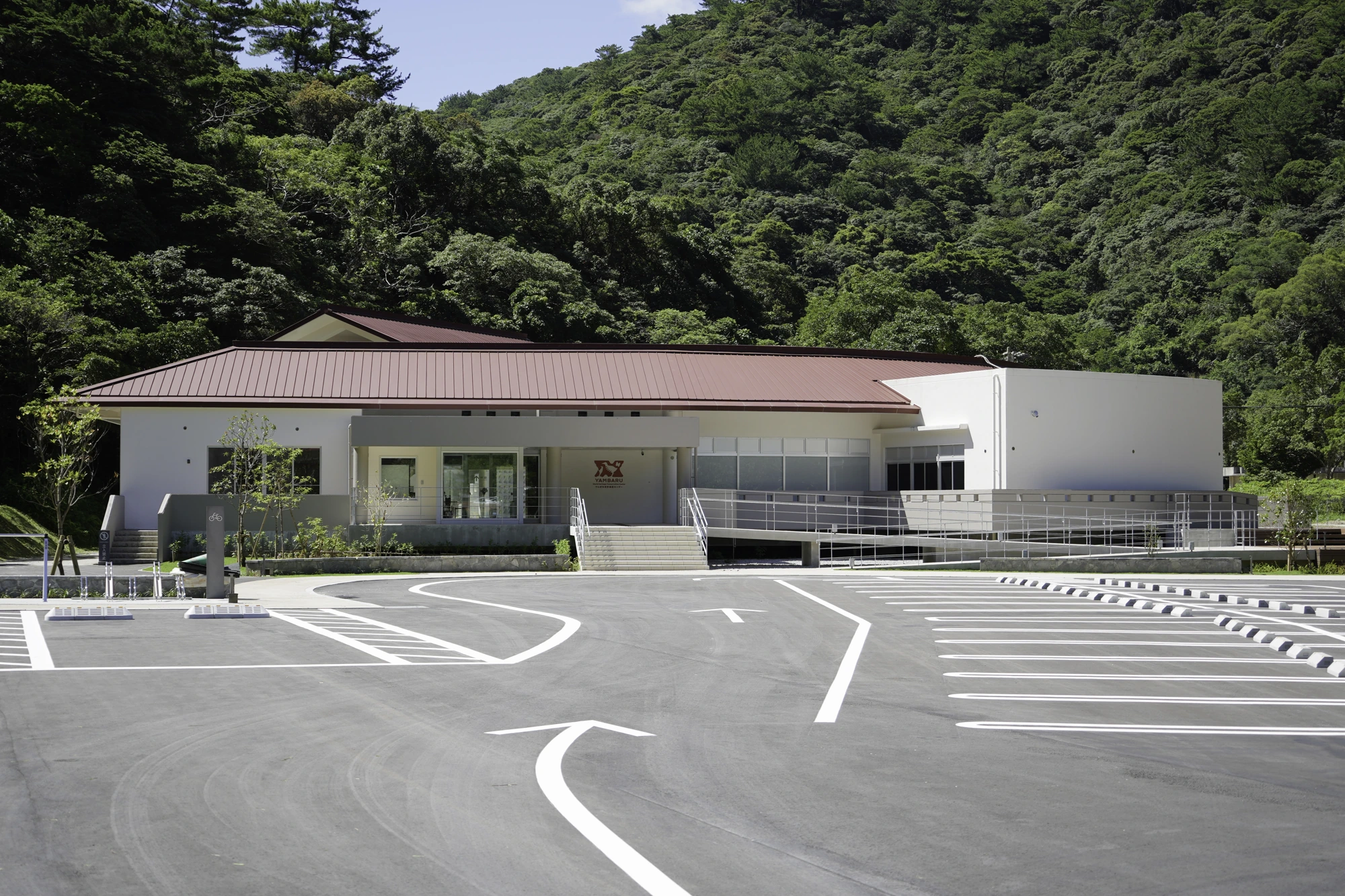
A white visitor-centre building with a red roof and entrance ramp stands in front of a densely wooded hillside, beyond an empty parking area.

Ufugi Nature Museum at the Yambaru World Heritage Conservation Center on 4 July 2026, before its public reopening later that month.

Ufugi Nature Museum, the Yambaru World Heritage Conservation Center 202607 01.jpg — Kugel~commonswiki, CC BY-SA 4.0 (https://creativecommons.org/licenses/by-sa/4.0/). Source: https://commons.wikimedia.org/wiki/File:Ufugi_Nature_Museum,_the_Yambaru_World_Heritage_Conservation_Center_202607_01.jpg. Proportionally resized from 7008 × 4672 to 2000 × 1333 pixels; recompressed as WebP quality 92, method 6. No crop, retouching, added text or colour adjustment. EXIF omitted from derivative. · Creative Commons

Walks and routes

Lake-and-forest walk

The village walking map shows an approximately 1.1-kilometre circuit taking in the lakeside and woodland. Allow 60–90 minutes including stops. Ask the office to point out the current route and any closed sections before setting off; follow the signs rather than making shortcuts through the trees.

Expect steps, slopes and places that become slippery when wet. This circuit is for walkers comfortable on uneven ground. A shorter out-and-back on a staff-recommended open path may be a better choice for young children or anyone who tires easily.

Lake-and-forest walk

A relaxed half day

Choose a day when both places are open. Spend 30–60 minutes at Ufugi, then leave a generous gap for the transfer, a drink and a chat with forest-park staff. Take a 60–90-minute walk on the route they recommend. If the path conditions or your group’s energy are poor, shorten the outdoor part and keep the museum as the main visit.

Things to try

Start with the forest film

Ufugi’s forest theater runs a ten-minute film across four screens. Follow it with the dioramas and choose one conservation question to explore: how roads affect animals, what invasive species change, or why collecting a beautiful insect can do harm.

Try a one-minute listening stop

Choose a safe place on an open path where your group is not blocking others. Be quiet for a minute, then compare the sounds each person noticed. Keep binoculars or a camera ready, but leave recorded calls off and let birds decide how close to come.

Make Ufugi the whole outing

On a wet day, spend more time with the film, dioramas and illustrated displays, then use the reading space for a slower look at the forest’s life. Severe weather can also close the museum or make the drive unsafe, so check its notice before travelling.

Wildlife and habitats

Look at the canopy before the wildlife

At the forest park, compare the tree ferns’ spreading fronds with the leaves of itajii and evergreen oaks. Make a photograph or sketch from the path. Leave leaves and acorns where they fall, and ask staff to help with an identification rather than pulling down a branch.

Meet the Okinawa rail through the displays

The Okinawa rail is part of the reason these forests matter so much. Start with its story at Ufugi, then take the road-safety advice outside with you. If an animal crosses your path, stop at a safe distance and let it continue; its location is not something to publish.

Winter flowers

In January or February, ask which camellias are flowering and whether the camellia paths are open. Their seasonal colour offers a reason to linger without going far into the forest.

Stories and discoveries

A name chosen locally

The name Ufugi was selected from suggestions from people in Yambaru’s three villages. Its meaning, a large tree, fits a museum devoted to the forest and the life it supports.

One World Heritage property, four areas

Northern Okinawa shares its World Heritage inscription with three other island areas. The shared story is exceptional biodiversity, while each place has its own wildlife and visitor rules.

When to visit

Spring

Use a settled March–April day for an unhurried woodland walk. Carry sun protection even when the air feels mild, and keep a rain layer handy.

Rainy season and summer

During May–June rain and summer humidity, shorten the walk, take regular water breaks and watch the forecast. Skip forest paths when heavy rain, thunderstorms or a typhoon threaten; a brief break in the clouds is not a reason to ignore warnings.

Autumn and winter

Autumn can still bring typhoons and hot days. In winter, bring a light warm layer for wind and showers, and ask about camellias in January–February. Check holiday closing dates before making the drive north.

Getting there and practical advice

Ufugi Nature Museum

Find the museum at 263-1 Hiji, Kunigami Village. It has wheelchair parking, a multipurpose toilet and facilities for feeding and changing babies. Bring drinks for the journey: the museum says there is no vending machine nearby, and eating and drinking are not allowed inside. Groups should apply at least a week ahead.

Kunigami Village Forest Park

The forest park is at 1094-1 Hentona, Kunigami Village. Published park hours are 09:00–18:00, with office hours 10:00–17:00 and Tuesday as the closing day. Day walkers should use the general visitor parking. Ask at the office about open paths, toilets and any charges for the particular facilities you plan to use.

Arriving by car

Ufugi gives around two hours from Naha city or 40 minutes from Nago as driving guides; traffic can add time. From Kyoda Interchange, its published approach is around 50 minutes north along Route 58. For the forest park, follow its current access directions uphill and allow time for uphill driving and parking. The park operator lists about nine minutes by car from Yuiyui Kunigami roadside station.

Arriving without a car

Route 67 connects Nago Bus Terminal with the Hentona area. For Ufugi, use Okuma Beach Entrance and walk about 15 minutes. For the forest park, one option listed by the operator is Okuma bus stop, followed by roughly 3 kilometres uphill with no regular bus on that final leg. Arrange a taxi and the return journey ahead of time; the park warns that local taxis are few. Check current bus departures rather than relying on an old timetable.

Plan the indoor and outdoor parts separately

If you need level access, make Ufugi the starting point and contact it about your needs. The forest park’s short distance does not remove its steps or slippery ground. Ask about parking-to-path access and a suitable toilet before committing to an outdoor route. Keep a museum-only visit as an easy fallback.

Sources and useful links

Wildlife you might spot

2

Each card links to a full Explore page with photos, traits, and fun facts.

We are still adding species preview cards for this place.

Snap map for this place

Start with the big picture, then zoom in to explore individual wildlife observations around this place.

Loading map…

Good to know before you go

Hiji Otaki’s waterfall trail and campground remain listed as completely closed after the November 2024 floods. Leave them out of this visit unless the local operator announces reopening.

Check the latest museum and forest-park notices, weather warnings and approach-road advice before leaving. Follow barriers even if a map shows a path.

Wear grippy closed shoes and light clothing that covers your arms and legs. Bring water, a hat, repellent and waterproofs; check for ticks after the walk.

Venomous habu snakes live in Okinawa. Watch where you place your hands and feet, stay on paths, and give any snake room to move away. Keep children close.

Drive slowly enough to respond to wildlife on the road, including in daylight. Avoid stopping in traffic to photograph an animal.

Do not collect insects, plants, fruit or fallen wood. Keep wildlife wild: no feeding, chasing, call playback or close approach for a photograph.

Arrange the forest-park transfer and return before travelling by bus. The last roughly 3 kilometres from its coastal bus stops are uphill, with no regular bus along that stretch.

Use the forest park’s general visitor parking and keep clear of accommodation areas. Day visitors cannot wander inside after 18:00; evening access requires the appropriate tour or overnight arrangement.

Frequently asked questions

Yes. The Hiji facility reopened as the Yambaru World Heritage Conservation Center on 16 July 2026, keeping the Ufugi Nature Museum nickname. Use the current operator information when planning; older listings may still show the former name and hours.
No. Ufugi uses exhibits, specimens, models and film. It does not offer live-animal viewing. You can still learn a great deal about the rail without searching for one in the forest.
Published hours are 10:00–17:00. It closes Mondays, national holidays except 4 and 5 May, 23 June, and 29 December–3 January. Admission is free, with a voluntary conservation contribution from ¥300 for visitors of junior-high-school age and older. Check the latest notice for temporary changes.
Not under the closure currently published by Kunigami’s tourism association. The waterfall trail and campground were damaged in the November 2024 floods; its notice, updated 28 August 2025 and still displayed in October 2026, says the site is completely closed and reopening may take years.
It needs a separate journey uphill. For a simple day, use a car or arrange a taxi in advance. The museum is about a 15-minute walk from Okuma Beach Entrance bus stop; the forest park’s own coastal bus-stop approaches are roughly 3 kilometres uphill.
Ordinary day-use hours are 09:00–18:00. From 18:00 to 09:00, entry inside is for overnight guests and guided-tour participants. Book an appropriate activity if you want a night visit; do not extend a daytime wander into the forest after closing.
Keep yourself out of traffic and avoid trying to catch the animal. For injured or dead rare wildlife, call the Yambaru ranger office on 0980-50-1025 and follow its instructions. Give the location privately to the rescuers. The museum’s visitor-enquiry number is different: 0980-43-4330.

Recent snaps at this place

Recent snaps will appear here as new observations are added.

View all ›

Take the discovery with you

Exploring Yambaru National Park?

Identify the wildlife you spot, learn as you go, and keep a collection of the adventure.

  1. 1Spot it
  2. 2Snap it
  3. 3Keep the discovery