Snappit logo
Snappit
Get App
Generic illustration, not a photograph of this venueIllustration
ParkÎle-de-France, FR

Georges-Valbon Departmental Park

Georges-Valbon rewards choosing one part of the park well.

About

Georges-Valbon rewards choosing one part of the park well. The Grand Lac gives a first visit a clear focus: water to watch, planted slopes around it and open places where children can pause between stretches of walking. The city remains close, sometimes visible beyond the trees, but this is also an important refuge for wildlife. Reedbeds, woodland and less intensively cut grass provide very different homes within the same landscape.

The departmental park spreads across La Courneuve, Dugny, Stains and Saint-Denis in Seine-Saint-Denis, and Garges-lès-Gonesse in Val-d’Oise. The familiar La Courneuve address is one way in, not the boundary of the place. Our main outing uses the Marville entrance on the Saint-Denis side. A second, separate visit to the Terrain des Essences explores how a former fuel depot has become habitat and public green space. Wondering what that bird or insect is? Find out on your visit using the Snappit nature app.

The first park sector opened in 1970, designed by landscape architect Albert Audias. Later designers shaped hills and valleys using material from major Paris-region building works. The result is a constructed landscape that has developed ecological value over decades. Renamed Georges-Valbon in 2010, it also holds memories of the former La Campa settlement and the communities who lived here. The Terrain des Essences, inaugurated in May 2025 after remediation, adds another chapter to that changing relationship between urban land and nature.

What to do here

Walk from Marville towards the Grand Lac, pause beside the water, then return with a play stop if everyone still has energy. Keep the visit outdoors during the visitor-centre works. On another day, try the Terrain des Essences for its meadow and wetland-restoration story.

Seasonal info

Water-play and misting equipment was switched off from early October 2026; reopening is planned from May 2027, subject to weather. Plan an autumn visit around walking and play equipment rather than fountains or boat hire.

Accessibility

The official map marks reduced-mobility routes in the Marville and Grand Lac sector. Use those marked paths as a planning aid, and confirm today’s surface conditions, gradients, gates and available accessible toilets before relying on a step-free visit.

Don't miss

1

The Grand Lac’s open water and wooded surroundings

2

A family-sized outing from the named Marville entrance

3

Sculptural gateways and the history of a deliberately shaped landscape

4

The Terrain des Essences restoration, best explored as a separate visit

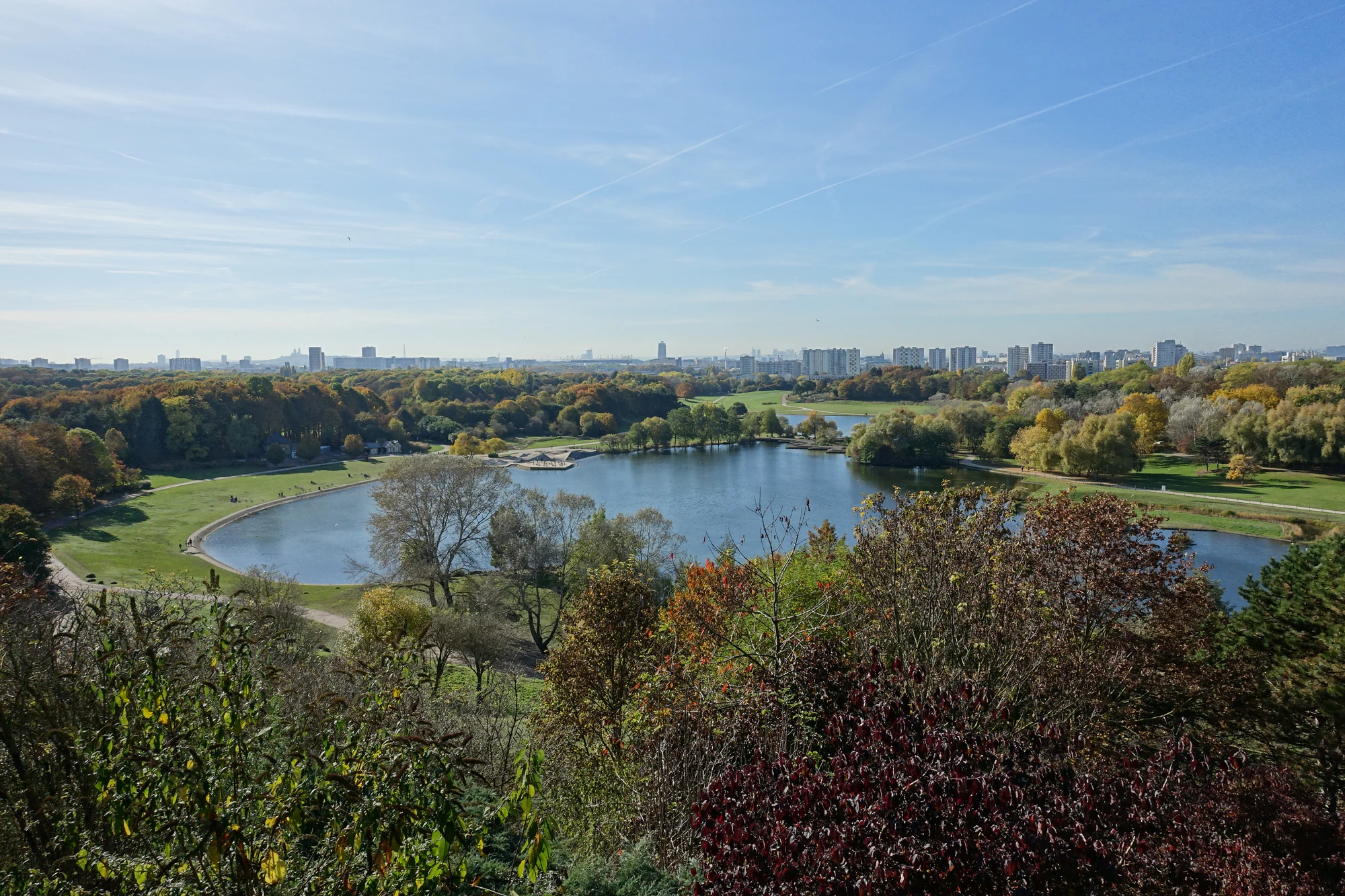
A broad lake and curving paths among autumn trees, with city buildings on the distant skyline.

An autumn view across Georges-Valbon Park, photographed on 31 October 2016, before later works and extensions.

“Viewpoint @ Parc Georges Valbon @ Saint-Denis” — Guilhem Vellut, CC BY 2.0. Source: https://www.flickr.com/photos/o_0/30084024644/. License: https://creativecommons.org/licenses/by/2.0/. Original unchanged. · Creative Commons

Walks and routes

Marville to the Grand Lac: a flexible first visit

Start at the signed Marville entrance on Avenue Roger-Salengro. Locate the Grand Lac and Maison du parc on the entrance plan, then use the main paths towards the Vallée des Fleurs and the lake’s southern side. The Maison du parc is a useful landmark even when closed. Choose a comfortable public waterside stopping place, enjoy the view and retrace your route. This is a suggested out-and-back outing using mapped park paths, rather than a named waymarked circuit; no complete lap of the lake is necessary.

The map shows reduced-mobility path connections through this sector, but it does not provide a current measured gradient or surface audit. Stay on the indicated main paths; skip hillside viewpoints or steps if they do not suit your group.


Marville to the Grand Lac: a flexible first visit

A relaxed half-day

Begin with the lake while attention is fresh, then stop for a picnic away from the water’s edge. On the return towards Marville, choose one of the nearby play areas rather than promising every playground. For a child who tires early, the play sector and a short garden walk can be the whole outing. Keep the return to the same entrance simple.

Another day: the Terrain des Essences

Use the signed Tapis Vert entrance as a familiar starting point and consult the current plan for the Circulaire, Boulodrome and Terrain des Essences. Allow 1–1½ hours for a modest visit, longer if you add play. Explore the public meadow paths and only the permitted access towards the ecological reserve and observation point. Its raised walkway is an opportunity to look into wetland habitat while staying out of it. The northern reserve has restricted access; an open park does not mean every habitat is open to walkers. Return by the same established paths.

Things to try

Make the lake stop count

Choose one patch of water and spend a few minutes watching movement: a bird landing, ripples spreading, or a change in reflection when clouds pass. Children can sketch the outline of the shore and add what actually appears. A single patient stop often works better than a long list of species to find.

Look at the entrance as an artwork

Marville’s sculpted gateway is part of Pierre Zvenigorodsky’s contribution to the park. Ask what its shapes suggest before reading about it. His work helped turn entrances, bridges and other everyday structures into landmarks, so the park’s design can become a discovery game as well as a backdrop.

Let the season choose the activity

For a guided nature session, check the park’s activity programme and its registration and age conditions. Confirm the meeting point: Maison Édouard-Glissant and the lakeside Maison du parc are different buildings.

A shower is different from a storm

For light rain, shorten the walk and use suitable main paths. The Maison du parc cannot provide shelter during its October closure; Maison Édouard-Glissant normally opens for scheduled events. In thunderstorms, strong wind or ice, postpone the visit rather than sheltering beneath trees.

Wildlife and habitats

Grey heron

Grey herons are a rewarding possibility around the Grand Lac, where the park supports a nesting colony. Look for a large grey bird waiting near water or flying with its neck drawn in. Watch from the ordinary public shore and leave nesting trees undisturbed.

Common kingfisher

A kingfisher may appear as a brief blue-green streak close to the water, or sit on a waterside perch. Its small size and fast flight make it easy to miss. Enjoy a chance encounter without following it along the bank or searching for its nesting burrow.

Common tern

In spring and summer, watch for a slender bird working over open water and plunging for fish. Common terns have long pointed wings and a forked tail; adults in breeding plumage show a dark cap. They are seasonal visitors, so an October outing should not depend on seeing one.

Natterjack toad

The natterjack toad is part of the Terrain des Essences conservation story, rather than a promised daytime sighting. This species uses shallow temporary water and open ground. Look at the habitat from authorised paths; do not turn stones, handle amphibians or enter pools to search for it.

More than the visible lake

The étang des Brouillards and Vallon écologique support reedbed habitat, including little bitterns. Woodland and grassland add other kinds of shelter and feeding space. These quieter areas explain why a busy urban park matters for conservation. You can appreciate that wider picture on a short lakeside visit without entering sensitive habitats or seeking out nests.

Stories and discoveries

Hills made from a changing city

The park’s hills were deliberately shaped. Excavated material from regional construction projects helped create the northern relief. When looking across the lake, notice how slopes hide and reveal the surrounding city.

From fuel storage to habitat

The Terrain des Essences once stored hydrocarbons. Remediation and landscaping made possible its May 2025 inauguration, combining recreation with a more protected ecological area. The change is a useful reminder that urban nature can be created through sustained repair and management.

When to visit

Spring

Watch breeding activity from a distance. Leave nests alone and move back if your presence changes a bird’s behaviour.

Summer

Pick a cooler part of the day and carry water; open lakeside paths can feel exposed. Check water-play operation, organised events and hire services separately. The lake itself remains outside the swimming options.

Autumn and winter

Autumn suits colour and reflections; winter favours a compact daylight outing. Play areas can close during prolonged freezing conditions. From November, the published ecoguard patrol window is 09:00–17:30, even though pedestrian gates normally remain open.

Getting there and practical advice

Reception and activities

The Maison du parc Victoria-Montou is beside the Grand Lac; its reception number is 01 43 11 13 07. Maison Édouard-Glissant is a different building on the Circulaire, opposite the Boulodrome, used for scheduled events and groups. Check the meeting point on your booking.

Picnic, toilets and drinking water

The park provides benches, picnic tables, shelters, drinking fountains and toilets at various locations. Locate the nearest facilities on arrival rather than assuming they are beside every entrance. Bring your own water in case a fountain is shut off, and ask which toilets are currently usable if accessibility is important.

Food, hire and play

Refreshment kiosks are seasonal, with the published main season from April to September. Carry food for an October outing. Bicycle and family-cycle hire, boating and water-play availability need a separate check. Near Marville, the Crique de l’Araignée and Crique des Toupies are listed for ages 3–12, and the Crique des Tours for ages 5–14; use the on-site age and safety signs.

Arriving for the Marville outing

The municipality and park manager list buses 150, 250 and 252 to Cité Floréal for the Marville entrance. Set your journey destination to that stop and entrance, rather than the park’s generic La Courneuve address. Check the current timetable and disruption information for your travel date.

A different entrance for the eastern side

For Tapis Vert, the manager lists bus 249 to Centre des Essences. RER B at La Courneuve–Aubervilliers and T11 at Dugny–La Courneuve are wider connections, but reaching the appropriate entrance still matters. Do not use the Aire des vents as an assumed shortcut during its construction closure.

Parking and the return journey

Use a designated car park serving your chosen entrance and read its closing notice. From 1 October to 2 November 2026, Georges-Valbon’s published parking hours are 07:30–19:30. Pedestrian opening does not keep a car park open. Bicycle parking is provided near refreshment points; bring a lock.

Plan around the actual connection

The manager-linked plan marks reduced-mobility paths and accessible toilets. Its Marville–Grand Lac markings are useful for choosing a starting sector, but the map predates recent works. Before travelling, ask reception about the precise entrance-to-lake connection, any steep sections or diversions, and the toilet you intend to use. A pushchair-friendly choice for one family may not meet another visitor’s mobility needs.

Keep a shorter option available

A return along the same path lets you turn back before a difficult section. Allow extra time with a wheelchair, pushchair or limited stamina, and take care on wet leaves and lakeside surfaces after rain.

Opening and weather

Pedestrian access has normally been continuous since 1 January 2026, but weather or works can close all or part of the park. Regulations provide for closure when observed gusts reach 70 km/h; violent storms and icy conditions also require caution and compliance with notices. For a family nature outing, use daylight and check the operator’s alerts before departure.

Construction areas to leave out

The Cascades are undergoing renovation: the July 2026 notice described temporary upper-level access before a second autumn phase. Do not assume that earlier reopening still applies. The Aire des vents has been closed for works since 15 September 2026, with only a designated through-route maintained when permitted; further total closures are possible. Follow current barriers and diversions.

Care for the shared landscape

Keep out of fenced habitat and work zones. Feeding wildlife, collecting plants or animals, fishing, fires and barbecues are prohibited. Cyclists should stay on permitted paths, reduce speed and give walkers room. Keep clear of frozen water as well as open water. For assistance within the park, the current departmental ecoguard contact is 01 43 93 13 00.

Visitor information

Before an October 2026 visit

The Maison du parc Victoria-Montou beside the Grand Lac is scheduled to close for works from 20 to 30 October 2026. Check the park’s latest notice before planning to go inside, including after the stated end date. The outdoor lake visit can be planned independently of the building.

Sources and useful links

Wildlife you might spot

4

Each card links to a full Explore page with photos, traits, and fun facts.

Snap map for this place

Start with the big picture, then zoom in to explore individual wildlife observations around this place.

Loading map…

Good to know before you go

Save the park plan before leaving and photograph your entrance name; neighbouring exits can put you a long way from your bus or car.

Pack drinking water and a picnic, especially outside the main refreshment season.

Use binoculars from public paths; never feed birds or enter reedbeds for a closer look.

Choose the return point while everyone still has energy. Completing a lake circuit is optional.

Keep children close at water edges, and choose playground equipment by the age guidance displayed.

Bring a light layer for the exposed lakeside, even when the surrounding streets feel warm.

Frequently asked questions

Yes. Georges-Valbon is its current name. The older name remains common, although the park extends across five communes and two departments.
A self-guided walk is free. Organised activities can require registration, while refreshments and equipment hire have separate terms. Check the event listing if you want to join a particular session.
No. Bathing in the park’s lakes and ponds is prohibited, including for dogs. Seasonal water-play installations and authorised organised activities are separate facilities.
Keep dogs on a lead except in explicitly designated dog areas, and out of playgrounds. Follow additional posted restrictions and give wildlife space.
For a first family visit, concentrate on one entrance and one main destination. The scale is part of the attraction, but adding distant sectors can turn a pleasant outing into a long return walk.

Recent snaps at this place

Recent snaps will appear here as new observations are added.

View all ›

Take the discovery with you

Exploring Georges-Valbon Departmental Park?

Identify the wildlife you spot, learn as you go, and keep a collection of the adventure.

  1. 1Spot it
  2. 2Snap it
  3. 3Keep the discovery