Snappit logo
Snappit
Get App
Generic illustration, not a photograph of this venueIllustration
ParkPays de la Loire / Centre-Val de Loire, FR

Loire-Anjou-Touraine Regional Nature Park

The confluence gives this enormous park a manageable starting point.

About

The confluence gives this enormous park a manageable starting point. Montsoreau and neighbouring Candes-Saint-Martin sit where river scenery, working history and village life meet. From a permitted riverside viewpoint, look across the channels and wooded banks; from the heights at Candes, the two rivers become part of a much wider landscape. A first visit works best when you choose one of these perspectives rather than trying to tour the whole territory.

Loire-Anjou-Touraine is a regional nature park spanning Maine-et-Loire and Indre-et-Loire, across Pays de la Loire and Centre-Val de Loire. It includes inhabited villages, vineyards, farms, woods and wetland landscapes. The villages are part of the experience: there are houses, roads and everyday businesses among the heritage sights. Public paths let you explore, but the designation does not open private gardens, vineyards or underground galleries to visitors.

Water has shaped both the wildlife and the livelihoods here. Floods and falling water deposit sediment and remake the river margins; fertile valley soils support cultivation and riverside meadows. The pale tuffeau stone links the hillsides to the houses. Stone quarried from galleries was brought down to the quays and carried away by boat, while former excavations found new uses. That relationship between landscape and people is the most rewarding thread to follow through your day. Unlock an interactive field guide for this spot: get the Snappit app to identify nature on the go.

Established in 1996, the park brings together a landscape whose history reaches far beyond its modern designation. For centuries, river transport connected local stone, wine and other produce with distant markets. Flat-bottomed boats and adjustable steering gear helped boatmen work with changing depths; currents carried them downstream and favourable westerly winds helped them return. The growth of rail and road transport transformed that trade. Today, the old quays make more sense when you imagine them as working loading places, with the hillside quarries behind them.

What to do here

Start around Place du Mail in Montsoreau for the old-quay setting, then use the official Au temps des mariniers de Loire guide if your group wants a longer outing. It connects the two villages with river-level and hillside sections. Add the Maison du Parc only after checking its seasonal opening; the outdoor visit can stand on its own.

Seasonal info

The Maison du Parc was closed for winter on 18 October 2026; its next public reopening date was not yet confirmed. River conditions and local closures can change independently of the visitor centre. Bare gravel or sand is a wildlife habitat, not an invitation to walk into the river.

Accessibility

The Maison du Parc offers the clearest supported accessible visit when open. The full heritage loop has steps and climbs and is not a step-free route. With a wheelchair or pushchair, plan a tailored shorter visit and ask locally about the exact outdoor surfaces before setting off.

Don't miss

1

The Loire–Vienne confluence and its changing channels

2

Montsoreau’s old quays and river-trade history

3

Candes-Saint-Martin’s hillside setting and panorama

4

Free interpretation at the Maison du Parc during its opening season

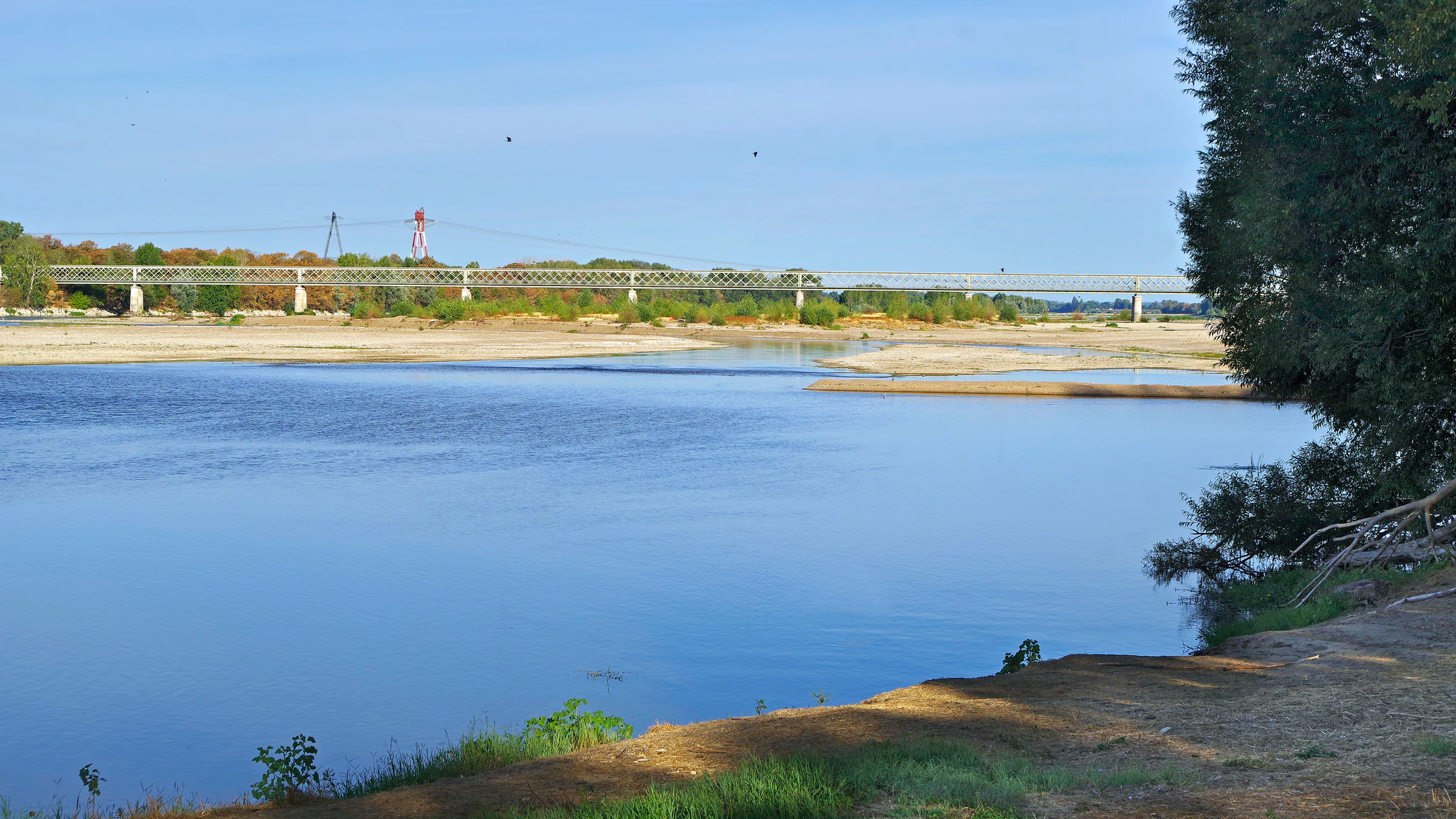
Blue river and exposed pale gravel bars beneath a long metal bridge, framed by a leafy tree.

The Loire and the Varennes–Montsoreau bridge, photographed in August 2026. Exposed gravel bars reflect the conditions on that date.

“Montsoreau (Maine-et-Loire)” — Daniel Jolivet, CC BY 4.0. Source: https://www.flickr.com/photos/sybarite48/55491933185/. License: https://creativecommons.org/licenses/by/4.0/. Original unchanged. · Creative Commons

Walks and routes

Au temps des mariniers de Loire

Start and finish at Place du Mail in Montsoreau. The dedicated park walking portal lists 4.4 km, 103 m of ascent and 2 hours. Follow its route and ground markers through the old-quay area, the lanes of Candes-Saint-Martin and the return over the hillside. The optional direction towards the panorama is described at the top of rue Saint-Maurice. An older park page lists 3.6 km for the same named walk; plan using the linked portal version rather than assuming the shorter figure.

Rated easy by the operator, but the instructions explicitly include stairs and uphill streets. This is a walking circuit rather than a wheelchair or pushchair itinerary. Take your time on descents and leave room for residents and other path users.


Au temps des mariniers de Loire

A short first visit with children

Keep the plan centred on Montsoreau. If it is open, spend around an hour in the Maison du Parc, then choose a short look at the village and old-quay setting around Place du Mail. Pick an accessible public position well back from the water and return the same way when attention or energy fades. You do not need to reach Candes or complete a circuit to make the outing worthwhile.

A half-day with a view

Download the heritage route, check local access notices and start with enough daylight for a relaxed return. Walk the official circuit at your own pace, using its story stops to break up the climbs. Pause near the collégiale in Candes, and take the panorama option only where the current signed access permits. Finish back in Montsoreau rather than adding another distant park site.

Things to try

Read the river from the village

Give yourself a stationary ten-minute look before walking on. Try a broad view first: open water, pale exposed ground and darker vegetation make different parts of the riverscape. Then follow one bird through the binoculars. Sketching these shapes can be more satisfying than trying to name everything, and children can compare their drawings without leaving the public viewpoint.

Follow stone from hillside to house

Look at a modest doorway as well as the grander buildings. Tuffeau’s pale colour and workable texture made it useful for both ordinary walls and carved details. On the village lanes, compare a plain opening with a decorated window or cornice. Keep this an outdoor observation game; an inviting-looking gallery or cave is not necessarily open to the public.

Add cycling as a separate outing

La Loire à Vélo passes through the area and is a useful way to extend a stay. Choose a distance that suits the least experienced rider and consult the current official cycling route before leaving. Do not transfer the walking loop’s stair sections onto a bike itinerary. Riverside cycle sections may flood, so a dry forecast alone does not confirm that the path is usable.

Keep an indoor plan realistic

During its open season, the Maison du Parc is the natural sheltered option. Outside that season, download its family activity sheets for later, or arrange a separately confirmed indoor attraction before leaving home. If the weather makes the hillside or river margin uncomfortable, a shorter village look and an early finish are better than forcing the full loop.

Wildlife and habitats

Eurasian beaver · Castor fiber

The park records beaver signs throughout its stretch of the Loire and on major tributaries. Pencil-shaped gnawed stumps and stripped bark can be clues, but an animal sighting is much less predictable. Stay on the path and leave gnawed wood where it lies; a photograph of a sign is enough. The quiet behaviour that makes beavers interesting also makes them easy to disturb.

Common tern · Sterna hirundo

In spring and summer, scan the river for slender birds fishing on the wing. The park identifies common terns as sand- and gravel-bank breeders; adults have a red bill with a dark tip, unlike the yellow-billed little tern. Use these details only when the view is good enough. A distant unidentified tern is still a worthwhile sight, and never a reason to approach a colony.

Stories and discoveries

A boat designed for a changing river

Traditional Loire craft have flat bottoms suited to shallow water. Their characteristic steering device, the piautre, can be adjusted to the available depth. A moored boat makes a useful prompt to imagine the practical problems of moving a heavy cargo along a river whose level changes.

The river also helped make the village

The tuffeau story connects extraction, transport and housing. Galleries cut into the hillside supplied building stone; blocks travelled down to the quays, then onward by water. Reused excavations contributed to the region’s troglodyte buildings. The hillside and waterfront belong to the same story.

When to visit

Spring and early summer

Terns return to the Loire to breed. Watch flights over the river from the bank, and respect signed nesting refuges. The prefecture highlights special restrictions from 1 April to 15 August within the protected perimeter. Leave exposed islands and sandbars undisturbed even when eggs and chicks are impossible to see.

High summer

Make the climb before the hottest part of the day, carry drinking water and take breaks in the village. The water may look especially inviting when gravel bars are exposed, but low water is no assurance of a safe crossing or bathing place. Choose land-based river watching for this visit.

Autumn and winter

The architecture and broad river landscape remain the main attractions. Expect a shorter usable day and be willing to cut the walk back to a village visit if surfaces are wet or conditions deteriorate. Check flood information and local barriers before approaching lower quays; winter closure of the Maison removes an easy indoor fallback.

Getting there and practical advice

Maison du Parc

The visitor address is 15 avenue de la Loire, Montsoreau. When open, entry is free; the site has exhibitions, information, a shop, picnic space and bicycle stands. For opening or a reserved group visit, contact 02 41 38 38 88. Bring your own essentials if visiting outside the public season rather than relying on closed-site services.

By bus from Saumur

Ogalo line 01 links Saumur, Montsoreau and Fontevraud. Use the Montsoreau Centre stop and the current school-day or Saturday/school-holiday column. The published winter timetable runs from 1 September 2026 to 2 July 2027; it has no Sunday or public-holiday service. Some departures marked TAD require advance registration and booking. Check both directions before travelling, and arrange any rail-to-bus connection separately.

By car or bicycle

Navigate to Montsoreau rather than a general pin for the whole regional park. Place du Mail is the heritage-walk reference point; the Maison du Parc has its own visitor address. Use signed parking and avoid blocking narrow lanes. Cyclists can use the centre’s bike stands when available, then explore the stair-containing heritage route on foot.

Inside the visitor centre

The operator lists mobility access, seating through the visit, a hearing loop, a magnifier and a designated parking place 5 m from the entrance. Ask about the facilities you specifically need and confirm opening before travelling. These details describe the Maison du Parc, not the surrounding heritage circuit.

Choosing an outdoor alternative

For a shorter outing, assess the ground and crossings immediately around your chosen starting point before committing to a longer section. The published loop gives no complete step-free substitute. If stairs or slopes are a barrier, request a suitable local option rather than relying on the route’s easy grade or following an improvised detour.

Sources and useful links

Wildlife you might spot

2

Each card links to a full Explore page with photos, traits, and fun facts.

Snap map for this place

Start with the big picture, then zoom in to explore individual wildlife observations around this place.

Loading map…

Good to know before you go

Download the route and booklet before arrival, especially when the Maison du Parc is closed.

Wear shoes with grip

village stairs and sloping lanes deserve more care after rain.

Carry water and a sunhat; a short distance can still include a warm climb.

Use binoculars from established public ground and let nesting birds keep their distance.

Keep children close beside water and roads, and keep dogs on a lead around wildlife.

Plan your return transport first; a weekend outing needs the correct dated bus timetable.

Frequently asked questions

No. It is a large lived-in territory across two regions. This guide concentrates on Montsoreau and Candes-Saint-Martin so you can enjoy a coherent first visit without spending the day driving between distant sites.
Public opening is seasonal, and the official page currently announces winter closure. Group visits can be arranged by reservation. Check the next season’s dates before making an indoor visit central to your plans.
Do not plan a swim here. The Maine-et-Loire prefecture prohibits swimming in the Loire except at specifically authorized sites or events. Currents, changing depths and unstable riverbed conditions make an apparently calm stretch a poor guide to safety.
Their presence is documented in the park, but they are discreet and mainly active around the beginning and end of the night. A daytime visit is better spent learning about their habitat and recognizing signs, without entering dense bankside vegetation or searching for occupied resting places.

Recent snaps at this place

Recent snaps will appear here as new observations are added.

View all ›

Take the discovery with you

Exploring Loire-Anjou-Touraine Regional Nature Park?

Identify the wildlife you spot, learn as you go, and keep a collection of the adventure.

  1. 1Spot it
  2. 2Snap it
  3. 3Keep the discovery