
Snappit logo
Snappit
Get App
Generic illustration, not a photograph of this venueIllustration
ParkKR

Mulhyanggi Arboretum

Come with two or three gardens in mind rather than a determination to see everything.

About

Come with two or three gardens in mind rather than a determination to see everything. The campus is large enough for a leisurely half day, yet close to Osan College Station on Subway Line 1. A good first visit pairs the Aquatic Plant Garden with the Wetland Ecology Garden, then adds an indoor stop or a shaded tree collection according to the weather. Use the entrance map to choose the connecting paths and leave time to return comfortably. Wondering what that bird or insect is? Find out on your visit using the Snappit nature app.

Mulhyanggi opened on 4 May 2006 after development from 2000 to 2005. It occupies a former forestry experimental site, so mature trees are part of its inheritance rather than a recently created backdrop. Its name recalls Su-cheong-dong, the local place name associated with clear water. Today the operator describes a 35.7-hectare public arboretum with 25 themed gardens.

What to do here

Explore the water-focused gardens, choose a woodland or seasonal-flower detour, and spend some time in the Forest Exhibition Hall. Families can add a booked nature activity instead of trying to cover every themed garden.

Seasonal info

The gardens offer different reasons to return: fresh growth in spring, water plants and flowering shrubs in summer, maple colour in autumn, and evergreen structure and indoor collections in winter. Flowering and foliage dates vary with the weather.

Accessibility

The operator describes generally gentle slopes, shade and seating, but this does not establish a continuous step-free route through every garden. Check specific paths, boardwalk transitions and building access with the visitor centre if they are important to your visit.

Don't miss

1

The Aquatic Plant Garden and its changing pond displays

2

The wooden path through the Wetland Ecology Garden

3

The Forest Exhibition Hall’s woodland and wetland interpretation

4

Seasonal collections, including maples and mugunghwa

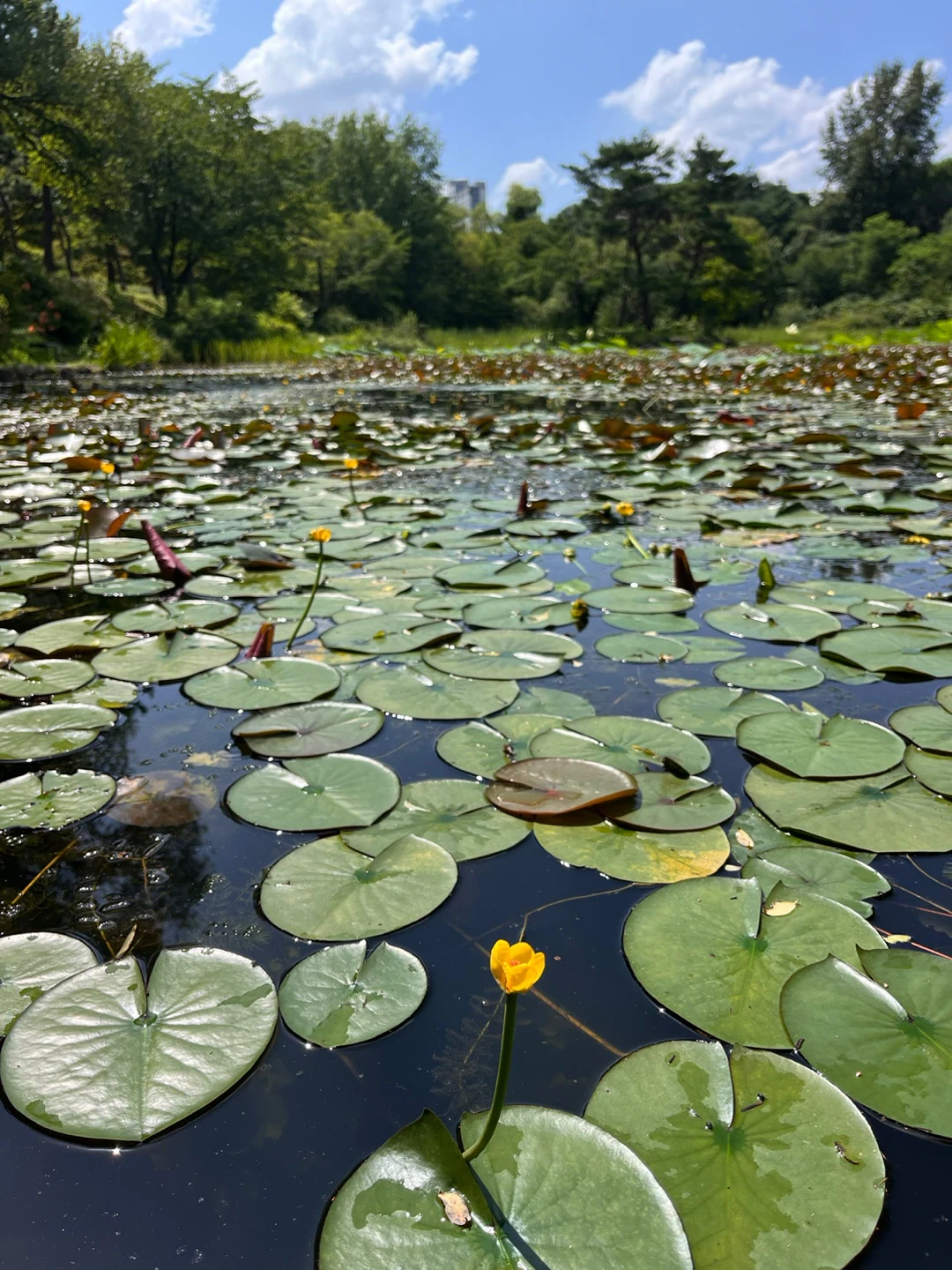
Round floating leaves and yellow flowers cover a pond, with a tree-lined bank and blue sky beyond.

The Aquatic Plant Garden in an official photograph published on 29 July 2026. The capture date is unknown; flowering and planting will vary with the season.

Photo: [“수생식물원 전경”](https://gnews.gg.go.kr/briefing/brief_gongbo_view.do?BS_CODE=s017&number=71073), published 2026, Gyeonggi Province / Forest Environment Research Institute. [KOGL Type 1](https://www.kogl.or.kr/info/licenseType1.do). Original publisher file unchanged. · www.kogl.or.kr

Walks and routes

Start with the water gardens

At the visitor entrance, open the official garden map and locate the Aquatic Plant Garden and Wetland Ecology Garden. Make these your two main stops, following the signed public paths between them and back to the entrance. The first introduces plants growing in and around water; the second brings you onto a wooden path through wetland planting. Choose the connecting paths to suit your group rather than treating this pairing as a fixed circuit.

Take the boardwalk slowly when wet. If a transition, gradient or narrow section is unsuitable, enjoy the permitted viewpoint you can reach and return; completing a loop is optional.

Start with the water gardens

Add the hall and a tree collection

For a broader visit, combine the water gardens with the Forest Exhibition Hall, then choose either the Maple Garden or Korean Pine Garden. This gives the day a change of scale, from leaves at water level to taller trees, without making every themed area a compulsory stop. Use the entrance map to choose convenient open connections and plan the return before adding the extra collection.

Build in a seated rest before the final outdoor section. If walking is becoming tiring, drop the extra tree collection rather than using up all your energy before the return.

Add the hall and a tree collection

A relaxed morning by train

Arrive at Osan College Station with water and a snack already packed. Walk to the official entrance, check notices and choose the two water gardens. Pause for a rest, then decide whether to add the exhibition hall. Have lunch after leaving, or use a designated eating area with your packed food. Keeping the afternoon free makes this an easy outing to shorten if the weather changes.

A family visit with a booked session

Let the confirmed activity time anchor the day. Arrive early enough to find its meeting point, use the toilets and settle in, rather than beginning a long walk first. Afterwards, let the children choose one garden from the map. A workshop plus one enjoyable outdoor stop can make a fuller experience than a hurried tour of the whole campus.

Things to try

Try the maze with children

The tree maze offers a simple change of pace from reading plant labels. Agree where to meet before anyone goes in, and keep younger children with an adult. Treat reaching the middle and finding the way out as a shared puzzle, then return to a calmer garden. Leave running games and sports equipment for another outing.

Book a nature activity

The programme page includes eco-orienteering for primary-school-age visitors and older, family natural-material crafts and small woodcraft projects. Eco-orienteering uses an activity sheet for self-directed observation around the exhibition hall. Check the programme descriptions for the right age group, then the booking calendar for your date. Confirm the session’s language and any charge before booking.

Make the exhibition hall part of the visit

The Forest Exhibition Hall explores the relationship between people and forests, wetland life and the benefits of woodland. Its themed displays make a useful companion to the outdoor gardens: visit first for context, or afterwards to connect what you have seen. Allow around 30–45 minutes at your own pace. Ask staff which displays and rooms are open that day.

Use indoor stops thoughtfully

The water-drop-shaped greenhouse contains subtropical plants, including mango and banana, while the Forest Exhibition Hall offers a different kind of indoor visit. Both still involve an outdoor approach. For light rain, choose one indoor stop and a short garden section; for severe weather, postpone. Check opening that day rather than assuming the indoor facilities remain available whenever the grounds are open.

Wildlife and habitats

Maples

The Maple Garden brings together cultivated maples with varied leaf shapes and colours. Compare labelled trees rather than assuming every maple belongs to one species. Autumn is an obvious time to linger, but the collection also rewards a closer look while leaves are green. Leave fallen material where it is and use photographs to remember the differences.

Rose of Sharon

Mugunghwa, the Rose of Sharon (Hibiscus syriacus), has its own garden. A July 2026 provincial report described roughly 50 varieties there, with different flower colours and forms. Individual flowers are short-lived while new ones open through the season, so the display changes. Use the plant labels to compare cultivars; a summer photograph is not a promise of blooms on your date.

Long-tailed Tit

The operator includes Long-tailed Tit (Aegithalos caudatus) in its list of wild birds recorded at the arboretum. Bring binoculars if you enjoy birdwatching, pause quietly on the woodland paths and allow birds to approach or move away naturally. Do not use calls, bait or a close approach to get a photograph. The published list identifies possibilities, not a guaranteed sighting or a particular viewing spot.

Stories and discoveries

A garden that keeps its winter forms

The Nature Garden, created in 2023, follows plants through their whole annual cycle. Emerging shoots, flowers, seed heads and brown winter stems all belong to the design. It is a useful place to visit outside peak flowering season: the point is to see how plants change, rather than to expect a bed that looks permanently in bloom.

When to visit

Spring: leave room for a detour

Fresh growth is a good reason to take your time between collections. Choose the water gardens and one other area rather than relying on an exact blossom date. If the Wildflower Garden is your priority, confirm its current access first. A light layer is useful for a cool start.

Summer: flowers with a heat plan

Hydrangeas, mugunghwa and aquatic flowers give summer a distinct character. The province documented a strong display in late July 2026; future timing depends on weather and plant care. Visit in the cooler part of the normal opening day, carry water and alternate exposed pond stops with shade. Leave before heat becomes exhausting.

Autumn: let the trees set the pace

The Maple Garden makes a natural focus for autumn colour, while the woodland provides a quieter counterpoint to the ponds. There is no fixed peak-colour date to plan around. Look at recent official updates, wear shoes with grip for damp leaves and remember the earlier closing time from November.

Winter: a shorter outdoor visit

Enjoy the shape of bare branches and the evergreen collections, then consider the greenhouse or exhibition hall if open. In freezing conditions, wet paths and boards need extra care. A short visit can be more rewarding than pressing on to every garden; check weather-related notices before leaving home.

Getting there and practical advice

Hours and closing days

Normal opening is 09:00–18:00 from March through October, with last entry at 17:00; November through February is 09:00–17:00, with last entry at 16:00. Mondays, 1 January and Seollal are closed. When Monday overlaps a holiday period, closure moves to the next weekday. Confirm Chuseok dates directly: official pages currently differ on that holiday. Hours checked on 18 October 2026.

Early-morning walking

A separate 2026 notice offers early access from 06:00 to 08:30, from 1 March to 30 November, subject to operational changes. Before making a dawn journey, check the early-opening notice and confirm the date, entrance and areas available. Do not assume the exhibition hall or greenhouse opens with this walking period.

Food, drinks and rubbish

There is no shop, restaurant or vending machine inside. Pack drinking water and a simple lunch if needed; eating is restricted to designated places. Bring a reusable cup and a rubbish bag. A bench is a welcome rest stop, but it is not automatically a permitted picnic spot.

Parking

For a standard small or medium vehicle, the current tariff is KRW 2,000 for up to three hours, KRW 3,000 for three to six hours, and KRW 6,000 for six to nine hours. Other vehicle classes and exemptions differ. Check the current parking table and signs before paying.

Visitor help and family facilities

The visitor centre number is 031-378-1261. Ask where the nearest toilets and designated eating areas are before setting off. If travelling with an infant, confirm the nursing room is available: an April 2026 improvement notice scheduled a temporary restriction, but a completion notice has not been verified. Bring the essentials rather than depending on an unconfirmed facility.

By Subway Line 1

Use Osan College Station (Osandae), not Osan Station. The operator directs visitors from Exit 2 across National Route 1, quoting about five minutes on foot. Allow longer for crossings and the walk around to the public entrance. Follow the signed entrance rather than assuming the fence nearest the station has a gate. Check station lift access separately if you need it.

By car or local bus

The arboretum address is 211 Cheonghak-ro, Osan-si, Gyeonggi-do. Navigate to its public entrance and parking, rather than an internal building. Bus services also connect the area, but check a live route planner for the stop and return service on your day. The operator particularly recommends public transport during the busy April–May and September–October periods.

Plan for the exact route you need

Gentle overall terrain is useful, but individual garden paths and boardwalk entrances can still matter for wheelchairs, pushchairs or tired legs. Call ahead about the entrance-to-hall route, accessible toilets, path surfaces and any temporary diversions. Start with the shortest suitable section and add more only when the return remains comfortable. A short, comfortable return is more useful than a route that looks complete on a map.

Ask about the mobility-support cart

The operator offers a guided cart programme prioritising people with limited mobility, including eligible disabled visitors, people aged 75 and over, and pregnant visitors. The published season runs from 22 April through November, Tuesday–Friday, excluding public holidays. Advance online booking is for eligible visitors, with evidence required; spare same-day seats may be available to others. Check cart reservations and ask about boarding, transfers and companions. It can be cancelled in bad weather.

Visitor information

Before visiting, check the latest arboretum notices. The Wildflower Garden and Climate-vulnerable Plant Conservation Garden had works scheduled for 28 April–29 May 2026, with dates subject to change. Their completion has not been confirmed here; ask which areas are available when you arrive.

Sources and useful links

Wildlife you might spot

3

Each card links to a full Explore page with photos, traits, and fun facts.

We are still adding species preview cards for this place.

Snap map for this place

Start with the big picture, then zoom in to explore individual wildlife observations around this place.

Loading map…

Good to know before you go

Bring a refillable water bottle and anything you need to eat before entering.

Keep children beside you around ponds and on wooden paths; this is a plant collection rather than a water-play park.

Take photographs from the paths and give other visitors room to pass.

Choose one extra garden only after checking everyone’s energy and the time left before closing.

Frequently asked questions

Yes. General admission became free on 1 July 2025 and the current visitor page still confirms it. Parking is charged separately. Older guides quoting an adult entrance ticket are out of date.
A simple packed lunch is allowed only in designated eating areas. Cooking, tents, shade shelters, pets, bicycles and scooters are prohibited. There are no rubbish bins, so bring a bag and take everything home.
Last admission is one hour before closing. That leaves little time for a broad visit, especially in winter. Choose a short outing and ask staff which nearby areas you can enjoy before everyone must leave.
Check the relevant programme calendar before travelling. Guided walks, family workshops and the mobility-support cart have their own eligibility and reservation arrangements. A general garden visit does not guarantee a place on any of them.

Recent snaps at this place

Recent snaps will appear here as new observations are added.

View all ›

Take the discovery with you

Exploring Mulhyanggi Arboretum?

Identify the wildlife you spot, learn as you go, and keep a collection of the adventure.

  1. 1Spot it
  2. 2Snap it
  3. 3Keep the discovery
