
Snappit logo
Snappit
Get App
Generic illustration, not a photograph of this venueIllustration
ParkKR

Namhansanseong Provincial Park

For a first visit, start inside the fortress at Sanseong Rotary rather than committing to a long climb from the city below.

About

For a first visit, start inside the fortress at Sanseong Rotary rather than committing to a long climb from the city below. The northwestern side gives you a good introduction to the place: woodland on the way to North Gate, the wall near West Gate and Sueojangdae beyond. Choose your turnaround as you go. A short visit can end at North Gate; a longer one can follow the official Course 1 circuit. This is a mountain landscape with heritage buildings, so comfortable shoes and a flexible plan matter more than ticking off every gate. Eager to name that creature? Identify any animal you find during your visit using the Snappit app.

Namhansanseong was developed as a refuge where the Joseon court could function during an emergency. Much of the main fortress took shape in 1626, incorporating an older defensive site. King Injo sheltered here during the invasion of 1636 and resisted for 47 days. The palace, shrines, military buildings and village help explain why this was more than a wall around a hill. Namhansanseong entered the UNESCO World Heritage List in 2014.

What to do here

Walk a suitable part of Course 1, pause at Sueojangdae if your legs and the conditions allow, and compare the fortress’s defensive setting with the royal spaces of Haenggung Palace. Keep a little unplanned time for the forest and the village.

Seasonal info

Spring brings changing woodland colour; summer shade helps but does not remove heat, humidity or storm risk. Autumn is a good time for the mix of evergreen pines and broadleaved trees. In winter, shorten the walk if ice or snow makes the slopes uncertain.

Accessibility

Do not treat the fortress circuit as a step-free stroll. There are slopes, uneven surfaces and changes of level around the heritage structures; the operator warns that some trail sections are steep. If you need a continuous accessible route, confirm the exact approach, toilets and return journey with the centre before travelling.

Don't miss

1

North Gate and the wooded northwestern approach

2

West Gate and the fortress landscape

3

Sueojangdae, the surviving military command pavilion

4

Haenggung Palace as a separate heritage visit

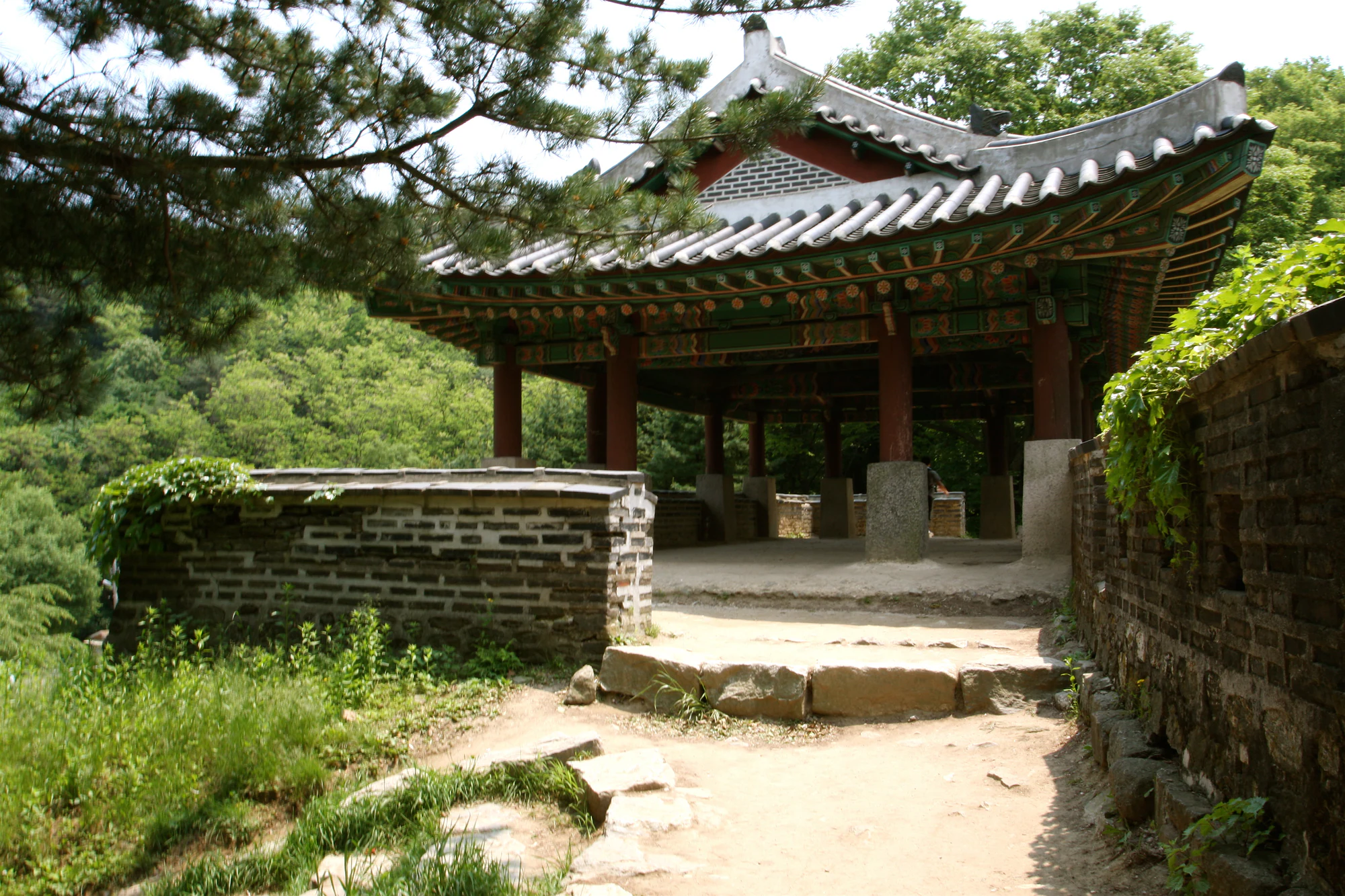
A tiled roof with painted wooden eaves stands above stone walls and an uneven foreground, framed by green trees.

A roofed fortress structure among woodland at Namhansanseong, photographed on 28 May 2009. The exact gate or pavilion is unconfirmed; this historical view does not establish current conditions.

Photo: [“Atop Namhansanseong Fortress Walls - Seoul”](https://www.flickr.com/photos/travelingotter/3679500335/) by [TravelingOtter](https://www.flickr.com/photos/travelingotter/), Flickr. [CC BY-SA 2.0](https://creativecommons.org/licenses/by-sa/2.0/deed.en). Original file unchanged. · Creative Commons 1 · Creative Commons 2

Walks and routes

Course 1: the northwestern fortress circuit

The official sequence is Sanseong Rotary → North Gate → West Gate → Sueojangdae → Cheonjusateo, the former temple site → South Gate → Sanseong Rotary. The operator publishes approximately 3.8 km and 1 hour 20 minutes. Use the official course page and map for junctions. Keep your pace relaxed and follow the signed circuit rather than improvising a shortcut down an unfamiliar slope.

This is a hill walk with uneven footing and changes of level, not a verified wheelchair or pushchair circuit. Allow additional time for rests and for anyone who needs to descend slowly.


Course 1: the northwestern fortress circuit

A shorter start: rotary to North Gate and back

For a small taste of the park, walk from Sanseong Rotary to North Gate and return along the same signed approach. The operator lists this outward segment as 0.4 km, making the out-and-back about 0.8 km by simple addition. Allow 30–60 minutes for a gentle-paced visit with pauses; the uphill approach can take longer than its short distance suggests.

Shorter does not mean level or step-free. Assess the first climb together and turn back before the return becomes tiring.

A shorter start: rotary to North Gate and back

An easy-to-adjust half day

Arrive at the fortress village, check notices and get your bearings at the rotary. Begin toward North Gate and decide there whether to turn back or continue with Course 1. Keep lunch until after the walk. If you still have time and energy, add the palace within its admission hours. With children, let the shortest enjoyable version count as a successful day.

History first, walking second

If buildings are your main interest, arrive for the palace’s opening period and explore before lunch. Afterwards, take only the woodland approach that suits the remaining daylight and your energy. This order also avoids arriving at the palace ticket desk just after the last admission, but check its closing day before setting out.

Things to try

Read the landscape from Sueojangdae

Sueojangdae was a military observation and command post. It is the only survivor of the fortress’s five command platforms, and its two-storey form dates to an enlargement in 1751. From the permitted visitor area, look at how the building’s position relates to the wall and surrounding hills. Seeing that relationship is more rewarding than rushing through for a single photograph.

Give the palace its own visit

Haenggung was designed to accommodate a court away from its usual capital. The restored compound offers a different scale of experience from the wall: gates, courtyards and royal living and administrative spaces. Allow about 45–60 minutes as a personal planning allowance. Check entry time before starting a long walk if the palace is important to your day.

Finish with the village

The village is part of the experience, with restaurants and cafés rather than a single isolated visitor attraction. Baeksuk, a gently boiled chicken dish, is a well-known local meal. Choose a place and check its menu, portion size and waiting time before settling in; a leisurely lunch works best after you have finished the uphill part of the day.

Use the History and Culture Museum as a separate stop

The Namhansanseong History and Culture Museum at 812 Namhansanseong-ro is an indoor alternative, with its own journey and schedule. It lists free admission, 10:00–18:00 opening and last entry at 17:30. It closes on Mondays except public holidays, on 1 January, and on Seollal and Chuseok day. Confirm before travelling, and allow roughly an hour if you want a calm introduction to the history. Do not assume the palace’s outdoor courtyards provide an equivalent rainy-day refuge.

Wildlife and habitats

Pines in a protected landscape

Korean red pine, Pinus densiflora, is documented in the forest survey. Its local story is tied to the community’s care for the woods. Enjoy the trees from the path, where their branching crowns give the fortress landscape much of its character.

Oaks in the broadleaved woodland

Several oak species were documented here in 2019–2020. They complement the pine woods, especially when leaves change or fall. Species vary across the woodland, so no particular oak is guaranteed beside your chosen path.

Pitch pine: a planted woodland tree

Pitch pine was recorded as planted in the 2019–2020 survey. It adds another layer to the woodland’s history: alongside its native trees, the landscape contains trees introduced through planting. The survey does not identify a particular visitor-side viewing point.

Pine and oak woods give the fortress walks much of their character. Plants described here were documented in 2019–2020; what you see will vary with the path and season. Stay on the trails, photograph without trampling the understory and leave plants undisturbed.

Stories and discoveries

The forest also has a human history

Local residents formed a forest-protection association during the Japanese colonial period to care for the pine woods amid heavy cutting. The park’s cultural landscape therefore includes both its buildings and the trees people worked to preserve. Provincial-park designation followed in 1971.

A wall built over time

The wall was developed and repaired across different periods, with changes in military technology influencing its construction. Look for variations in masonry from the path, without assuming every visible section is from the same date. Restoration is part of this place’s continuing history.

When to visit

Spring and autumn

Aim for comfortable walking conditions rather than a promised flowering or foliage date. Woodland colour varies with weather and position on the hill. A weekday or earlier arrival gives your plan more breathing room; keep the palace schedule and your return journey in view.

Summer

Carry water, wear sun protection and make the walk shorter if the heat is draining. Check heavy-rain and thunderstorm warnings before heading for the wall. If a storm is developing, choose an indoor visit or postpone; a tall tree or exposed pavilion is not a reason to remain on the hill.

Winter

Expect a different balance between daylight, cold and footing. Ice can make a modest descent difficult, especially where sunlight has not reached the path. Choose another day if you cannot confidently manage the conditions, and remember that the palace’s winter closing time is earlier.

Getting there and practical advice

Palace tickets and hours

As checked on 18 October 2026, standard palace admission is KRW 2,000 for adults aged 19–64 and KRW 1,000 for ages 7–18. Exemptions include Gyeonggi residents and certain other visitors; bring the required evidence. Hours are 10:00–18:00 from April to October and 10:00–17:00 from November to March. Ticket sales end 30 minutes earlier. The palace closes on Mondays except public holidays.

Questions, toilets and rest stops

For park and trail advice, contact the Namhansanseong World Heritage Center on 031-8008-5155. Locate a toilet and organise water before you set off, rather than assuming every gate has facilities. For step-free needs, ask specifically about the route from your arrival point, accessible toilets, gradients and any temporary construction; the published general guidance is not an accessibility audit.

Parking is separate from admission

The operator lists post-paid parking: a regular passenger car of 1,000 cc or more is KRW 3,000 on weekdays and KRW 5,000 on public holidays. Other vehicle classes and concessions differ. Recheck the current table and signs, especially for a weekend or holiday visit, and leave room in your plan for the approach road and finding a space.

By train and bus

A useful approach from Seoul is Subway Line 8 to Sanseong Station, then a bus signed for the Namhansanseong terminus inside the fortress. The operator lists buses 9 and 52 from Sanseong Station; it also lists 15-1 from Gyeonggi Gwangju Station. Check live directions, boarding stops and the final return service on the day. The metro station itself is not the hilltop village, so allow for the bus connection rather than treating the station name as the walking start.

By car

Use a verified public parking destination inside the fortress area and the operator’s parking guidance. The centre’s address is 731 Namhansanseong-ro, Namhansanseong-myeon, Gwangju-si, Gyeonggi-do; it identifies the centre, not every car park or trail entrance. Do not leave a vehicle on a verge or in front of a gate just because the map shows a nearby pin.

Choose effort by terrain, not distance alone

Even a compact fortress walk can involve repeated climbing. Keep hands free on awkward sections, use footwear with dependable grip and let the slowest walker set the pace. For a wheelchair user or someone unable to manage steps, seek a confirmed building-focused visit rather than assuming a paved photograph means a continuous accessible route. Exact gradients, step counts and accessible transfer arrangements have not been verified.

Make the return part of the plan

A slope that feels manageable uphill may be harder on the descent. If anyone is tiring, retrace a familiar permitted section while there is still ample daylight. Do not rely on a taxi being available beside a remote wall section, or on being able to exit through any opening in the fortifications.

Visitor information

Before you choose a wall section

Checked 18 October 2026: the operator’s repair schedule lists South Gate–East Gate parapet work through 2 November 2026, with dates subject to change. Check the repair notice and on-site signs before extending in that direction. A scheduled end date is not confirmation that a section has reopened.

Sources and useful links

Wildlife you might spot

3

Each card links to a full Explore page with photos, traits, and fun facts.

Snap map for this place

Start with the big picture, then zoom in to explore individual wildlife observations around this place.

Loading map…

Good to know before you go

Keep North Gate as an early decision point: turning back is a useful plan, especially with young children or uncertain footing.

Carry water and a snack before leaving the village. Do not count on finding refreshments at every wall-side stop.

Use the signed paths and stay off the masonry. A photograph is not worth climbing onto a parapet.

Bring a light extra layer for exposed stops, and leave enough daylight for the descent and your bus connection.

Leave flowers, fungi, cones and other natural material where you find them; the operator specifically warns against collecting or eating wild plants.

Frequently asked questions

No. The provincial park extends across Gwangju, Seongnam and Hanam in Gyeonggi-do. The World Heritage property and its buffer zone have separate boundaries. This guide covers the park, with a practical focus on the fortress village and northwestern walking routes.
Yes. Choose the rotary–North Gate out-and-back in this guide, or make the palace your main visit. You do not have to complete a gate-to-gate loop to enjoy Namhansanseong.
There is no general Namhansanseong admission charge. Haenggung Palace and parking have their own charges and conditions; see the practical details for each.
The operator prohibits dogs and cats on the park trails. Its published exceptions cover the park village district and qualifying assistance dogs. Check the [current park rules](https://www.gg.go.kr/namhansansung-2/contents/contents.do?ciIdx=1278&menuId=3492) for your specific visit.
Ask the centre about the available languages and arrange a tour before travelling. Confirm the meeting point, length, booking requirements and any separate palace ticket; do not build your day around an unconfirmed departure.

Recent snaps at this place

Recent snaps will appear here as new observations are added.

View all ›

Take the discovery with you

Exploring Namhansanseong Provincial Park?

Identify the wildlife you spot, learn as you go, and keep a collection of the adventure.

  1. 1Spot it
  2. 2Snap it
  3. 3Keep the discovery




