
Snappit logo
Snappit
Get App
Generic illustration, not a photograph of this venueIllustration
ParkKR

National Sejong Arboretum

The most satisfying first visit balances the Four Seasons Conservatory with a few contrasting gardens.

About

The most satisfying first visit balances the Four Seasons Conservatory with a few contrasting gardens. The glasshouse introduces plants from warmer climates; outside, the Korean Traditional Garden, Bonsai Garden and smaller themed collections give the day a different scale. This is a managed national arboretum with labelled, cultivated plants, educational work and changing exhibitions. Choose the collections that interest you rather than trying to cover the entire 65-hectare campus. The neighbouring Central Park and Lake Park are separate destinations. Take the ultimate field guide with you: use the Snappit app to identify birds, plants, and animals on your trip.

Planning and construction created a purpose-built urban arboretum rather than converting an old forest into a visitor park. The institution was established in July 2020 and formally opened in October that year. Its work combines plant conservation, research, public displays and garden education. The young campus makes an interesting companion to older Korean gardens: here, traditional forms are deliberately presented within a modern botanical institution.

What to do here

Begin with the conservatory, then use the operator’s short recommended course as a framework for the Korean Traditional Garden and bonsai displays. Families can finish at the Children’s Garden and Life Garden. If plant collections are your priority, leave extra time for the Iris Garden or Wall Garden instead of rushing through every stop.

Seasonal info

A hot day is easier with a shorter outdoor circuit and regular breaks. In winter, centre the visit on the conservatory and add outdoor gardens according to the weather. Night openings are date-specific: an evening event does not mean every garden or facility stays open late.

Accessibility

The site has substantial level paths, ramps, accessible toilets and a conservatory lift described by Korea Tourism Organization. The operator lists wheelchair and stroller loans, but availability and the temporary construction-era collection point need checking. Call 044-251-0001 about the step-free arrival route and any specific access requirements before setting out.

Don't miss

1

The iris-inspired form and contrasting displays of the Four Seasons Conservatory

2

Korean Traditional Garden and Bonsai Garden

3

Iris and clematis collections for a more focused botanical visit

4

Sensory Garden, Children’s Garden and everyday gardening ideas

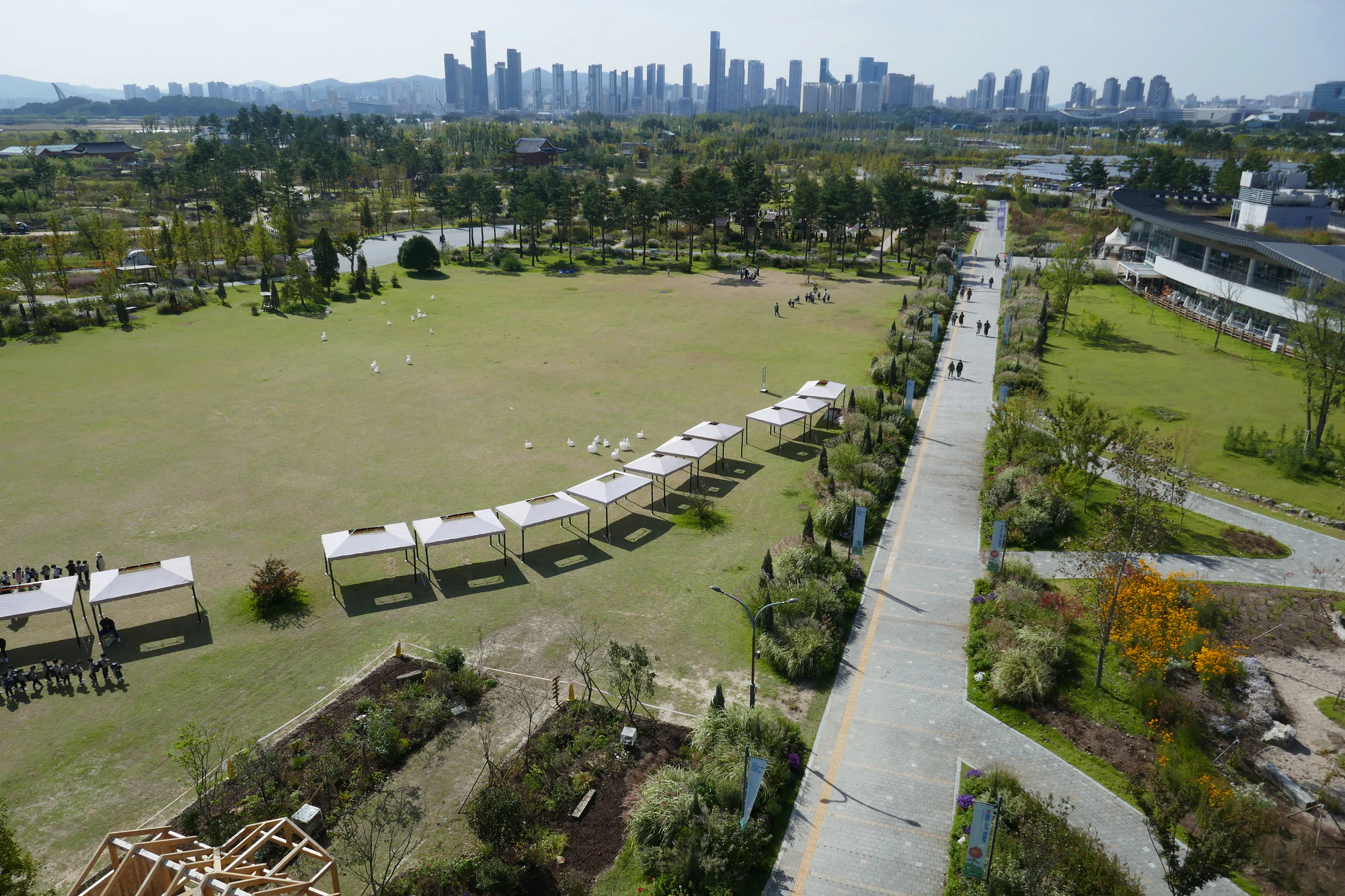
A broad lawn with shade tents and small visitors, planted paths, a curved building at the right and a city skyline beyond the gardens.

National Sejong Arboretum’s garden landscape in October 2023, photographed by Phil Venditti. This historical view shows the relationship between the open lawn, planted paths and surrounding city.

“2023--6 October--Geumgang Forest Preserve, Yeongpyeongsa Temple, and Sejong Administrative City, Korea” by Phil Venditti (LittleRoamingChief), Flickr, CC BY 2.0. Supplied description: “The National Arboretum”. Unchanged original; no crop, resizing or re-encoding. · Creative Commons 1 · Creative Commons 2

Walks and routes

Use the official short course as your starting point

Course 1 runs from the Visitor Centre to the Four Seasons Conservatory, Korean Traditional Garden, Bonsai Garden, Children’s Garden and Life Garden. The operator rates it 1 out of 4 for difficulty and publishes approximately 1 km and 1 hour. Treat that as an overview, then add time for the displays you enjoy. Follow the current recommended-course page and on-site signs; temporary works can change the approach.

Use the official short course as your starting point

A relaxed half-day

Arrive early enough to settle the entry arrangements without sacrificing display time. Spend the first part of the visit in the conservatory, then choose the traditional garden and bonsai or a specialist collection. Take a café or picnic-area break before a final short garden stop. With children, finish while there is still energy for the journey home; there is no need to complete every named garden.

Things to try

Explore the conservatory without rushing

Give the Mediterranean and tropical displays time of their own, then see what is showing in the special-exhibition space. Comparing the different growing environments is more rewarding than treating the building as a quick indoor detour. The three-part glasshouse takes its form from an iris flower, a reference to Sejong’s city flower. If you are interested in interpretation, ask about an audio guide: a Korea Tourism Organization feature describes a loan device covering 43 plants, although its current availability and languages need checking.

Look at Korean garden design, then bonsai

The Korean Traditional Garden presents palace, scholar-retreat and domestic garden traditions. Its palace section draws on Changdeokgung, while the retreat garden takes inspiration from Soswaewon in Damyang. Continue to the bonsai displays for a closer-scale encounter with cultivated trees. A good visit can be built around these two stops without committing to every specialist collection.

Make the family visit practical

Pair the Children’s Garden with the Life Garden, where food-growing plants connect the visit with familiar gardens and kitchens. The Sensory Garden offers scent and texture as well as colour; follow the instructions at individual beds about touching. For a class or guided activity, use the official programme listings reached from the arboretum’s education menu and check the age range, language, fee and meeting point before applying.

Build a shorter indoor-focused day

If rain makes the outdoor collections less appealing, concentrate on the conservatory and take a break in an open café. Buildings do not turn the whole campus into a covered route, so bring rain protection for the approach and any garden transfers. In severe weather, check whether the site or individual displays are operating before travelling.

Wildlife and habitats

Purple beautyberry — Sensory Garden

The operator lists this shrub among the Sensory Garden’s representative plants. Look for its labelled planting; purple fruit can be a useful identification feature when present. These are garden-grown shrubs.

Japanese iris — Iris Garden

The Iris Garden includes Japanese iris and Ensata-group horticultural material among its cultivated collections. Use individual labels for cultivar names. The garden’s published May–June flowering season is a broad planning guide, not a promise that every plant flowers together.

Clematis collections — Wall Garden

The Wall Garden collects and displays clematis from Korea and overseas. Compare the labelled climbing plants and how they use the walls. Clematis is a genus containing many different species and cultivated varieties; read the individual plant labels.

Stories and discoveries

A living collection, not a fixed flower show

The arboretum’s display gardens sit alongside conservation and educational work. Some areas collect related plants, while others demonstrate how people use or design gardens. This is why a quiet month can still suit a visit: labels, plant form and garden structure offer something beyond a single seasonal display.

When to visit

Spring into early summer

For a specialist flower visit, put the Iris Garden on your shortlist in May–June. Keep the rest of the visit flexible: the Wall Garden’s clematis collection offers another botanical focus, but an individual plant or cultivar may not be flowering on your date.

Autumn collections and evening events

The Maple Garden is designed around diverse maples and autumn colour. For an evening visit, check a dated event notice rather than assuming year-round late opening. The October 2026 notice lists remaining night openings on 23, 24, 30 and 31 October, with last entry at 21:00 and viewing until 21:30; cultural events are also announced for those dates.

Entrance works: check before travelling

As checked on 18 October 2026, garden-shop and centre expansion is scheduled through February 2027. The temporary entrance arrangement is listed for 7 October–23 December 2026, with the usual parking-to-Visitor Centre passage and parts of the information/garden-centre area restricted. Follow the dated entrance notice and staff directions; dates can change.

Getting there and practical advice

Food, family facilities and help

The operator lists food outlets in the Visitor Centre, cafés in the centre and conservatory, and nursing rooms by toilets at the Visitor Centre, conservatory, Maple Garden and Healing Garden. Use the facilities directory for the current outlets. Ask staff where information and equipment loans are operating during the entrance works rather than relying on an older map.

Get off at the visitor entrance

The destination is 136 Sumogwon-ro, Sejong; the visitor-information number is 044-251-0001. The operator lists buses 221, 274 and 279 serving the arboretum/Central Park stop. Do not use the similarly named arboretum research-building stop for a visitor-centre arrival. From Osong Station, the published connection uses BRT B1 or B2 to Government Complex Sejong North, then bus 221. Confirm directions and live services through the operator’s transport page, which links Sejong’s bus information system.

Plan the arrival as carefully as the gardens

Korea Tourism Organization describes mostly level routes, ramps, a lift in the conservatory and accessible toilets at the Visitor Centre and conservatory. That does not establish an uninterrupted step-free route through every garden. During the current works, ask specifically about the accessible parking or drop-off point, temporary gate, toilet route and wheelchair-loan point. A shorter conservatory-centred visit may suit limited stamina; include breaks and keep optional garden additions genuinely optional.

Sources and useful links

Wildlife you might spot

3

Each card links to a full Explore page with photos, traits, and fun facts.

We are still adding species preview cards for this place.

Snap map for this place

Start with the big picture, then zoom in to explore individual wildlife observations around this place.

Loading map…

Good to know before you go

Check the entrance notice before travelling: construction has changed the usual arrival route.

Use plant labels to distinguish species and cultivated varieties. A garden specimen is not evidence that the plant grows wild here.

Keep to visitor paths and leave flowers, seeds, fruit and stones in place.

Pack a rain layer for the outdoor stretches between buildings and gardens.

Pets, bicycles, kick scooters and drones are not permitted; the operator makes an exception for assistance dogs.

Photography is best kept handheld

the visitor rules list tripods among prohibited items.

Frequently asked questions

March–October hours are 09:00–18:00, with last entry at 17:00. November–February hours are 09:00–17:00, with last entry at 16:00. The arboretum closes Mondays, 1 January, Seollal and Chuseok day, and during maintenance closures. If Monday is a public holiday, the published rule moves closure to the following day. Check the dated monthly notice for holiday exceptions.
Standard individual admission is KRW 5,000 for adults aged 19 and over, KRW 4,000 for ages 13–18 and KRW 3,000 for ages 7–12. Eligible groups of at least 20 pay KRW 1,000 less per paying visitor. Bring evidence for any discount or exemption and use the staffed ticket counter. Special free-entry days are announced separately.
General admission can be bought at the visitor centre or online. The current standard ticket pages do not list a separate timed conservatory reservation. If the conservatory is the main reason for your trip, check its current entry arrangements with the arboretum, particularly around special exhibitions. Education and guided programmes have their own application requirements.
Use the designated picnic area rather than eating among the collection beds. The operator provides picnic tables, but restricts several food categories and prohibits cooking and delivered meals. Cafés and food outlets provide an alternative; check the current food rules if bringing a packed meal.
No. This guide covers the ticketed arboretum and its public gardens. Central Park and Lake Park are neighbouring places with separate management and access arrangements; allow extra time if adding either to your day.

Recent snaps at this place

Recent snaps will appear here as new observations are added.

View all ›

Take the discovery with you

Exploring National Sejong Arboretum?

Identify the wildlife you spot, learn as you go, and keep a collection of the adventure.

  1. 1Spot it
  2. 2Snap it
  3. 3Keep the discovery
