
Snappit logo
Snappit
Get App
Generic illustration, not a photograph of this venueIllustration
ParkFR

Pyrénées National Park

The Parc national des Pyrénées follows the French side of the Spanish frontier across six valleys.

About

The Parc national des Pyrénées follows the French side of the Spanish frontier across six valleys. Its landscapes range from Cauterets’ granite mountains to the immense limestone walls of Gavarnie. It spans both Hautes-Pyrénées and Pyrénées-Atlantiques, in Occitanie and Nouvelle-Aquitaine. A visit to one valley is a beginning, not a circuit of the whole park.

For a first outing, use Cauterets as your valley base and the Puntas car park at Pont d’Espagne as your mountain starting point. Here you can make the waterfall the main event and add a modest walk towards Clot if everyone is comfortable. The contrast is the pleasure: turbulent water near the bridge, then a more open setting of meadows and small streams.

There is plenty to discover without reaching a famous lake. Take an unhurried look at how the water moves around boulders, compare the enclosed woodland with the open plateau, and leave time to watch quietly. The surrounding slopes are also part of a living conservation landscape: Clot was the setting for the first release in the park’s Iberian ibex reintroduction programme in July 2014. Wondering what that bird or insect is? Find out on your visit using the Snappit nature app.

The national park was created on 23 March 1967. Protecting isards was among its early conservation objectives, and scientific monitoring remains an important part of its work. Pont d’Espagne also carries an older human story: its name recalls the mule route linking France and Spain, and the present bridge dates from 1886. This is a pastoral landscape as well as a protected one, so the mountain scenery includes generations of human use.

What to do here

Walk to the waterfall first. Continue only as far towards the Plateau du Clot as suits your group, then return the same way. Pair the outdoor visit with the Maison du Parc national in Cauterets on a day when it is open; its exhibitions help explain the animals and water you have been looking at.

Seasonal info

For an October 2026 visit, plan without the lifts: their summer season ended on 27 September. The short pedestrian visit remains possible when the access road and paths are safe. Snow or ice can turn a modest outing into a different proposition; winter needs its own route and equipment decisions.

Accessibility

The summer visitor plan marks the Plateau du Clot as accessible to wheelchair users, but it does not establish a continuous step-free journey from the car park when the lifts are shut. Ask the site about the precise usable approach, gradients, surface and toilets before travelling. Do not assume that the waterfall viewpoints or Gaube trail share that designation.

Don't miss

1

The cascade and historic bridge at Pont d’Espagne

2

Woodland giving way to the Plateau du Clot

3

A landscape connected with the return of Iberian ibex

4

The Cauterets Maison du Parc’s exhibitions on isards, bats and water

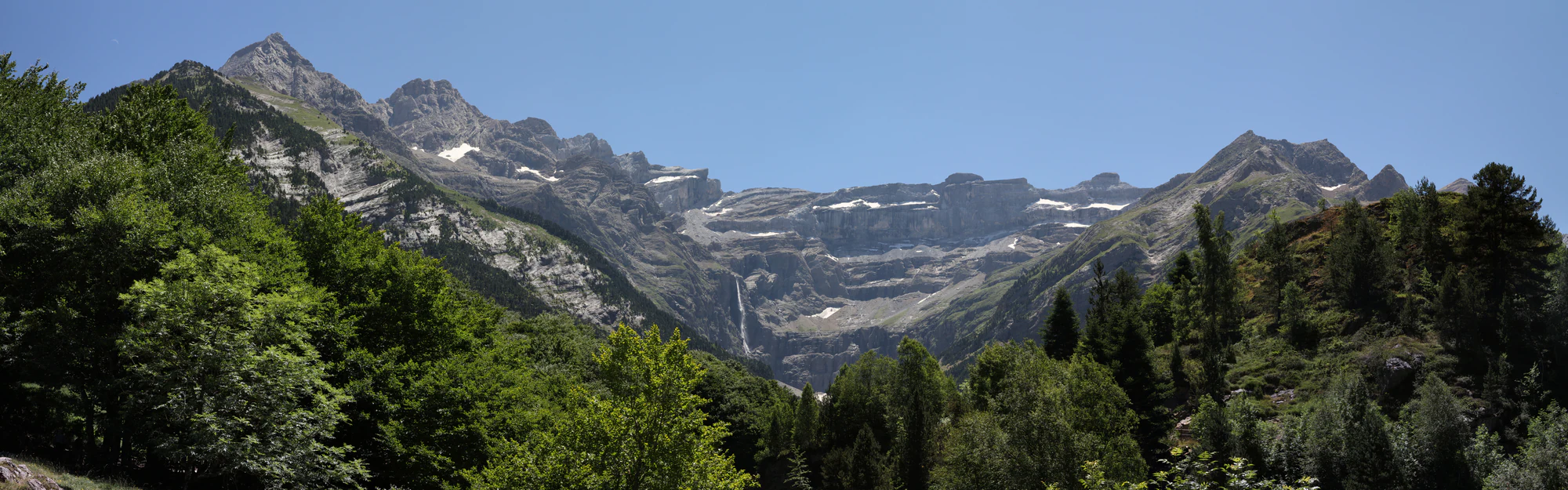
A wide arc of layered grey cliffs, a thin waterfall and patches of snow above green woodland under a clear blue sky.

Cirque de Gavarnie, photographed on 23 July 2012. This is wider national-park context, in a different sector from the Pont d’Espagne and Clot outing.

“Cirque de Gavarnie” by Eusebius@Commons. Embedded photographer credit: Guillaume Piolle. CC BY 2.0. Original photograph, unchanged. · Creative Commons

Walks and routes

Puntas, the waterfall and an optional walk to Clot

Begin at the Puntas visitor entrance and follow the signed pedestrian access to the waterfall. After looking at the cascade, use the marked approach towards the Plateau du Clot if the surface and weather suit everyone. The park’s visitor information lists Clot as a twenty-minute walk; allow more for a relaxed outing. Make the plateau your furthest point, then return by the same approach. There is no need to continue towards the higher Marcadau valley or turn onto the Gaube ascent. Use the official visitor plan and signs at junctions rather than treating this description as a navigation map.

This is a short mountain outing, not a certified step-free circuit. The Clot designation on the summer plan needs to be checked against the actual approach available that day. A short walking time alone says nothing about suitability for a particular wheelchair, pushchair or walking aid.

Puntas, the waterfall and an optional walk to Clot

A relaxed first half-day

Before leaving Cauterets, settle the road and weather check and pack what you need. At Puntas, begin with the waterfall and decide there whether to add Clot. Leave the plateau with enough energy for the return. Back in town, visit the Maison du Parc if its opening day fits, or keep it for another day rather than squeezing in a second mountain destination.

Things to try

Look closely at moving water

Choose a secure place on the path and watch one small part of the cascade. Which water seems to move fastest, and where does white foam form? Try a wide photograph that includes the surrounding trees as well as the falls. Stay well back from wet rocks and avoid blocking the path while you compose it.

Read the change from woodland to meadow

On the Clot approach, notice how an enclosed view opens out. Compare shade, wind and the sound of water without leaving the trail. For children, a useful question is which part of the walk would provide shelter for a small animal, rather than trying to collect something to take home.

Stay in Cauterets for the Maison du Parc

At 1 avenue de la Gare, the Maison du Parc explores isards, bats and water, with films available on request. The published hours are Monday–Friday, 08:30–12:30 and 14:00–17:00, closed weekends and public holidays. Check before travelling; it will not solve a rainy Sunday on that schedule.

Wildlife and habitats

White-throated dipper

Cinclus cinclus is a small, plump bird with a white breast and dark body. The park records it along its watercourses, where it dives for aquatic food. From a secure place on the path, look for a quick low flight or a bird perched on a rock. Never walk onto the torrent stones to follow it.

Alpine marmot

Marmota marmota lives in open slopes and rocky ground. The park records established populations in all its valleys following reintroductions. A sharp whistle may be your first clue, but the short woodland visit is not a reliable marmot-watching route. Hibernation also makes the colder months a poor time to plan around seeing one.

Iberian ibex

Capra pyrenaica has a particularly strong connection with Clot: the first release here took place on 10 July 2014. The animals now live freely in the park. Read the outing as a chance to understand that return, rather than a promise of a close encounter. Even an apparently calm ibex needs space; observe with binoculars and keep moving if it seems disturbed.

Isards and bearded vultures

The isard, Rupicapra pyrenaica, is the Pyrenean chamois associated with the park’s early conservation work. It uses mountain grassland and rocky slopes, with seasonal movements towards woodland. The bearded vulture, Gypaetus barbatus, ranges across the park’s valleys; its long, pointed wings and diamond-shaped tail are useful clues. Neither should be expected on demand during a short family walk.

Stories and discoveries

A park across very different rocks

Gavarnie’s limestone amphitheatre and Cauterets’ granite mountains belong to the same national park. These contrasting landscapes are a good reason to explore one valley at a time, with a fresh route and weather check for each.

When to visit

Snow-free days

Make the short waterfall-and-Clot outing your baseline, then adjust it to the day. In summer, check the last shuttle or lift before buying a pass for a different outing. In autumn, expect fewer services and bring enough food and clothing to remain independent of them.

Snow and ice

Choose an officially open winter pedestrian or snowshoe itinerary with advice from local mountain professionals. Do not carry this snow-free plan straight into winter, and do not head to Lac de Gaube just because a summer map makes it look close.

Getting there and practical advice

Parking and the visitor entrance

Puntas is the road-end starting point for this outing. The advertised parking charge checked on 18 October 2026 is €8 for the day and €13 for stays over twelve hours. The summer plan marks reception and toilets; confirm what is operating outside the staffed season.

Bring your own picnic in the shoulder season

The Clot refuge is advertised as closed from 15 October to 4 December 2026. The live information also shows the Pont d’Espagne hotel as closed, alongside a note about weekend opening. Verify directly before relying on a meal there. Choose a picnic stop away from the torrent edge and take everything back with you.

Getting to the mountain starting point

From Cauterets, use the D920 towards Pont d’Espagne and Puntas. Check InfoRoute65 for the access road before leaving, especially after snow or heavy weather. A map showing a road is not confirmation that it is open. In winter, also check the applicable vehicle-equipment requirements.

Arriving without a car

Lourdes is the rail gateway, with liO route 965 continuing to Cauterets. The onward Pont d’Espagne shuttle is seasonal: its published summer 2026 timetable ends on 26 September, so do not assume an October connection. Confirm a separate return transfer before travelling up, or choose a date with a published shuttle. Do not replace a missing bus with an unplanned walk up the mountain road.

Ask about the complete journey

For a wheelchair visit, ask about parking or drop-off, the route to Clot without the Puntas gondola, any slope or step, and the usable toilet. The Maison du Parc in Cauterets has exhibitions over three levels linked by a lift and is a more clearly documented accessible option. Confirm its opening and any equipment you depend on.

Sources and useful links

Wildlife you might spot

3

Each card links to a full Explore page with photos, traits, and fun facts.

We are still adding species preview cards for this place.

Snap map for this place

Start with the big picture, then zoom in to explore individual wildlife observations around this place.

Loading map…

Good to know before you go

Wear shoes with grip, even if the waterfall is your only destination; damp or frozen surfaces deserve extra care.

Bring drinking water, a snack and a warm waterproof layer. Pack for the mountain starting point rather than the weather outside your accommodation.

Keep children close beside the torrent and remain behind barriers. Choose a comfortable viewing place instead of scrambling for a photograph.

Take binoculars if you have them. Watch from the path and let animals decide how close they come.

Choose a turnaround time before you start, leaving room for stops and the return journey.

Carry all rubbish back, leave plants and stones where they are, and avoid playing sound through speakers.

Frequently asked questions

No. The waterfall can be reached on foot from the car park; the tourism office gives an approach of about five minutes. A lift ticket is not needed for this short walk.
Treat it as a separate mountain walk. The tourism office gives about 1½ hours for the ascent on foot. That climb, its descent and the conditions underfoot need their own plan; they are not part of the short Clot outing described here.
The park core generally excludes dogs, including on leads. Pont d’Espagne has a restricted exception from 1 May to 31 October: dogs on leads may go as far as the Plateau du Clot, and to Lac de Gaube only using the lifts. The Gaube walking trail is not an alternative dog route when the lifts are closed, and dogs must not continue beyond the lake. Dogs are prohibited throughout the Pont d’Espagne site from 1 November to 30 April. If you travel with an assistance dog, confirm the applicable arrangements with the park.
Do not plan water play on this visit. Swimming and other partial or full immersion activities are prohibited in lakes and small lakes in the park core, and aquatic hiking in watercourses is prohibited. Enjoy the torrent from the path.
No. Gavarnie is another sector of the national park and needs a separately planned visit. The panoramic photograph in this guide shows that wider landscape, not the view from Pont d’Espagne.

Recent snaps at this place

Recent snaps will appear here as new observations are added.

View all ›

Take the discovery with you

Exploring Pyrénées National Park?

Identify the wildlife you spot, learn as you go, and keep a collection of the adventure.

  1. 1Spot it
  2. 2Snap it
  3. 3Keep the discovery
