
Snappit logo
Snappit
Get App
Generic illustration, not a photograph of this venueIllustration
ParkHokkaido, Japan

Rishiri-Rebun-Sarobetsu National Park

Start with the mainland wetland.

About

Start with the mainland wetland. Rishiri-Rebun-Sarobetsu National Park reaches across northern Hokkaido and out to Rishiri and Rebun islands, so it is far too spread out for one walk. For a relaxed first visit, make Sarobetsu Wetland Center in Toyotomi your destination and build your time around its roughly 1 km boardwalk. The islands are separate journeys. You do not need a ferry to enjoy this part of the park.

The pleasure here is changing your scale of attention. Look across the open wetland first, then slow down and study the small plants beside the path. Bog cranberry creeps close to the ground; round-leaved sundew has tiny insect-catching leaves; Sphagnum moss is part of the living wetland carpet. The view can feel almost empty until you start noticing these details. In clear weather, Mount Rishiri may appear beyond the plain, but the walk is worth doing even when cloud hides it.

Go inside the center before heading out. Its exhibits introduce the wetland and its wildlife, giving the landscape more meaning than a quick photo stop. Ask which plants are currently visible and whether any boardwalk sections are closed. Then walk slowly, pause at a rest area and leave time to return with questions. With children, turn it into a small observation game: find a low plant, a taller stem and something moving in the wind, without stepping off the boards or picking anything.

This is also a landscape shaped by people. Peat extraction continued in the Sarobetsu Plain until 2002, and former extraction areas became part of restoration work. Drying and the spread of bamboo grass have challenged the wetland, while conservation has sought ways for nature and farming to coexist. The center is a good place to understand that story before seeing the living habitat outside. Be ready to snap and learn! Get the Snappit app to identify any nature species you find here.

The national park was designated on 20 September 1974. Sarobetsu Wetland Center opened on 28 April 2011. Its setting is part of a longer story of wetland formation, farming, peat extraction and restoration; a visit works best when the indoor explanation and outdoor walk are enjoyed together.

What to do here

Begin with the center exhibits and a quick conditions check, then follow the signed public wetland circuit. Use the benches and viewing deck to alternate between close-up plant watching and the wider landscape. Bring binoculars for birds rather than trying to approach them. If you would like help identifying what you see, ask about a guided nature walk in advance; programs, languages and fees need confirmation. Finish with a few minutes indoors to match your photographs to the displays.

Seasonal info

Spring can still feel wintry, while summer brings the best-known flower displays. Autumn shifts the emphasis to tawny vegetation and the wider region's migrating birds. Winter is a separate snow-season visit: confirm the center's schedule, snow conditions and any guided snowshoe options instead of assuming the summer boardwalk circuit is usable. Published center schedules generally give 09:00–17:00 in May–October and 10:00–16:00 in November–April, with winter Monday closures; holiday exceptions and summer hours need checking before travel.

Accessibility

Official visitor information describes the approximately 1 km center boardwalk as barrier-free and suitable for wheelchairs and strollers, with resting places; a multipurpose toilet is also listed. This applies to the designated public circuit, not every branch or every park site. Before traveling, ask the center about the route from parking, current surfaces, snow or ice, temporary works and the toilet equipment or access you need.

Don't miss

1

A short public boardwalk opening onto an expansive northern wetland

2

Small bog plants that reward a slow, close look from the path

3

Ezo kanzo daylilies in their variable early-summer flowering season

4

Wetland interpretation indoors, with a possible Mount Rishiri view outside

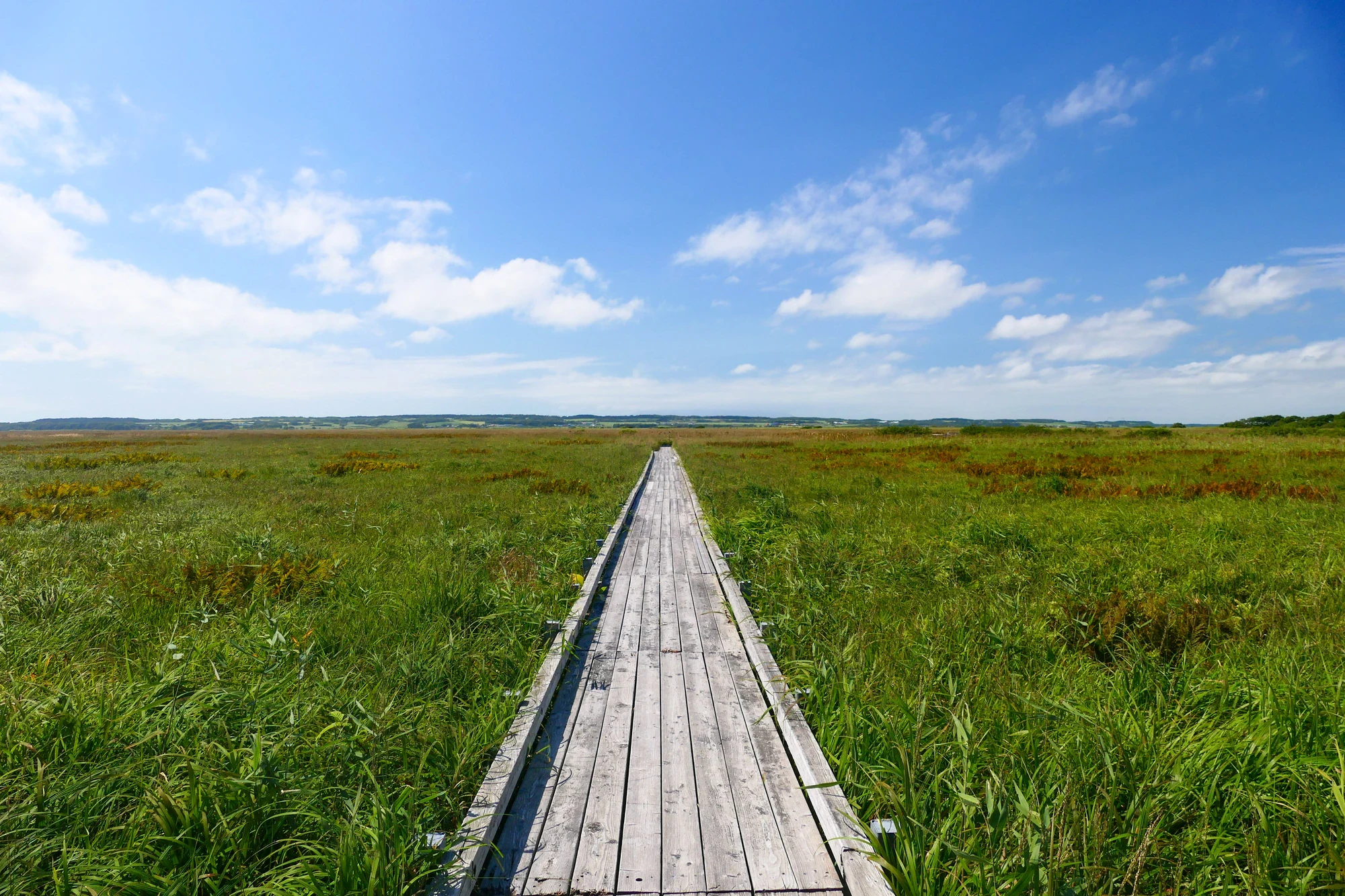
A narrow wooden walkway runs straight through broad green and golden wetland vegetation beneath an open blue sky.

A wooden walkway crosses the open Sarobetsu wetland. Photographed in August 2024.

Sarobetsu-Genya.jpg — MaedaAkihiko, CC0 1.0 (https://creativecommons.org/publicdomain/zero/1.0/). Source: https://commons.wikimedia.org/wiki/File:Sarobetsu-Genya.jpg. Resized with Lanczos resampling to 2000 pixels on the long edge, preserving aspect ratio within integer rounding; recompressed as WebP quality 92. No crop, retouching, color adjustment or added text. Original metadata omitted from derivative and preserved in source evidence. · Creative Commons

Walks and routes

Sarobetsu Wetland Center public boardwalk

Start from the center, follow the current signs for the public wetland circuit, stop at resting and viewing areas and return to the center. Ask staff to point out the usable circuit and any closures. Follow the on-site signs and do not enter research paths.

The published roughly 1 km circuit is described as barrier-free. Ask staff about current repairs, winter surfaces and the route between parking, the circuit and the toilet facilities.

Sarobetsu Wetland Center public boardwalk

Spend about 15–20 minutes in the center. Check conditions and choose one or two plants to look for.

Allow roughly 30–60 minutes for the public circuit, with a rest and quiet observation stops.

Return to the center for a short identification check and time to meet your booked transport.

Things to try

Look down, then look out

At a safe stopping place, choose a small patch visible from the boards. Compare plant shapes without touching: a low creeping shoot, a small leaf rosette and a moss cushion are useful things to look for. Then lift your eyes to the horizon. If you cannot identify a plant, photograph it from the path and ask inside.

Give birds a quiet minute

Pause at a public rest area and listen before raising your binoculars. Note whether a sound comes from the sky, taller vegetation or farther across the wetland. You do not need to identify every bird to enjoy the difference. Stay away from nests and never try to flush a bird for a photograph.

Let a local guide add the detail

The center advertises guided nature experiences through the local NPO. Ask ahead about dates, language, group size, price and the route that suits your party. Treat winter snowshoe programs as separately arranged activities.

A center-first visit

Use the indoor exhibits as the main visit if the center is open. Only add the boardwalk if current weather and surfaces are suitable; there is no need to complete the loop to make the stop worthwhile.

Wildlife and habitats

Bog cranberry

A creeping wetland shrub to look for among low plants. Leave all berries in place; a photograph is the right souvenir.

Round-leaved sundew

Look for a small rosette rather than a tall showy flower. Its sticky leaves can capture insects. View it from the boardwalk without touching or feeding it.

Sphagnum moss

Sphagnum is a group of bog mosses. Look for the low moss layer as part of the wetland habitat, and ask staff to help you recognize it. Enjoy its texture and color from the boardwalk without touching or stepping onto it.

Stories and discoveries

Much of the botanical interest is close to the ground. Hokkaido’s nature guide explains that nutrient-poor wetland conditions limit plant growth, so a slow look beside the boardwalk can reveal more than scanning the horizon.

Despite its Japanese name ending in “goke,” round-leaved sundew is a flowering plant, not a moss. Sticky leaf secretions help it capture insects in its nutrient-poor habitat.

Sarobetsu’s conservation story includes the surrounding farms. A restoration effort begun in 2005 sought to address wetland drying while supporting coexistence between agriculture and the wetland.

When to visit

spring

Expect a quieter, less flower-filled landscape than summer. Ask which early plants are visible and whether snow or cold conditions affect the circuit.

early_summer

Use late June to early July as a flexible daylily-planning window, then check the year’s bloom report. Flower abundance is variable.

autumn

Enjoy changing vegetation and the broader Sarobetsu region’s migration season. The base loop does not include Panke or Penke lakes.

winter

Check opening days and conditions directly. Snowshoe activities, where offered, need their own arrangements and equipment; do not set off expecting the summer circuit.

Getting there and practical advice

Sarobetsu Wetland Center

Indoor interpretation, staff information and visitor facilities are the starting point for this visit. Admission is listed as free; confirm current opening and services before travel.

Boardwalk rest areas and viewing deck

Published information lists benches and terraces along the circuit. Use a resting place for longer observation stops so other visitors can pass.

Toilet facilities

A multipurpose toilet is listed at the center site. Ask the center about the equipment, transfer space or changing facilities you need before traveling.

Center parking

Official regional tourism lists free parking at the center. Check current access if arriving with a larger vehicle or during snow conditions.

Seasonal rest house

A neighboring rest house is seasonal. Check its opening dates and meal service before relying on it, and bring water and a snack.

Toyotomi–Wakasakanai demand bus

The town’s Wakasakanai timetable includes the Wetland Center in both directions. Book the outward and return trips; unreserved services do not run. As of 16 October 2026, the town requires reservations by 16:00 the previous day. The booking line is 0162-73-0145, Monday–Saturday 09:00–16:00. Check the current timetable, operating dates, fare, language help and mobility requirements when reserving.

Engan’s regular Sarobetsu line ended after 31 March 2021. Some tourism pages still show it, so use the current municipal reservation information instead.

A car or a prearranged taxi is another way to reach the center. If taking a taxi, arrange the return pickup rather than assuming one will be waiting, and confirm the fare when booking.

A roughly 1 km barrier-free boardwalk with benches is documented. Confirm the exact usable circuit with staff; the recommendation does not extend to research paths or every wetland site.

Ask the center about path widths, gradients, turning spaces and toilet equipment that matter to your visit. If using the demand bus, check that it can accommodate your wheelchair or other mobility needs before booking.

Sources and useful links

Wildlife you might spot

3

Each card links to a full Explore page with photos, traits, and fun facts.

We are still adding species preview cards for this place.

Snap map for this place

Start with the big picture, then zoom in to explore individual wildlife observations around this place.

Loading map…

Good to know before you go

Arrange the journey back before setting out. The old Engan Sarobetsu bus line ended in 2021; the municipal replacement is reservation-based.

Start at the staffed center and check current closures and bear information. Sarobetsu is brown-bear habitat; a boardwalk is not a wildlife barrier.

Keep to signed public paths. Narrow research boardwalks are not an invitation to explore farther.

Carry a windproof layer and rain protection, even for a short summer walk; use footwear with grip when the boards are wet.

Bring binoculars or a camera zoom. Keep away from nests and let birds decide their distance.

Photograph plants in place. Do not pick flowers or berries, feed wildlife or leave food scraps.

Bring water and a snack rather than depending on the seasonal rest house being open.

For wheelchair or stroller use, confirm the currently usable circuit with the center before traveling, especially outside the snow-free season.

Frequently asked questions

No. This plan stays at the Sarobetsu Wetland Center on Hokkaido. Rishiri and Rebun are separate island visits requiring their own transport, weather and accommodation planning. A view of Mount Rishiri does not mean you are on the island.
Yes, but arrange it ahead of time. Toyotomi Town lists a reservation-based Wakasakanai service that stops at the Wetland Center. As of 16 October 2026, the town requires reservations by 16:00 the previous day, with the booking line open Monday–Saturday 09:00–16:00. Confirm both legs, operating dates and fares on the current town page; do not rely on old regular-bus listings.
Official visitor information lists admission to the center as free. Guided activities and equipment rental may cost extra. Reconfirm charges and availability before booking a program.
Neither is guaranteed. Late June to early July is the usual daylily window, but weather and the year affect flowering. Birds move around the larger wetland; a quiet circuit can still be rewarding for plants, sounds and the landscape.
No. Stay on signed public boardwalks and respect closures. Wetland ground is fragile, and research boardwalks are not public routes. Ask staff before taking any branch you cannot identify.
Plan winter differently. Snow can change access completely, and center hours and closure days differ. Ask about conditions and supervised snow-season activities rather than expecting the snow-free circuit.

Recent snaps at this place

Recent snaps will appear here as new observations are added.

View all ›

Take the discovery with you

Exploring Rishiri-Rebun-Sarobetsu National Park?

Identify the wildlife you spot, learn as you go, and keep a collection of the adventure.

  1. 1Spot it
  2. 2Snap it
  3. 3Keep the discovery
