Snappit logo
Snappit
Get App
Generic illustration, not a photograph of this venueIllustration
ParkPaís Vasco, Spain

Salburua Wetlands Park

Salburua is a place to linger rather than cover ground.

About

Salburua is a place to linger rather than cover ground. A few minutes watching the water can reveal more than a hurried lap: a coot diving, a stork crossing the sky, or the changing outline of reeds against open water. The city is close, but the wetland has its own pace.

For a first visit, begin at Ataria, the interpretation centre on Paseo de la Biosfera. Its exhibits explain how the wetlands work, and the building’s lookout helps you get your bearings. Then choose one outing: a short walk that you can turn back from easily, or the Arcaute lagoon circuit with time in a bird hide. Betoño is a shorter alternative with its own starting point.

The water is part of a recovery story. These lagoons were drained for farming, then brought back through restoration that began in 1994. Today the ponds, wet meadows and woodland belong to Vitoria-Gasteiz’s Green Belt. Their value goes beyond a pleasant walk: the wetland supports wildlife and helps hold excess water during heavy rain.

You may also see deer grazing behind the wetland’s fences. They were introduced to manage vegetation and live in semi-liberty. Enjoy them from the public paths, while treating the birds and other free-living animals as a separate wildlife experience. None of this is an animal-feeding or contact attraction. Planning to visit? Download the Snappit app to identify the wildlife you spot in real-time.

Salburua’s lagoons were progressively drained for agriculture, and much of the woodland was lost. Municipal restoration began in 1994; a dam closing the drainage channel helped recover Arcaute and Larregana from 1998. Salburua became a Ramsar Wetland of International Importance in 2002, and Ataria opened in 2009. In 2015 the Basque Government designated the wider Salburua site as both a Special Area of Conservation and a Special Protection Area for birds within Natura 2000.

What to do here

Visit Ataria’s exhibits and lookout, then take a quiet lagoon walk. Arcaute is the choice for the two named bird hides, Las Zumas and Los Fresnos; Betoño suits a shorter circuit. Pause at a few interpretation panels instead of trying to identify everything at once.

Seasonal info

Water levels change substantially. Ataria’s bulletin published on 12 October 2026 described low water at Arcaute despite recent rain. In wetter weather, a passage on the Arcaute route can close after heavy rainfall. Spring breeding, summer vegetation and autumn migration make repeat visits different; keep your distance from animals in every season.

Accessibility

Ataria lists ramps, lifts and adapted toilets. The Arcaute route page and Betoño leaflet describe surfaced paths suitable for pushchairs, but boardwalks, wet conditions and individual hide access need a separate check. Ask staff about the exact route, viewing position, surfaces and toilets that suit your wheelchair or other access needs.

Don't miss

1

Ataria’s wetland exhibits and lookout

2

A quiet spell in an Arcaute bird hide

3

Betoño’s water-edge vegetation and interpretation panels

4

A restored landscape where wildlife conservation also helps manage water

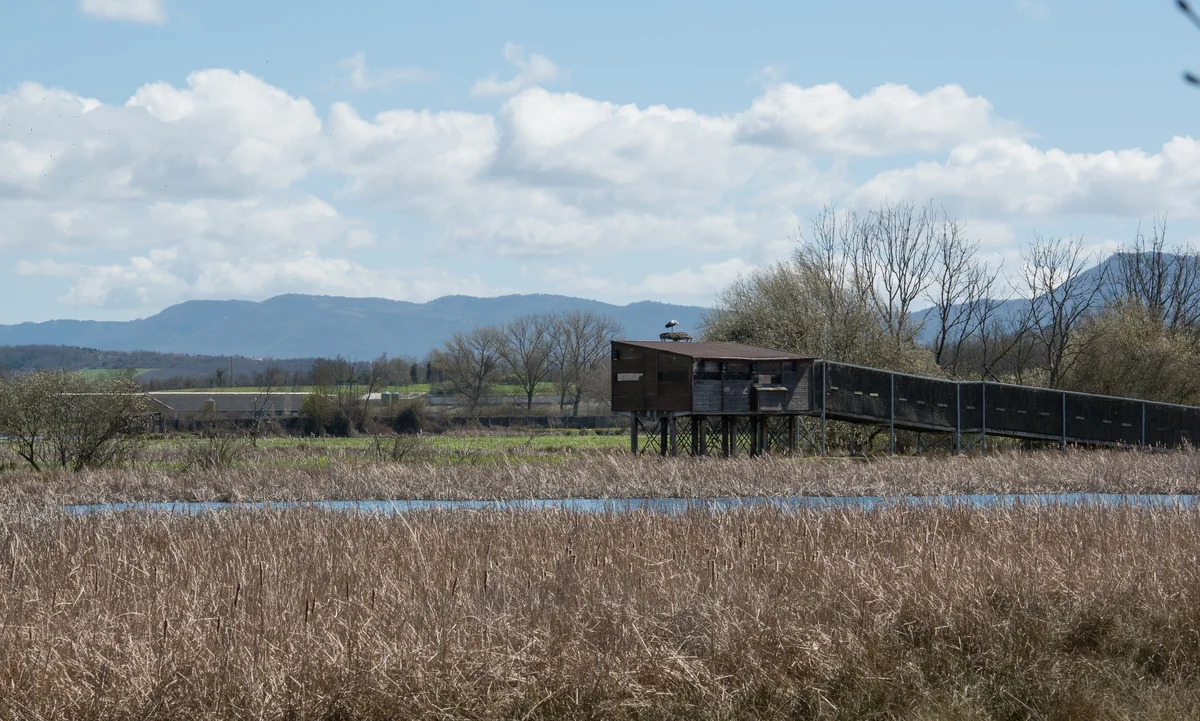
An elevated wooden birdwatching hide and screened walkway stand beyond a narrow stretch of water and a wide reedbed at Salburua.

An observation hide among Salburua’s wetland reeds, photographed in March 2016.

Salburua 10.jpg — Basotxerri / Wikimedia Commons / CC BY-SA 4.0 · Creative Commons

Walks and routes

Ataria and a short wetland stroll

Spend time in the exhibits and at the lookout, then ask reception for a short open path that suits your group. Walk only as far as you want and retrace your steps. Allow 1–1½ hours altogether; this flexible visit has no fixed distance and is not a separate named trail.

Use Ataria’s ramps and lifts as needed. Confirm the outdoor section and whether it leads to a suitable stopping place before leaving the centre.


Ataria and a short wetland stroll

Arcaute lagoon circuit from Ataria

Follow the official Arcaute circuit from Ataria, using its map and the signs on the ground. The dedicated web guide lists 4.23 km, about an hour of walking; allow 1½–2 hours with observation stops. Take the signed hide approaches to Las Zumas or Los Fresnos when open, then return to the circuit. The walk also passes wet meadows and crosses wooden walkways near Larregana.

The dedicated route page describes a surfaced path suitable for pushchairs. It is not an assurance that every hide, boardwalk or approach meets your wheelchair needs. Ask about the full loop before committing to it.

Arcaute lagoon circuit from Ataria

Betoño lagoon circuit from Bulevar de Salburua

The official 2.4 km circuit starts at the park entrance on Bulevar de Salburua. It follows the lagoon, includes a wooden walkway and returns by the open grassland. Allow 1–1½ hours for a gentle visit; the leaflet’s walking estimate is 40 minutes. The branch towards Duranzarra and Ataria is an optional connection outside this circuit, not a shortcut that keeps its distance unchanged.

The leaflet describes a surfaced route suitable for pushchairs, with a wooden walkway. Ask about the current surface and boardwalk condition if you need a firm, step-free route. The Arcaute hides are on the other lagoon.

Betoño lagoon circuit from Bulevar de Salburua

An easy first morning

Arrive around Ataria’s 11:00 opening on a day it is open. Spend 30–45 minutes inside, ask about today’s conditions, then choose a short out-and-back or the Arcaute circuit. If you borrow binoculars, agree a return time before the 14:00 closure. Do not squeeze in Betoño as well unless everyone wants more walking.

A shorter walk from the city side

Start the Betoño circuit at Bulevar de Salburua and keep the outing to that lagoon. Stop at a couple of panels and let the water-edge plants be part of the visit. If you later decide to continue to Ataria, check its hours and allow extra walking time rather than relying on the 2.4 km loop figure.

Things to try

Try a ten-minute bird watch

Choose an open hide or an established viewing place and stay still for ten minutes. Notice how birds move and feed before trying to name them. Let children describe one bird’s shape or behaviour, then compare it with a guide. A small number of careful observations makes a satisfying visit; sightings vary with the season and conditions.

See why the deer are here

Look across the grazed meadows from the public path. The deer were introduced to control plant growth and are enclosed in semi-liberty. Autumn may bring their rutting calls, but do not follow sounds into closed areas. Ataria’s seasonal programme can help you understand the herd without approaching it.

Join a guided visit

Ataria advertises free guided visits with telephone reservations on +34 945 16 26 16. Ask which visit is running, its language, meeting point and access arrangements. Groups are asked to book at least 24 hours ahead; themed activities in the agenda have their own registration details.

Let Ataria carry the visit

On a wet day, concentrate on the exhibits and the building’s lookout, if the centre is open. If flooding, strong winds or staff advice rule out the outdoor walk, postpone it. The Arcaute route’s flood-prone passage and exposed boardwalks are reasons to change plans, not challenges to overcome.

Wildlife and habitats

White stork

Watch the open sky and water-edge landscape from public paths or hides. Ataria records white storks at Salburua, including in its October 2026 bulletin. Keep your attention on the birds’ movement rather than seeking out nests.

Eurasian coot

A dark waterbird with a contrasting white forehead, often easiest to study while it swims or dives. Use binoculars from a settled viewing position and see whether you can follow one bird through a short feeding sequence.

Yellow iris

Ataria identifies this yellow-flowered iris among the wetland plants, with its main flowering display around May. Enjoy it from the path; water-edge vegetation also shelters animals, so do not push through it for a closer photograph.

Pedunculate oak

The oak woodland adds a different layer to the lagoon walk. Compare leaves and the outline of trees visible from the path, while leaving protected woodland and fenced areas undisturbed. The park includes both surviving woodland and restoration planting.

Marsh mallow

A plant of Salburua’s damp meadows, with flowers in summer. Use the interpretation panels to put a name to the vegetation without leaving the path or picking specimens. The wet meadow is as much a habitat as the open water.

Common reed

Tall reeds form part of the wetland’s structure. Look at how a reedbed separates sheltered water from the more open lagoon, and listen without entering it. It is worth noticing the habitat even when its animal inhabitants stay out of sight.

Stories and discoveries

A wetland with a practical job

The lagoons hold water from the underlying aquifer and can store excess flows during heavy rain. The same landscape that supports waterbirds is part of the city’s flood-management story. A fuller lagoon can therefore change both the view and the route available to visitors.

Restoration is still visible

Betoño’s older poplar plantation is gradually being replaced with trees associated with the area’s native wet woodlands. The park is a recovering, managed landscape. Looking at the trees as well as the water makes that story easier to see.

When to visit

Cool-season birdwatching

Use binoculars to compare birds on open water and at the vegetation edge. Autumn migration and winter gatherings make this a rewarding time to watch, but dress for standing still as well as walking. In October 2026 the latest checked bulletin described low water at Arcaute, so expect the view to differ from older photographs.

Spring and summer details

In spring, watch from a distance as birds use the wetland and look for yellow iris flowers. In summer, the wet meadows and water-edge plants add interest even when the water level is lower. Leave plants untouched and keep children beside you on boardwalks.

Getting there and practical advice

Ataria: address and opening

Ataria is at Paseo de la Biosfera 4, Vitoria-Gasteiz; telephone +34 945 16 26 16. Published hours are 11:00–14:00 and 16:00–19:00 from 1 October to 30 April; the afternoon extends to 20:00 from 1 May to 30 September. It closes Mondays, or Tuesday when Monday is a public holiday, plus 1 and 6 January, 28 April, 4 and 5 August, and 24, 25 and 31 December. Check before travelling.

Hides: a separate timetable

Las Zumas and Los Fresnos overlook Arcaute. The municipal directory lists daily hours of 07:30–19:30 in October–March and 06:30–22:00 in April–September. Other official leaflets carry different older hours, so confirm with Ataria if a hide is essential to your visit, especially early or late in the day.

Useful facilities inside

Ataria lists adapted toilets, baby-changing facilities and a children’s area, as well as free binocular loans. A café is advertised on site; check its own opening arrangements before relying on it for lunch. Bring drinking water for the walk.

From central Vitoria-Gasteiz

Ataria’s arrival page suggests bus L3 to Portal de Zurbano/Biosfera, followed by about five minutes on foot. Check the current L3 route and departures for your date. Walking from the centre is described as roughly 40–45 minutes, so allow that separately from your wetland time.

Cycling or driving

Bicycle racks are provided at Ataria. If driving, the official arrival page points to parking by Fernando Buesa Arena; check local signs and event-day arrangements. Use proper access routes and avoid treating a wetland path as vehicle access.

Ask for the route that suits you

Ataria lists visual, sound and tactile interpretation, a Braille guide, and adaptations for guided activities by advance request. It also advertises free mobility-scooter loans. Confirm availability, suitability and the current route before relying on a loan. Ask specifically about the desired hide, boardwalks and the return journey rather than just whether the park is accessible.

Sources and useful links

Wildlife you might spot

6

Each card links to a full Explore page with photos, traits, and fun facts.

Snap map for this place

Start with the big picture, then zoom in to explore individual wildlife observations around this place.

Loading map…

Good to know before you go

Check Ataria’s opening calendar before setting out. The centre closes between 14:00 and 16:00, and its Monday closure can move to Tuesday after a public holiday.

Ask Ataria which paths and hides are open that day, especially after heavy rain or strong winds. Never step past a barrier or try to wade across an inundated path.

Bring binoculars if you have them. Ataria advertises free loans at reception; ask about availability and return arrangements before walking away.

Keep to paths and boardwalks, speak quietly in hides and give feeding or resting birds room. Avoid playback calls, approaches to nests and sharing sensitive wildlife locations.

Watch deer from outside the fenced area. Do not feed them, reach through fencing or approach them during the rut.

Keep dogs on a lead on the wetland paths. Off-lead use is limited to specifically signed areas; check entry arrangements for the centre and hides separately.

Wear shoes with grip and bring a warm or waterproof layer, drinking water and a small snack. An easy-looking loop is less comfortable if you spend half an hour standing still in the wind.

If you arrive by bicycle, give people on foot priority and use the racks at Ataria. Leave time for your return journey rather than rushing the final part of a loop.

Frequently asked questions

Ataria advertises free admission. Its guided visits require advance telephone booking, and individual activities have their own registration arrangements. For a self-guided walk, start with the current path notices and check with reception if you need advice.
Choose Arcaute for the fuller walk and the two bird hides. Choose the 2.4 km Betoño circuit if you want less walking. Its official start is on Bulevar de Salburua, so do not count an approach from Ataria as part of that distance.
They are an introduced, managed herd kept in semi-liberty to graze the wetland vegetation. They are different from the free-living waterbirds. Watch from the public paths and keep the fence between you and the animals.
Both official lagoon route descriptions identify pushchair-suitable surfaced paths, and Ataria has accessibility facilities. A wheelchair visit still needs a route-specific check, including boardwalk condition, any flooded passage and access to the chosen hide. Call ahead for assistance and equipment availability.
Turn back and ask Ataria for an open alternative. The official Arcaute leaflet warns that a passage near the start can be cut off in heavy rain. Keep the indoor centre as an option when it is open; a published loop is never permission to cross a closed section.
They have a separate timetable. The municipal directory lists 07:30–19:30 from October to March and 06:30–22:00 from April to September, but older official leaflets differ. Confirm the hours and access with Ataria before planning an early or late visit.

Recent snaps at this place

Recent snaps will appear here as new observations are added.

View all ›

Take the discovery with you

Exploring Salburua Wetlands Park?

Identify the wildlife you spot, learn as you go, and keep a collection of the adventure.

  1. 1Spot it
  2. 2Snap it
  3. 3Keep the discovery