Snappit logo
Snappit
Get App
Generic illustration, not a photograph of this venueIllustration
ParkChubu, Japan

Shirotori Garden

Shirotori Garden turns a short city walk into a journey across central Japan.

About

Shirotori Garden turns a short city walk into a journey across central Japan. A landscaped hill stands for Mt. Ontake, water flowing away from it represents the Kiso River, and the broad pond becomes Ise Bay. The whole composition fits into about 3.7 hectares in Nagoya’s Atsuta district. You can enjoy the water and planting without knowing the story, but following it gives children and adults something satisfying to piece together.

Start by noticing what changes along the stream. The upstream rocks look rugged and closely packed; farther along, the stonework softens and the water opens out. Then look across the pond rather than down into it. Islands, bridges, roofs and reflections become parts of a much larger-looking landscape. A good visit is less about covering every path than choosing a few places to pause.

Near the centre, Seiu-tei brings architecture into the picture. Its low, spreading form was inspired by a swan coming down to the water, and its timber construction belongs to the sukiya tradition of tea-house design. It is a working venue for tea gatherings, so interior access depends on bookings. For an everyday drink, head to Saryo Shioiri, the separate café overlooking the garden’s modern interpretation of changing tides.

Plants give the same walk a different focus through the year: plum and cherry blossom, hydrangeas and aquatic flowers, autumn leaves, then the lines of winter branch-support ropes. Leave room for an unplanned discovery, such as a seed head or a bird waiting beside the water. This is a particularly rewarding stop for people who enjoy looking closely, with enough variety for a gentle family outing. Be ready to snap and learn! Get the Snappit app to identify any nature species you find here.

Shirotori Garden opened on 14 April 1991 and marked its 35th anniversary in 2026. It occupies land formerly used as a timber yard. The modern garden interprets the geography of the Chubu region through a continuous water story, while Seiu-tei combines the work of Kyoto sukiya specialists and Owari carpenters.

What to do here

Trace the water story from the stream and rocky gorge to the wider pond, compare Seiu-tei’s roofline with its reflection, and pause at Shioiri to look at the changing water display. Add a seasonal flower search or a quiet birdwatching stop. A café break makes a natural finish; tea ceremonies are separate events with their own arrangements.

Seasonal info

In summer, look for cultivated lotus in pots near Shioiri and around the lawn area, alongside the garden’s separate water-lily planting. The operator recorded lotus flowering several times in July 2026. Its usual lotus season is mid-June through August, but the display changes with the weather. In winter, decorative yukitsuri ropes support tree branches; installation normally starts in early November and removal in late February.

Accessibility

Ask at the entrance for the wheelchair route map and help choosing suitable paths. The garden includes steps, stepping stones, stream crossings and bridges with trip or fall risks. The marked wheelchair route avoids the hilltop circuit, so plan to enjoy the lower paths rather than assuming every viewpoint is reachable. Wheelchair-usable toilets are marked by the main gate and Shioiri.

Don't miss

1

The mountain-to-sea water story, told through a hill, stream, rocky gorge and pond.

2

Seiu-tei’s swan-inspired roofline and its reflection in the water.

3

Shioiri’s designed tidal effects, fountain spray and symbolic titanium “rocks”.

4

Seasonal details, from summer lotus seed heads to the patterned ropes of winter yukitsuri.

Walks and routes

A slow water-story circuit

Pick up the garden map at your chosen gate. Make the stream and rocky gorge your first focus, then follow the public paths toward the more open pond scenes. Stop to view Seiu-tei from outside, look across the island-and-bridge composition, and finish at Shioiri. Treat this as a flexible sequence of things to see: you can reverse it or shorten it to suit your entrance, the weather and any closed areas.

Use the red route on the official wheelchair map if you need to avoid steps and stepping-stone crossings. Ask staff which sections best suit your chair or stroller; leave the hilltop out of this version.
A slow water-story circuit

Two hours with children

Spend the first 15 minutes getting oriented and choosing a route that suits everyone. Give roughly 45 minutes to the stream, pond and tea-house views, then 15 minutes to a seasonal flower or bird search. Use the remaining time for a snack or café break and a last favourite view. Skip a section whenever interest or energy starts to fade.

Things to try

Follow the changing river

Give children three things to find from the path: a noisy stretch of water, a quiet reflection and a place where the stream widens. Ask which scene feels like a mountain and which feels like the sea. There is no need to climb rocks or cross stepping stones to play.

Make a three-shape garden sketch

Choose a safe place to pause and draw only three shapes: one roof, one bridge and one patch of water. Then look again at what you left out. This is an easy way to notice how the garden suggests a larger landscape without needing a long art session.

Let a guide point out the details

Volunteer Japanese tours normally run on Saturdays and take 30–60 minutes. The usual session is 10:00–12:00 in July–September and 13:30–15:30 in October–June, with final sign-up 30 minutes before the session ends. Confirm your date because schedules can change. English tours are listed by advance reservation, requested by telephone at least one month ahead; guiding is free, with garden admission separate.

Watch the water over tea

Saryo Shioiri serves tea and Japanese sweets, with some light meals. It normally opens 09:30–16:30, last orders 16:00, and does not take seat reservations. Arrive well before last orders if the café is an important part of your visit.

A shorter rainy-day visit

Light rain can make the gorge rocks and leaves especially atmospheric. Keep to sure-footed paths, shorten the circuit and use a roofed rest area or the café for a break when available. Seiu-tei is not a guaranteed indoor refuge because rooms may be booked; in heavy rain, save the garden for another day.

Wildlife and habitats

Sacred lotus

Look for leaves and flowers raised above the water and the distinctive seed receptacle left when petals fall. Shirotori’s lotus pots make this an easy summer plant to study without entering a pond. In the July 2026 diary, the garden recorded several flowering displays near Shioiri.

Water lilies

Compare these with the lotus: the garden’s water-lily flowers sit close to the pond surface. Look from the paths near the water and notice how the flower and its reflection meet. The operator lists several colours, without identifying one exact species for the whole display.

Common kingfisher

A small bird with a vivid blue back and orange underside may pause above the water before diving. Scan quietly rather than following it along the bank. The garden lists it among its birds, with easier viewing when foliage is thinner.

Grey heron

Look for a tall, long-necked bird with a grey back around the water. Its stillness can make it blend into the scene. Watch from a distance and let it choose when to move; a patient pause is more useful than a chase. A grey heron appears in the garden’s bird guide.

The flower displays are cultivated; the birds are wild visitors and may be absent. Look quietly from the paths, leave plants untouched and give wildlife plenty of room.

Stories and discoveries

Those metal pipes are part of the landscape

The titanium elements in Shioiri represent hard rock left standing after years of wave erosion. Compare their clean outlines with the rougher stonework elsewhere in the garden.

A bird translated into architecture

Seiu-tei’s exterior was designed to suggest a white swan descending onto the water. Look at the whole silhouette from outside before focusing on its individual rooms.

A conspicuous pale stone

In the ocean scene, look for the pale, irregularly perforated stone on the island. The garden calls it Taiko-ishi, linking its name with nearby Toyotomi Bridge. View it from the public path or bridge without climbing the rockwork.

When to visit

Late winter and spring

Plum flowers can appear from January through March, followed by the usual late-March to early-April cherry season. Exact timing varies, so use the garden’s flower updates to choose a date.

Late spring and summer

Water lilies usually flower from May into August, hydrangeas mainly in late May and June, and lotus from mid-June through August. Start early in the day in hot weather and keep the walk short enough for regular drinks and shade breaks.

Autumn leaves and a dated evening option

Enjoy the changing colour along the stream. For 2026, the November calendar lists illumination on Saturdays, Sundays and holidays from 14–29 November, with opening extended to 20:00 and last entry at 19:30. This is not an every-night schedule. Recheck the event notice before travelling.

Winter structure

Look at evergreen foliage, bare branches and the radiating yukitsuri ropes. Rope installation normally begins in early November, with removal starting in late February; work depends on conditions. Do not plan on a live demonstration unless the garden confirms it.

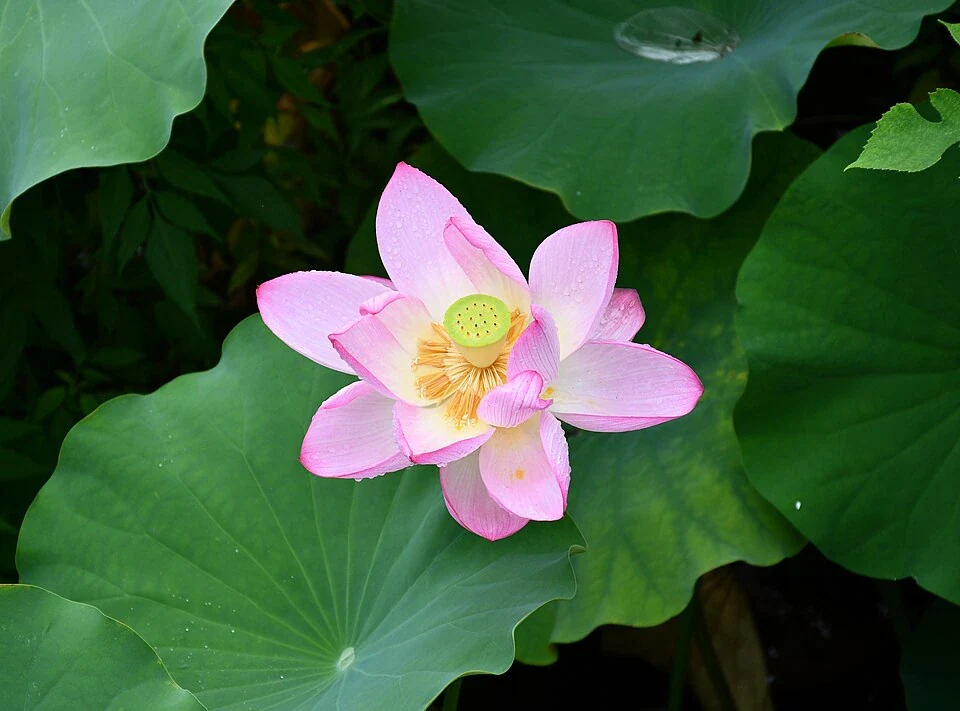
Off-site botanical example: an open pink lotus flower with a yellow-green central seed receptacle and broad green leaves, photographed in Tokyo rather than Shirotori Garden.

Lotus flower: an off-site example photographed at Shinobazu Pond in Tokyo’s Ueno Park in August 2018. Shirotori Garden also grows lotus, but this is not a photograph of its plants or grounds.

Nelumbo nucifera in Ueno park.jpg — Gzzz, CC BY-SA 4.0 (https://creativecommons.org/licenses/by-sa/4.0/). Source: https://commons.wikimedia.org/wiki/File:Nelumbo_nucifera_in_Ueno_park.jpg. Proportional reduction to at most 1200 pixels wide without upscaling; encoded as WebP quality 92, method 6. No crop, retouching, added text or colour correction. EXIF omitted. · Creative Commons

Getting there and practical advice

Admission and opening hours

Normally 09:00–17:00, last entry 16:30. Standard adult admission is ¥300; junior-high-school children and younger are free. The regular closure is Monday, moving to the next weekday after a Monday holiday, plus 29 December–3 January. Check the calendar for exceptions.

Rest and refreshments

Use the lawn or roofed rest areas for your own food, or visit Saryo Shioiri for refreshments. Keep the visit flexible if café seating is full.

Help at the main gate

Ask at the main gate if you need a place to nurse; the office can be used by arrangement. Ask the entrance desk about a wheelchair if you need one. Availability should be confirmed for your visit.

Accessible toilets

The wheelchair map marks toilets usable by wheelchair visitors near the main gate and at Shioiri. Check with staff if you need details about transfer space or equipment.

By subway

Use Atsuta Jingu Nishi Station on the Meijo Line. The garden lists about 10 minutes on foot from Exit 4. This station was formerly called Jingu Nishi; Atsuta Jingu Temmacho is a different station. If you need lifts, check the station’s accessible exit before travelling.

By bus

From Kanayama, the garden lists the Kanayama 25 bus to Shirotori-bashi, followed by about a three-minute walk. Check the current timetable and destination before boarding.

By car

The address is 2-5 Atsuta-nishimachi, Atsuta-ku, Nagoya. Main-gate parking has 40 ordinary-car spaces; the current main access page lists ¥500 per visit. Ask staff about payment and any affiliated parking arrangements rather than assuming nearby car parks use the same tariff.

Choose the path before the viewpoint

The wheelchair map offers a practical starting point, not a reason to attempt every shortcut. Steps and stepping-stone crossings occur within the garden; the operator’s hazard map also flags bridges and stream crossings. Ask staff to point out a route matching your mobility and balance.

Rain and evening visits

Move slowly on wet stones and keep away from pond edges when visibility is poor. For an evening event, allow extra time to find the main paths, and ask about any sections closed after dark.

Visitor information

Planning a late-October 2026 visit?

Confirm your visiting day and any guided-tour time with the garden on 052-681-8928 before setting out: the published October calendar and regular schedule do not fully agree.

Sources and useful links

Wildlife you might spot

4

Each card links to a full Explore page with photos, traits, and fun facts.

Snap map for this place

Start with the big picture, then zoom in to explore individual wildlife observations around this place.

Loading map…

Good to know before you go

Check the calendar before travelling. Normal hours are 09:00–17:00, with last entry at 16:30; Monday and year-end closures apply.

Keep children close at pond edges and crossings. Take the ordinary path instead of stepping stones if footing is uncertain.

Wear shoes with a good grip, especially after rain or for an evening opening.

Bring drinking water in hot weather and leave time for a seated break.

Food can be eaten on the lawn or in roofed rest areas. Take your rubbish home; alcohol is not allowed.

Watch birds without feeding or approaching them. If feeding koi, use only food sold by the garden.

Keep photography equipment out of the way. Ask the garden beforehand about organized, professional or commercial shoots.

Finish everything you want to do before leaving: the admission ticket does not allow re-entry.

Frequently asked questions

Standard admission is ¥300 for adults; junior-high-school children and younger enter free. The reduced ¥100 senior rate is for Nagoya residents aged 65 or over with the required proof. These rates were checked on 16 October 2026; special events may have separate charges.
Normally every Monday, or the next weekday if Monday is a holiday, plus 29 December–3 January. Check the current calendar for event openings and any changes before you travel.
Seiu-tei’s rooms cannot be viewed while they are in use, and its tea garden may also be unavailable. Ask staff what is open that day. Saryo Shioiri is the separate café for a casual tea break.
There is a dedicated wheelchair map, but some paths and crossings have steps or uneven footing. Ask staff for a suitable circuit and current conditions; the hilltop is outside the marked wheelchair route.
Pets are not admitted. Assistance dogs are permitted.

Recent snaps at this place

Recent snaps will appear here as new observations are added.

View all ›

Take the discovery with you

Exploring Shirotori Garden?

Identify the wildlife you spot, learn as you go, and keep a collection of the adventure.

  1. 1Spot it
  2. 2Snap it
  3. 3Keep the discovery