
Snappit logo
Snappit
Get App
Generic illustration, not a photograph of this venueIllustration
ParkCanary Islands, Spain

Timanfaya National Park

Timanfaya is a place to look at slowly, even when part of the visit happens through a coach window.

About

Timanfaya is a place to look at slowly, even when part of the visit happens through a coach window. Rounded red cones rise beyond rough black lava, with pale patches of lichen breaking up what first looks like bare rock. The eruptions of 1730–1736 transformed this part of Lanzarote; life has been finding a foothold in the resulting landscape ever since.

Start at the Centro de Visitantes e Interpretación de Mancha Blanca. It is an information and exhibition centre outside the national-park boundary, and a useful way to make sense of the scenery before entering it. Spend time with the volcanic models, ask what is open, and use the centre’s raised walkway if conditions allow. You can enjoy this stop without buying the separate Montañas del Fuego ticket.

For the classic volcanic panorama, continue to Montañas del Fuego at your booked time. After the controlled vehicle approach, you change to the visitor coach for the Ruta de los Volcanes. Back at Islote de Hilario, staff demonstrate the heat still held below ground. This is a good first encounter for a family that wants dramatic scenery without a long hike. Walking among the interior lava fields is a different proposition: choose a reserved park-led walk rather than setting off from a roadside pull-in. Eager to name that creature? Identify any animal you find during your visit using the Snappit app.

The landscape records a human upheaval as well as a geological one. Eruptions from 1730 to 1736 buried settlements and farmland, and people moved away or adapted the way they grew food. The cultivation of figs among lava and volcanic ash is part of that story. A further eruption in 1824 added another chapter; the much larger eighteenth-century episode remains central to what visitors see. Timanfaya became a national park on 9 August 1974. During the development of Lanzarote’s visitor facilities, César Manrique and Jesús Soto helped shape the Ruta de los Volcanes. The carefully controlled visit reflects a practical problem that still matters: how to let people understand an exceptionally fragile landscape without spreading foot traffic across it.

What to do here

Pair Mancha Blanca’s interpretation and walkway with the separately ticketed Montañas del Fuego visit. If you want a quieter, more detailed walking experience, reserve a park-led route for another part of the day or a separate day.

Seasonal info

Summer heat makes exposed walking harder, while cooler months can be windy. Rain, strong wind or an official weather alert can change or cancel activities. Check the forecast and park notices before travelling, including in an otherwise sunny holiday week.

Accessibility

Mancha Blanca has adapted access and sensory interpretation. Ask staff about the walkway and the facilities you need. CACT lists adapted coaches for the Ruta de los Volcanes; confirm the boarding arrangement for your wheelchair before booking. The guided lava and coastal paths have uneven ground.

Don't miss

1

Understand the landscape at Mancha Blanca before entering the volcanic visitor sector.

2

Watch the colours and textures change along the coach-only Ruta de los Volcanes.

3

See staff demonstrate geothermal heat at Islote de Hilario.

4

Notice the lichens and small plants that make a home on volcanic ground.

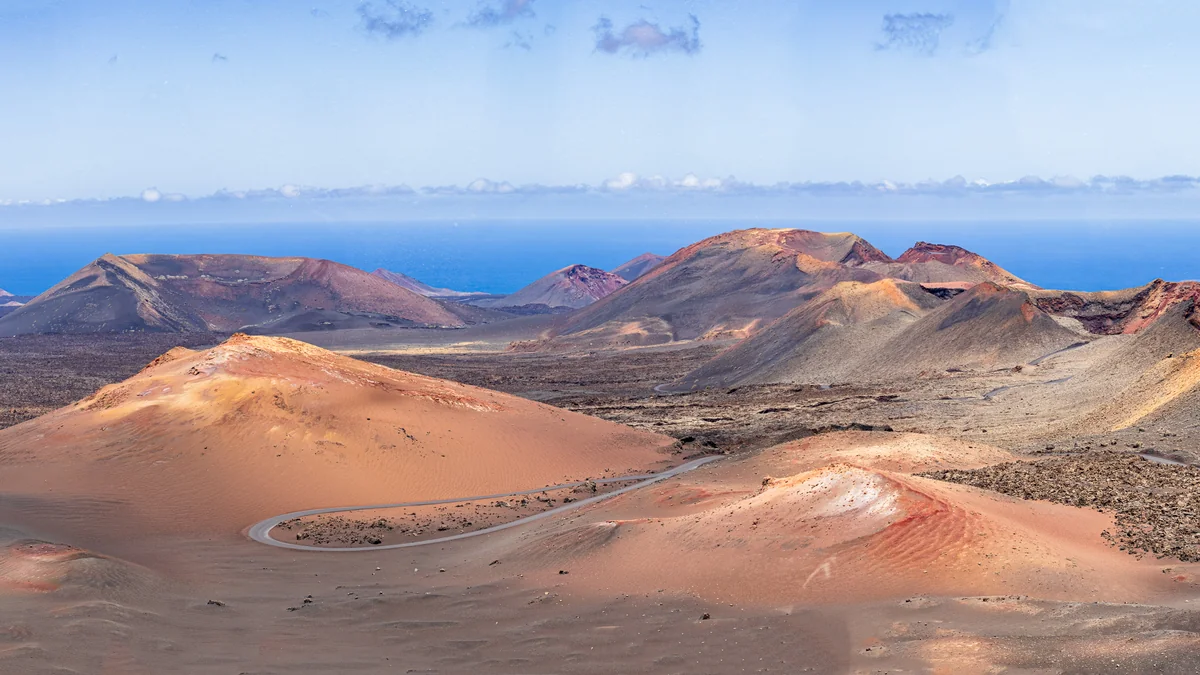
Red, orange and dark volcanic hills surround a winding paved road, with the blue sea beyond.

Volcanic cones and lava fields in Timanfaya National Park, photographed from a bus tour in June 2024.

Timanfaya National Park landscape.jpg — MiljenkoSuljic / Wikimedia Commons / CC BY-SA 4.0 · Creative Commons

Walks and routes

Mancha Blanca exhibitions and raised walkway

Take a short, self-paced look at the exhibitions, then use the raised walkway to see lava without stepping onto it. This is the external gateway stop, not the Montañas del Fuego circuit. Allow 45–75 minutes for the whole centre visit.

The official leaflet describes an adapted walkway, and the centre lists accessible entry and a sensory room. Ask about current surfaces, toilet access and assistance for your visit.


Mancha Blanca exhibitions and raised walkway

Ruta de los Volcanes by coach

From the Islote de Hilario visitor area, the included coach ride takes you through the volcanic interior in about 35 minutes. Stay seated in the vehicle throughout; there are no independent walking stops.

CACT lists adapted coaches. Confirm boarding, wheelchair dimensions and assistance with the operator before booking; the car-park approach is sloping.

Ruta de los Volcanes by coach

Tremesana with a park guide

The free small-group walk links volcanic forms with the ways islanders cultivated a changed landscape. The reservation listing gives 3 km and about three hours; allow the full activity time, including transfers. Meet at Plaza de los Remedios in Yaiza, 15 minutes before your reservation.

The booking page rates it low difficulty but requires closed sports shoes suitable for uneven ground. Participants must be 16 or older; ages 16–17 need an accompanying responsible adult or guardian.

Tremesana with a park guide

Short coastal walk with a park guide

This separate free, reserved outing explores where lava met the sea. The booking listing gives 2.8 km, about three hours and medium difficulty. Its meeting point is the north car park in El Golfo, beside the playground; arrive 15 minutes early.

Expect uneven coastal ground. The reservation requires ages 16+, suitable closed trekking shoes and water. Ages 16–17 need a responsible adult or guardian.

Short coastal walk with a park guide

Long coastal route: a separate demanding day

Official guidance allows independent walking along the public coastal domain, but rates this route as highly difficult on rough lava. Descriptions range from 9 to 9.75 km, with the Canary summary allowing 5–6 hours. Ask the park which start, finish and current route those figures cover before planning transport or a return journey.

This is rugged, exposed walking, unsuitable as a casual family add-on. Take strong footwear, water, food and navigation appropriate to a full walking day.

Long coastal route: a separate demanding day

A relaxed first half-day

Give Mancha Blanca the first 45–75 minutes, then leave enough time to travel to the Montañas del Fuego entrance for the arrival time on your booking. Allow around 90 minutes at the volcanic visitor sector. Keep lunch flexible rather than squeezing in a guided walk as well.

A walking-focused alternative

Build the day around a confirmed Tremesana or short coastal reservation. Follow that activity’s meeting instructions, then add the visitor centre only if its opening hours fit. If there are no walking places, the centre and a separately booked coach visit still make a worthwhile plan.

Things to try

Read the landscape through the window

On the coach, compare rounded cones with broken lava and smoother-looking flows. Pick a colour or texture to follow as the view changes. Save close inspection for authorised visitor areas; a promising photograph is not a reason to get out.

Watch heat being demonstrated

At Islote de Hilario, watch the staff-led demonstrations from the designated area. Ask how the water-and-steam effect works and how it differs from the original eruption. Keep hands and feet clear of the demonstration ground.

A small family challenge

At Mancha Blanca, choose one model or exhibition idea to explain to each other: where the lava went, how a volcanic cone forms, or how life returns. Then look for the same idea in the landscape from the walkway or coach.

Let the exhibitions carry the visit

If conditions make the outdoor sections unattractive, spend longer with Mancha Blanca’s indoor interpretation, provided the centre is open and travel is safe. Do not substitute an exposed coastal walk for a cancelled activity.

Wildlife and habitats

Hoopoe

Watch open ground from a permitted visitor area: hoopoes often feed on the ground and fly with an undulating motion. If a bird moves away, let it go rather than following it across the lava.

Eurasian kestrel

Look up occasionally for a small falcon hovering over open ground. Watch its behaviour from where you are; a hunting bird can move well beyond the area visitors are allowed to enter.

Crystalline ice plant

The park’s flora account includes this plant, locally called barrilla. Ask a guide to point it out if your permitted route passes a suitable patch, and compare it with the lichens without picking either.

The species below are documented for the park, but a visit may bring only a few glimpses. Enjoy the lava and lichens as well as the birds. Watch from authorised areas, avoid nests and do not feed animals, collect plants or step onto the lava for a closer look.

Stories and discoveries

An island within the lava

In this landscape, an islote can mean older ground left surrounded by newer lava, rather than an island offshore. These surviving patches help explain why vegetation is not spread evenly across the park.

Lichens change the first impression

Pale or yellow-green patches on volcanic rock can be living lichens. Trade-wind moisture helps shape their distribution. Look without scraping or touching: these small organisms are a large part of Timanfaya’s story.

A coast belongs to the park too

Timanfaya extends to the Atlantic. Its coastal habitats add another side to the volcanic story, but they are not visited by the ordinary Montañas del Fuego coach circuit. A coastal outing needs its own plan.

When to visit

Warm, bright days

Keep outdoor time manageable, protect skin and carry water. Plan any reserved walk around the actual conditions rather than assuming a short distance makes it easy in strong heat.

Wind, cooler weather and rain

Carry a warm or windproof layer and use the forecast when choosing the day. Walking services can be cancelled under adverse-weather alerts. Check both your booking messages and current park notices.

Getting there and practical advice

Mancha Blanca visitor centre

The centre currently lists daily opening from 09:00 to 16:00. It has exhibitions, audiovisual interpretation, a shop and parking. Ask what is operating that day, particularly the eruption simulation and sensory room. Contact: +34 928 118 045.

Food, toilets and a pause

Montañas del Fuego has El Diablo restaurant and a shop at Islote de Hilario. Eating there is optional and extra; the restaurant operates without table reservations, subject to availability. Bring your own drinking water, and confirm any toilet or baby-care facilities you need before travelling.

Echadero de los Camellos

This is a separate roadside visitor stop with a museum/information point about dromedaries and their local use. The park also lists a café and shop; the museum is closed on Sundays in the current centre listing. The introduced working animals are not wild park fauna.

Use the right destination

The LZ-67 links the visitor facilities between Tinajo and Yaiza. Set Mancha Blanca visitor centre and the Montañas del Fuego entrance as separate stops. Follow CACT’s entrance link for the latter, rather than navigating directly to a viewpoint inside the restricted sector.

Without a car

The park says there is no scheduled public bus into the national park. Village buses to Tinajo or Yaiza can form part of a journey, but arrange the onward and return taxi or a suitable organised excursion in advance. The included volcanic coach is an internal tour, not transport from your hotel.

Mancha Blanca: start with your needs

The centre lists adapted access, accessible parking spaces and sensory material using tactile elements and Braille. Ask staff to suggest a visit that suits your group and confirm the walkway and toilet arrangements before you travel.

Coach access needs its own check

Contact CACT on +34 928 84 84 84 about the adapted coach you will use, including boarding equipment and whether you can remain in your wheelchair. A coach-based visit still includes getting from parking to the boarding area.

Pushchairs and sensory comfort

CACT warns that a pushchair can be awkward and suggests a baby carrier. At the visitor centre, ask about the eruption simulation before joining it if noise or effects could be uncomfortable. Choose the exhibitions or landscape views if that is a better fit.

Sources and useful links

Wildlife you might spot

3

Each card links to a full Explore page with photos, traits, and fun facts.

Snap map for this place

Start with the big picture, then zoom in to explore individual wildlife observations around this place.

Loading map…

Good to know before you go

Buy Montañas del Fuego tickets on the official CACT site for your chosen date and time. Arrive at the entrance 15 minutes early; do not rely on buying a ticket on arrival.

Keep Mancha Blanca and Montañas del Fuego as separate destinations in your journey plan. A visitor-centre stop does not include the coach tour or reserve a guided walk.

Bring drinking water, sun protection, a windproof layer and closed shoes. For the coastal guided walk, water and suitable closed trekking shoes are required.

From El Taro to the Islote de Hilario car park, remain inside your vehicle. On the Ruta de los Volcanes, stay on the coach for the whole circuit.

Follow staff instructions around the geothermal demonstrations and keep children close. Do not test the heat of rocks or ground yourself.

Leave volcanic stones, lichens and plants where they are. Use only authorised paths and parking areas, take your rubbish away and do not light fires.

Check the language, meeting point, age requirements and documents for a reserved walk. Its reservation is separate from CACT admission.

Pets are not permitted. Ask the relevant operator about assistance-dog arrangements. Professional filming or photography needs prior park authorisation; check before planning a shoot.

Frequently asked questions

The Mancha Blanca visitor centre is free. Montañas del Fuego is a separate paid attraction: on 16 October 2026, standard tickets were €30 for adults, €15 for children aged 7–12 and free for ages 0–6. Reduced rates have documentation requirements. Recheck the official ticket page before buying.
The operator currently says tickets must be bought online in advance, for a specific date and time. The ticket page says changes and refunds are not permitted. Follow the arrival time on your booking; published opening-hour summaries differ between official pages.
No. Your vehicle takes you only along the authorised approach to the visitor car park. The volcanic circuit is travelled on the visitor coach, without getting off along the way. An admission ticket does not authorise wandering into the surrounding lava.
No. Tremesana and the short coastal interpretation route are park-led walks requiring reservations. There is also a demanding longer coastal route that official guidance permits independently along the public coastal domain. Get a current route briefing before attempting it; this is not a general right to roam across the park.
The park reservation pages require participants to have turned 16; those aged 16–17 must come with a responsible adult or guardian. Families with younger children can choose the visitor centre and Montañas del Fuego instead.
Plan for cooled lava landscapes and staff-run geothermal demonstrations. The water-and-steam display shows heat below ground; it is not a promise of an eruption or a naturally erupting geyser.
No. The neighbouring Los Volcanes protected area has its own scope and walking options. Do not use a route in that landscape as evidence that independent walking is allowed inside Timanfaya’s restricted interior.

Recent snaps at this place

Recent snaps will appear here as new observations are added.

View all ›

Take the discovery with you

Exploring Timanfaya National Park?

Identify the wildlife you spot, learn as you go, and keep a collection of the adventure.

  1. 1Spot it
  2. 2Snap it
  3. 3Keep the discovery




