
Observation-area circuit
1 km; published walking estimate 30 minutes. Museum → observation point → Forest Trail 1 → museum. A compact first choice if you want interpretation and a short outdoor visit.
 Illustration
The name covers a complex rather than a single pond: Upo, Mokpo, Sajipo and Jjokjibeol are natural wetlands, while Sanbakbeol is a restored wetland.
The name covers a complex rather than a single pond: Upo, Mokpo, Sajipo and Jjokjibeol are natural wetlands, while Sanbakbeol is a restored wetland. A visit can be a short outing from the ecology museum or a longer walk through several named sectors. The paths offer different perspectives on the same living system; completing a circuit does not mean reaching every pool or entering the protected habitat.
This is a landscape shaped by water. The Ramsar description connects its lakes, ponds and marshes with fish habitat and the needs of breeding, passage and wintering birds. Conditions change with rainfall and plant growth, so an attractive scene in a photograph may look very different on arrival. Use the signed public paths, leave the water and vegetation undisturbed, and let the day’s weather and restrictions determine how far you go. Take the ultimate field guide with you: use the Snappit app to identify birds, plants, and animals on your trip.
Upo received Ramsar designation on 2 March 1998 and became a Korean wetland protection area in August 1999. These designations recognise conservation value, rather than defining a walking route. The Ramsar listing’s 854 hectares and smaller tourism-area figures refer to different scopes and should not be used interchangeably. Today the surrounding visitor facilities and public paths let people learn about the wetland while keeping much of the habitat outside ordinary visitor access.
Start with the ecology museum if it is open, then choose between the short observation-area circuit and a longer embankment walk. The museum makes a useful introduction before looking across the real wetland. For a first visit, favour time to stop over covering maximum distance: distant birds need binoculars, and much of the interest lies in the transition from open water to plant-covered shallows. The Mokpo circuit starts at a different car park, so decide on your route before arranging a lift or return transport.
Water levels, vegetation and bird presence vary. Summer rain can alter access, while autumn and winter bird-health measures can affect visitor choices. A flowering period, misty morning or particular bird should be treated as a possibility, never an appointment.
The ecology museum offers ramped entry, a lift and accessible toilets. For a wheelchair or stroller visit, make it your starting point and ask staff to help choose a suitable outdoor section.
A wetland complex with natural pools and restored Sanbakbeol
Short observation-area walks and longer embankment circuits
Aquatic plants above, on and below the water
Wintering-bird habitat and the story of ibis restoration
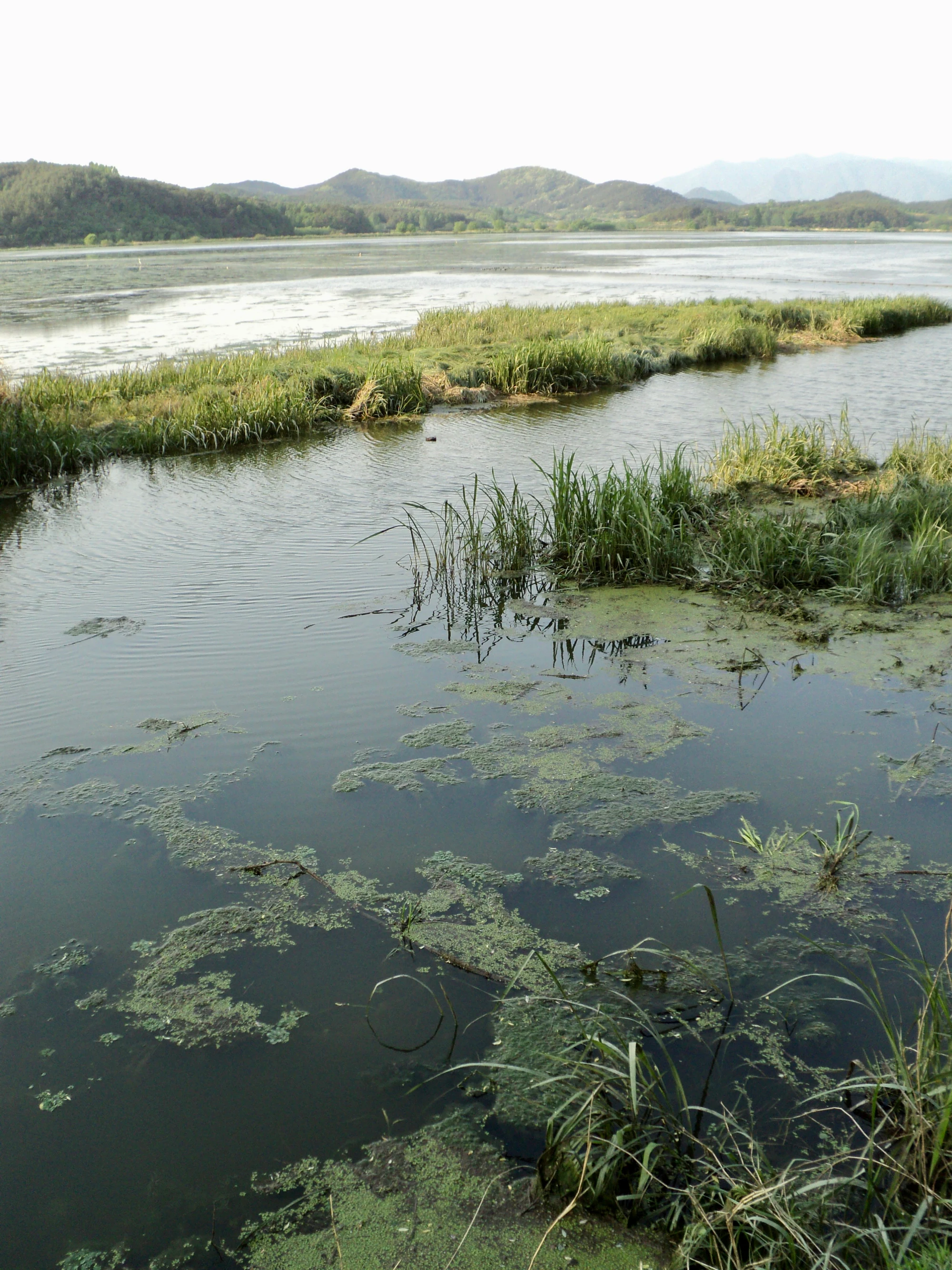
Upo Wetland photographed on 17 May 2011. This historical view does not show current water levels or vegetation.
“Upo Wetland” by Kyle (Kjmagnuson), via Flickr, licensed CC BY 2.0. No changes. · Creative Commons 1 · Creative Commons 2
1 km; published walking estimate 30 minutes. Museum → observation point → Forest Trail 1 → museum. A compact first choice if you want interpretation and a short outdoor visit.
2.5 km; published walking estimate 60 minutes. Museum → Daedae embankment → observation point → Forest Trail 1 → museum. Choose this over the shortest option if you want more walking without committing to the long circuits.
4.8 km; published walking estimate 120 minutes. Somok village car park → Forest Trail 3 → second observation point → Mokpo embankment → Uman embankment → willow stand → Pureun Upo Saramdeul → Somok car park. This has a separate start; do not arrange collection at the museum unless you have planned the transfer.
8.4 km; published walking estimate 180 minutes. Museum → Daedae embankment → Sajipo embankment → Forest Trail 2 → Somok village → Forest Trail 3 → second observation point → Mokpo embankment → sedge stand → observation point → museum. Reserve enough daylight for stops and a slower return; avoid adding this after a late museum visit.
9.7 km; published walking estimate 210 minutes. Museum → Daedae embankment → Sajipo embankment → Forest Trail 2 → Somok car park → Forest Trail 3 → Mokpo embankment → Upo suspension bridge → Sanbakbeol → museum. Choose this for the restored-wetland sector only after confirming the bridge and all connecting sections are available.
Suggested budget: two to three hours. Begin with the museum during its opening hours, ask which outdoor sections are suitable that day, then choose the observation-area or Daedae circuit. Leave a margin for rest stops and return transport. Shorten the walk if conditions deteriorate.
Suggested budget: four to five hours. Choose one long museum-based circuit after checking the whole route, or make the separate Somok start your focus for Mokpo. Bring water and food, keep a daylight margin and resist adding a second circuit simply because its distance looks short on paper.
Before choosing any circuit, ask visitor information which paths are open and whether the surfaces, slopes and steps suit your group. A short distance does not guarantee a step-free walk. Follow the signed route, and turn back at any barrier or flooded section rather than looking for a shortcut.
The route list preserves the county’s named sequences. Its walking times do not include the museum, a picnic or long birdwatching stops. Ask for the current visitor map on arrival, identify the correct return branch, and turn back if access has changed. Do not improvise a shortcut through vegetation, fields or a water crossing.
Use binoculars or a long lens from a permitted viewpoint, leaving birds room to feed and rest. If they become alert or move away, increase your distance. Wide landscape photographs can show the wetland’s pattern without needing a close encounter. Keep tripods out of the walking line and avoid publishing sensitive nesting locations.
If the museum is operating, its exhibitions provide a worthwhile wet-weather introduction without needing a long walk. Check the Monday and holiday closure rule first. In heavy rain, lightning or high water, postpone the outdoor route rather than treating a wooded section or bridge as a weather shelter.
Cygnus cygnus is documented at Upo, including a January 2012 field visit. It is a reason to understand the wetland’s winter role, not a promise that swans will be visible from your chosen path.
Platalea leucorodia appears in Upo’s conservation accounts and the government’s 2024 overview. Watch any distant white wading birds carefully through binoculars; do not assign an identification from colour alone or approach to obtain a photograph.
Ardea cinerea is explicitly documented in the dated Upo field report. Shallow-water edges are a sensible place to watch wading birds from a permitted path, but an old record does not guarantee today’s presence.
Phragmites australis is among the plants listed by Upo researchers. Reed margins contribute to the wetland’s layered appearance; stay outside them and avoid treating every tall waterside grass as the same species.
Hydrilla verticillata represents the submerged part of the plant community. It may be hard to recognise from the bank. Do not enter the water or pull up stems to confirm an identification.
Spirodela polyrhiza is another plant documented in Upo research. Small floating plants can be difficult to separate at a distance; use this as an introduction to the habitat, not a claim that every green surface patch is this species.
Researchers studying Upo in summer 2013 recorded pheasant-tailed jacanas nesting on prickly water-lily leaves. That historical observation helps explain why apparently empty plant beds deserve space. It is not a forecast of nesting birds at a particular viewpoint today, and visitors should not search inside the vegetation.
A study of Mokpo found that aquatic-plant distributions differed with water depth. Emergent margins, floating leaves and submerged growth are therefore more than different shades of green: they occupy different parts of the wetland environment. The visible pattern can shift, so a single photograph is not a permanent habitat map.
Sanbakbeol was restored in 2017. Research published in 2024 examined its early restoration ecology and management needs. It is a useful place to think about restoration as an ongoing process involving water and vegetation, rather than assuming a restored area immediately functions like every older part of Upo.
Aquatic vegetation begins its growing season. Make the short circuit the default if your group wants frequent stops, then extend only if the day’s conditions suit. Avoid promising a particular flower from a calendar alone.
Warm-season plants can give the wetland a very different appearance from its winter open water. Summer-concentrated rainfall is part of Upo’s ecology. Check forecasts and water-related restrictions, carry water and choose a shorter visit during uncomfortable heat; do not step into flooded paths.
Upo’s seasonal descriptions highlight autumn mist, but it depends on conditions. Do not make a tight itinerary depend on seeing it. With migratory birds returning, check the current biosecurity advice before planning a dawn wildlife outing.
Historical winter records include Whooper Swans and Grey Herons. Dress for standing still as well as walking, and watch from a permitted distance. Bird-health guidance takes priority over a seasonal birdwatching plan; indoor interpretation can be the better choice when outdoor visits are discouraged.
At 220 Upo-neup-gil, Yueo-myeon, the museum presents wetland life through five themed exhibition areas, models and videos. KTO’s September 2026 listing gives free admission, 09:00–18:00 opening and last entry at 17:00. It closes on Mondays, the following day when Monday is a public holiday, and 1 January. Confirm changes on 055-530-1556.
Upo tourist information is listed on 055-532-0660. Ask about today’s path restrictions, the return bus and a route suited to your group. Toilets around the wetland are limited, so use the visitor-area facilities before a longer outing. Carry what you need rather than depending on finding refreshments halfway round.
The ibis programme began in 2008, with the first wild releases in 2019. The restoration centre requires advance arrangements and may suspend visits for bird-health reasons. The separate wetland experience centre includes aquatic-plant and fish interpretation. Confirm the specific facility and programme before travelling; neither is automatically included in a museum visit.
Museum-based walks start at 220 Upo-neup-gil, Yueo-myeon. The Mokpo circuit starts at Somok village car park, 330 Upo 2-ro, Ibang-myeon. These are different meeting points. If arriving through Changnyeong bus terminal, ask tourist information to confirm the current onward service and return departure before setting out. For a taxi or private pickup, agree the exact car park and time.
KTO lists accessible parking, ramped entry, a lift, accessible toilets, Braille information, wheelchair and stroller loans, and a nursing room at the museum. Ask about availability rather than relying on a loan device being free when you arrive. For the outdoor visit, check recent surface conditions, any steps or steep sections, usable toilets and a comfortable turnaround point. Building access and trail access need separate answers.
Each card links to a full Explore page with photos, traits, and fun facts.
We are still adding species preview cards for this place.
Start with the big picture, then zoom in to explore individual wildlife observations around this place.
Carry binoculars; stay on the public path rather than moving closer to birds.
Use the visitor-area toilets before a long circuit, and carry drinking water.
Choose your starting car park and confirm the return journey before walking.
Bring sun and rain protection; do not continue onto a flooded or closed section.
Keep voices low, take litter away and leave plants and animals where they are.
Check current notices before travelling, especially in the winter-bird season.
Recent snaps will appear here as new observations are added.

Maryland, US
You might spot White-Tailed Deer and Eastern Gray Squirrel.
View guide →

District of Columbia, US
You might spot Eastern Gray Squirrel, Duck, and House Sparrow.
View guide →

Illinois, US
You might spot American Robin, Canada Goose, and House Sparrow.
View guide →

Virginia, US
You might spot Spotted Lanternfly and Northern Cardinal.
View guide →
Take the discovery with you
Identify the wildlife you spot, learn as you go, and keep a collection of the adventure.