



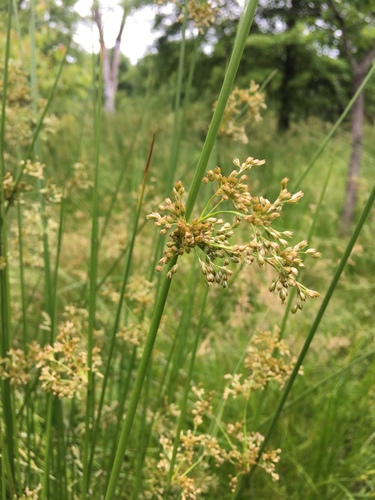
Foxtail Barley
Upload a photo of the leaf bases, stems and seed head to identify grasses, sedges and rushes. Then dig deeper in the Snappit field guide.

Identify and collect plants and mushrooms with your phone.


Drag a photo here, or choose one below.
JPG, PNG or WebP · Up to 10 MB

Include a whole seed head and several leaves. A close-up of the leaf sheath and stem helps too, if you can get it without pulling the plant up.

Compare the suggested name with what you see in your photo. Then open its field-guide entry for fun facts and look-alikes to rule out.

Browse the field guide here, or save your finds as collectible cards in the Snappit app. Build collections and learn something new together.
From the Snappit field guide: the meadow grasses, fluffy seed heads and pond-edge rushes kids brush past on every walk. Open a card for a closer look.
A freshly mown lawn hides most of the details that set grasses apart. Look for an unmown flowering stem, the leaf bases, and whether the plant forms a clump or spreads. Sedges and rushes can look similar, so check several structural clues instead of relying on one stem-shape rule.

Start where the leaf meets the stem. In grasses, the long flat or folded blade grows from a sheath, the lower part that wraps around the stem, usually split down one side. A photo showing both the blade and that wrapped base is far more useful than a close crop of green leaves.

If you can see it, the ligule is worth catching. It's a tiny flap or fringe of hairs right where the blade meets the sheath. It can be papery, short, long or hairy, and those differences help separate grasses that otherwise look alike.

The flowering top is often the biggest clue. Some grasses have open, airy sprays of many small branches, while others carry tight spikes or brushy heads. Show the full shape, not just a magnified piece, because the outline of the whole seed head matters as much as the fine detail.

Step back to show how the plant grows. A fountain-like tuft points to a clumping grass, while scattered shoots, runners or a creeping patch mean it spreads. Growth habit won't name a plant on its own, but it helps sort lawn grasses, ornamentals, sedges and stubborn grassy weeds.
Compare real field-guide examples: Foxtail Barley · Timothy Grass · Orchard Grass

"Sedges have edges": many have solid, triangular stems, while grasses usually have round, hollow stems with obvious joints. The rhyme is a clue, not a rule. Sedges also tend to grow in tidy tufts, with leaves in three rows and closed sheaths, while grasses show varied seed heads.

"Rushes are round": they're often wiry, with smooth cylindrical stems and few or no flat leaf blades. Some look like plain green rods with a flower cluster that seems to burst from the side near the tip. If your plant looks more like rods than leaves, photograph the stem and base clearly.

A lawn can hold several grasses, and short mown leaves look nearly identical. Once a stem escapes the mower and flowers, it can look surprisingly different from the rest of the turf. Compare it with the patch around it: seed head, stem height, and whether it rises alone or from a tuft all help.

Grasses without flowers are harder, but not hopeless. Look at where each leaf starts, whether blades are folded or flat, how wide they are next to the stem, and whether the plant makes a dense tuft or sends shoots outward. A seedling with two or three leaves may only narrow to a broad group, while a bigger plant without flowers still shows useful structure.
Don't lean too hard on color or leaf width. Bright green, bluish, narrow and broad leaves turn up in many unrelated grassy plants depending on age, water and mowing. A clear view of the lower stem, the leaf bases and how the plant grows usually tells you more than a close-up of one blade.

In a lawn, the question is usually whether a patch is part of the turf or a different grassy weed or sedge. Show the contrast: take a wide shot with the patch and a closer one, then upload whichever is clearer. Notice whether the odd patch grows faster, stands more upright or forms a denser clump.
Ornamental grasses and tall roadside plants are easier once you can see the whole plant. Many ornamentals form rounded fountains, while roadside grasses may stand in tall columns, reedy stands or airy flowering tops above the verge. Season and region help when you compare candidates in a local guide, though you can't enter them with the photo.
One frame that shows the lower leaf bases and the seed head gives far more to work with than a tight crop of leaves or flowers alone.

If you can, photograph the spot where the blade meets the stem. That's where the sheath and ligule show, two of the most useful grass features.

Take a few photos if you need to, then pick the clearest. The tool accepts one JPG, PNG or WebP image up to 10MB.
Sometimes, especially if a stem has flowered. A freshly mown lawn usually hides the features that separate common turf grasses. Look for an unmown stem and photograph it with part of the surrounding patch. Without a seed head, you may only get a broad grass group rather than an exact species.
Ornamental grasses are often easier than lawn grasses because their whole shape shows well. Capture the full clump, its height next to nearby plants, and any flowering plume or spray. Many are recognized from shape and seed head together, while a cropped shot of leaves alone says much less.
Height alone won't narrow it much, since lots of species grow tall in rich roadside soil. The best clues are the full seed head shape, whether stems stand alone or in a colony, and how the leaves attach lower down. Step back far enough to keep the plant's outline in the shot.
Look at the structure, not the color. Many sedges have solid, triangular stems you can feel as edges when you roll them between your fingers, with leaves in three rows and no obvious joints. It's not a perfect test, so photograph the base, several stems and the flowering top if there is one.
Yes. With grasses, the flowering or seeding top is often the fastest way to narrow things down. An open, branching spray points to a different set of plants than a tight spike or a bottlebrush head. Even when the flowers are tiny, the shape of the whole head says a lot.
Usually only broadly. Young grassy seedlings haven't grown the features that separate similar species yet, so you may get grass, sedge, rush or a smaller group rather than an exact name. Once the plant grows a bit, the leaf bases and any flower stem will help much more.
Yes. Snappit for iPhone and Android identifies grasses, flowers, trees and 3,600+ other plants from a photo, with short, kid-friendly facts. Each find becomes a collectible card with a rarity tier in a private family collection, with no ads or chat. It's free to download with free IDs every day; a subscription unlocks unlimited snaps.
Some are. Foxtails, wild barley and other grasses with stiff, barbed bristles on their seeds can burrow into a dog's ears, nose, eyes or between the toes. Check your dog after walks through long grass in summer, and see a vet if your dog keeps shaking its head, sneezing or licking a paw.
The Snappit appAges 4+ · No ads
Take what you learn here into Snappit and turn your next walk or day out into a shared adventure.
Save your discoveries as collectible cards in the app, with rarity tiers and themed collections to explore.
Short, friendly facts give young readers something to notice, ask about, and remember. The app is made for ages 4 and up, without ads.
Discover new collection themes, try the daily discovery, and earn badges as you keep exploring together.


Open a place guide to see its species checklist and plan what to look for on your next visit.
South Carolina, US
You might spot Soft Rush, Schoenoplectiella, and Fuirena Ciliaris.
View guide →

British Columbia, CA
You might spot Silver Hairgrass, Orchard Grass, and Bulbous Bluegrass.
View guide →

Pennsylvania, US
You might spot Woolgrass, Sallow Sedge, and Japanese Stiltgrass.
View guide →