
Snappit logo
Snappit
Get App
Generic illustration, not a photograph of this venueIllustration
ParkFR

Ballons des Vosges Regional Nature Park

Rounded mountain summits are only one part of the Ballons des Vosges.

About

Rounded mountain summits are only one part of the Ballons des Vosges. The park’s character comes from the contrasts between high pastures, glacial hollows, deep woodland, inhabited valleys and the pond country of Haute-Saône. Established in 1989, this is a regional nature park where conservation, farming, villages and working landscapes belong together. It spans Grand Est and Bourgogne-Franche-Comté, across Haut-Rhin, Vosges, Haute-Saône and Territoire de Belfort.

For a first family visit, choose the Chajoux valley at La Bresse. Lispach lies at about 910 metres, in a hollow shaped by ice. Open water, floating vegetation and wooded margins sit close enough together to compare from the marked path. The apparent simplicity of the scene is the attraction: children can start by distinguishing water, trees and peatland, then use the interpretation panels to understand how they connect.

The lake also tells a human story. Its basin is glacial, but its water level has been altered by dams; it is not an untouched glacial relic. Water management historically supported the textile industry farther down the Chajoux valley. That combination of natural processes and local livelihoods makes Lispach a good introduction to the wider park. Munster is a useful eastern gateway, while La Bresse is the practical base for this particular outing. They are different starting points, so allow for the mountain journey between them. Turn your visit into a safari! Use the Snappit app to scan and log wildlife sightings here.

The park was created in 1989. Its current classification was extended to 3 May 2027, while a successor charter is being prepared. Across the mountains, pasturing, forestry, water use and local crafts have helped shape landscapes that are still lived in today.

What to do here

Walk the lake-only yellow-ring circuit at Lispach, read a few panels and pause where the path gives a clear view across the floating vegetation. Keep the whole visit centred on the lake rather than adding a summit. If your party wants a longer walk, decide on the separate Lispach–Ténine interpretation itinerary before setting off.

Seasonal info

These are mountain wetlands. Rain can make the wooden walkways slippery, autumn daylight runs out early, and snow or ice changes a short walk into a different undertaking. Summer access information and shuttle dates must not be carried over into winter.

Accessibility

The lake circuit is described as easy, but that does not establish wheelchair or pushchair access. Wooden walkway sections are specifically reported, with a slipping hazard when wet. Ask the tourist office about current surfaces, steps, widths and the approach from your parking or drop-off point before relying on a continuous accessible circuit.

Don't miss

1

A floating peatland seen from a marked lakeside walk

2

Interpretation panels that explain the wetland at a family-friendly scale

3

Forest, water and peatland in one compact outing

4

A wider park of high pastures, inhabited valleys and pond landscapes

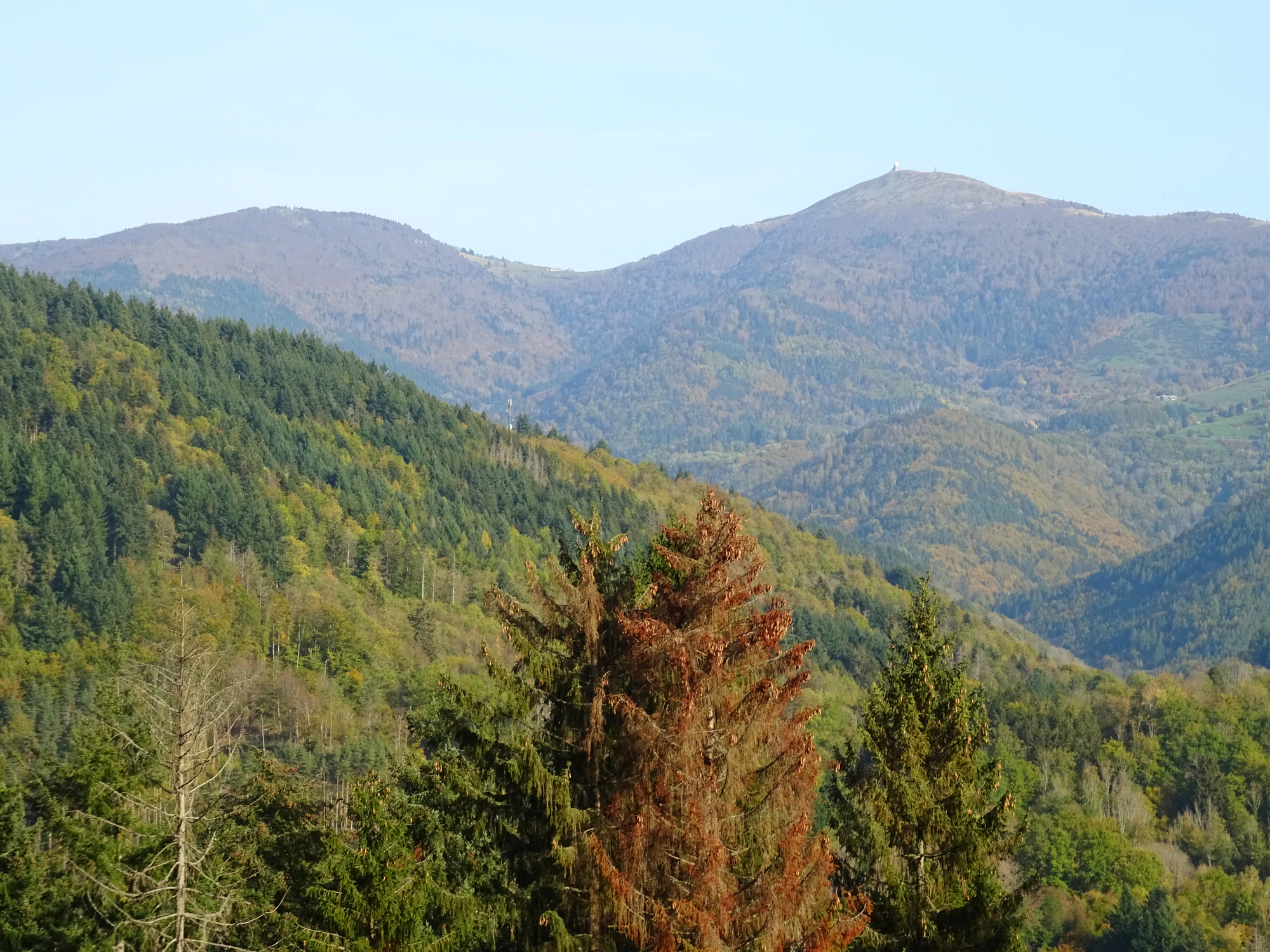
Green and yellow woodland covers successive hills below a rounded summit with a small white radar structure; a large brown conifer stands in the foreground.

Wooded slopes below the Grand Ballon, photographed on 29 October 2022 from the descent towards Bitschwiller-lès-Thann. This historical view gives context for the wider park; it does not show Lispach or current route conditions.

“Vue vers le Grand Ballon d'Alsace, depuis la descente vers Bitschwiller-lès-Thann, Haut-Rhin” — Olive Titus, CC BY 2.0. Source: https://www.flickr.com/photos/96064256@N04/52468238007/. License: https://creativecommons.org/licenses/by/2.0/. Original unchanged. · Creative Commons

Walks and routes

Lac de Lispach: the short yellow-ring loop

Start at the signed lake access on Route de Lispach in La Bresse and follow the yellow-ring waymarks around the lake. The tourist office publishes 2 km with 36 m of ascent. Take the panels in small doses: choose one about how the peatland formed, then look back at the water to connect the explanation with the landscape. There is no need to complete every panel or find a rare species for the walk to work well.

Several sections use wooden walkways. Wet surfaces can be slippery; the official easy rating describes walking effort, not an audited step-free route. Turn back if the next section is unsuitable for anyone in your party.

Lac de Lispach: the short yellow-ring loop

A gentle half-day from La Bresse

Begin by checking conditions and the chosen trail at the tourist office if needed. Travel to Lispach, give the short circuit 1–2 hours with stops, then return to La Bresse for a meal or a village visit. Keep an unhurried margin for wet footwear, children’s breaks and the journey back. This plan does not depend on fitting in a second mountain site.

A second day for the wider park

From an eastern base such as Munster, use the park’s reception and interpretation at Le Tétras 1139 on the Col de la Schlucht to understand the high landscapes before choosing another walk. Check opening times and road conditions first. The pass and nearby reserve terrain are a separate excursion; they are not an extension of Lispach’s short circuit.

If you want to include La Ténine

The departmental tourism listing describes a 4.5 km Lispach–Ténine interpretation itinerary, rated easy, with a published walking time of 1 hour 30 minutes. Treat it as a separate choice from the short lake loop. Obtain the current route sheet and check its full course before starting; allow extra time for panels and family stops. The shorter circuit is the better default when energy, footing or daylight is uncertain.

Things to try

Read the edge of a floating landscape

Look for the boundary between open water and the mat of vegetation, then compare it with the wooded bank. Without leaving the path, make a simple sketch with three shapes: lake, peatland and forest. The exercise works even when individual plants are too far away to identify.

Make photographs that show relationships

A broad view can include both the water surface and the surrounding trees; a closer view from the path can show contrasting textures. Wait for people to pass before stopping on a narrow section. A camera zoom is more useful here than trying to approach a plant across the bog.

Art and local heritage in La Bresse

The Maison de La Bresse, 7A rue de la Clairie, offers changing art and heritage exhibitions with free admission. Its published standard pattern is Tuesday–Friday 10:00–12:00 and 14:00–18:00, and Saturday–Sunday 14:00–18:00; check the current exhibition’s hours and holiday exceptions. It is a useful village alternative when wet walkways or mountain weather rule out the lake.

Wildlife and habitats

Sphagnum mosses

The park’s Lispach account records sphagnum mosses, including a species sensitive to trampling. Look at the mossy carpet as a habitat from the walkway; colour alone will not identify a species. Sphagnum is a whole group of mosses, so enjoy the variety without trying to name every patch.

Sundews

Lispach’s manager describes several sundew taxa. These small insect-catching plants are one reason the peatland deserves such careful treatment. Use the panels or a guided explanation to learn about them, and accept that they may be too small or too far from the path to see.

Bog cranberry

The 2010 Lispach management plan records bog cranberry among the peatland plants. It also describes its relationship with the cranberry fritillary, whose caterpillars feed on the plant. Treat this as background about the site’s ecology, not a promise of a current sighting or an invitation to pick fruit.

Small whiteface

This dragonfly is listed in the 2010 site plan among specialists associated with acidic peatland pools. Watching insects from the path is worthwhile on suitable days, but identifying a fast-moving dragonfly can be difficult. A fleeting view should stay unidentified rather than becoming a certain record.

Stories and discoveries

Peat is an accumulation, not ordinary soil

In waterlogged conditions, plant remains break down slowly and can accumulate as peat. Sphagnum mosses help create the growing carpet. The resulting wetland stores water and holds a long environmental record, which is why a small patch can be important far beyond its size.

High grassland has a human history too

The wider park’s high pastures belong to a working mountain landscape. Looking at them as part of a relationship between livestock, local livelihoods and conservation makes more sense than expecting every open slope to be untouched wilderness.

When to visit

Spring and early summer

Wait for a genuinely snow-free, usable path. The wetland may be saturated even when the valley feels warm. Spring is also sensitive for wildlife, so stay with marked routes and avoid making a search for nesting birds part of the outing.

Summer

Give time to the small-scale wetland features rather than treating the lake as a bathing stop. Bring water and protection from sun as well as rain. Confirm any summer shuttle anew; its service dates are shorter than the full walking season.

Autumn and winter

Autumn colour can make the surrounding woodland especially engaging, but leaves and moisture can conceal slippery footing. Start with enough daylight for an easy return. In winter, seek current advice from the local operator and choose an appropriate maintained activity; do not walk out onto a frozen lake or bog.

Getting there and practical advice

Get the right route sheet

La Bresse tourist office is at 2A rue des Proyes. Ask specifically for the lake-only Lispach circuit if you want the shorter outing, and ask about any current path work or restrictions. Take a map or downloaded route information with you rather than depending on continuous phone reception.

Pack for a self-contained walk

Carry water and a small snack and use town facilities before setting off. Do not build the visit around a seasonal café, a drinking-water tap or an accessible toilet beside the lake without checking those details first. For a rest, choose an established stopping place and leave room for other walkers.

Arriving by road

For the recommended walk, use the signed access on Route de Lispach in La Bresse. Check local notices and park only where permitted, leaving entrances clear. If you are crossing the massif, verify the actual roads: the Route des Crêtes has winter closures, and a route suggested by a satnav is not evidence that a mountain road is open.

Public transport needs two separate checks

Munster has TER services towards Colmar and Metzeral, useful for an eastern park base. They do not deliver you to Lispach. La Bresse’s free Esti’Van shuttle served the lake in the published 2026 summer season, 11 July–23 August; that season has ended. Check newly published dates and the last return before relying on a future shuttle, and arrange the connection to La Bresse separately.

Choose by surface, not by the word easy

If you use a wheelchair, walking aid or pushchair, ask about the complete route from arrival to return: any steps, narrow boards, gaps, gradients and wet-weather limitations all matter. A short suitable out-and-back section may be more enjoyable than committing to the loop, but agree that section with local staff rather than assuming it exists.

Pace and supervision

For children who tire quickly, make the first clear lake view a perfectly acceptable destination. Have an adult manage any water-edge pause while another reads a panel with the group. Carrying a young child also changes your balance on damp wood, so be willing to shorten the visit.

A regional park contains different protected areas

Lispach is a sensitive wetland and Natura 2000 site; its visitor rules do not stand for every part of the park. At Machais, the central peatland is closed to visitors all year and dogs are not allowed even on a lead. The Route des Américains is closed to vehicles in winter. At Frankenthal-Missheimle, some paths close from 1 November to 30 April; dogs are excluded except where tolerated on a lead along the GR5. Check the specific reserve’s information before a separate visit.

Sources and useful links

Wildlife you might spot

4

Each card links to a full Explore page with photos, traits, and fun facts.

We are still adding species preview cards for this place.

Snap map for this place

Start with the big picture, then zoom in to explore individual wildlife observations around this place.

Loading map…

Good to know before you go

Choose the lake-only route on the day’s map: the combined Lispach–Ténine itinerary is longer.

Bring shoes with grip, a warm layer, rain protection and drinking water, even for a short circuit.

Keep children close beside open water and on narrow walkway sections; the floating vegetation is not a play surface.

Photograph plants from the path and leave moss, flowers and berries in place. Fires and wild camping are prohibited at Lispach.

At Lispach, keep dogs on a lead. Rules in other protected parts of the park differ.

Check the weather, local access notices and your return transport before leaving your base.

Use daytime for your visit and keep voices low around wildlife.

Choose a village stop instead of a forest walk in strong wind or thunderstorms.

Frequently asked questions

No. The recommended first outing is the lakeside circuit at Lispach. Ridge walks and the Sentier des Roches need separate planning and are outside this family itinerary.
No. Swimming and water activities are prohibited; the tourist office identifies fishing as the exception, subject to its own requirements. A lakeside walk does not include permission to enter the water.
A dog on a lead is allowed on the Lispach itinerary according to the tourist office. Do not extend that permission to every reserve: Machais excludes dogs, including those on leads.
The regional park is a broad inhabited territory, not a single gated attraction. The recommended lake walk is presented as a self-guided outdoor outing; visitor centres, guided activities and winter facilities have their own arrangements.
No. Munster is an eastern gateway to the park. The chosen trail is on Route de Lispach in La Bresse, on the Vosges side. Plan the onward journey separately.

Recent snaps at this place

Recent snaps will appear here as new observations are added.

View all ›

Take the discovery with you

Exploring Ballons des Vosges Regional Nature Park?

Identify the wildlife you spot, learn as you go, and keep a collection of the adventure.

  1. 1Spot it
  2. 2Snap it
  3. 3Keep the discovery
