An unhurried hour
Use this flexible order during ordinary daytime opening. Choose only the paths and rooms open on the day; reverse the order if weather or access makes that easier.
 Illustration
Yokokan is a lovely place to give an hour your full attention.
Yokokan is a lovely place to give an hour your full attention. The large pond, low roofs and planted banks belong to a single composition: walk outside to see the residence across the water, then go indoors and let its rooms frame the garden. The sukiya-style building sits so close to the pond that the boundary between house and landscape seems unusually thin.
This was a retreat for the Matsudaira lords of Fukui. Today’s residence is a reconstruction, while important elements of the historic garden survived the 1945 air raid. That history makes the carefully recovered relationship between architecture, water and stone especially rewarding to notice.
Keep the visit small and unhurried. Notice a reflection, follow the changing shoreline from the open paths, and leave time to sit. It suits children who enjoy a short looking-and-listening challenge, as well as anyone drawn to gardens or traditional buildings. For more historical context, the Fukui City History Museum is immediately to the west; treat it as an optional extra with its own opening calendar. Turn your visit into a safari! Use the Snappit app to scan and log wildlife sightings here.
Known in the Edo period as Osensui Yashiki, the site became a Matsudaira family villa and was substantially remodelled under the seventh lord. Its buildings were lost in the 1945 air raid, but the pond and significant garden features survived. National Place of Scenic Beauty designation followed in 1982. The residence and garden were restored using archaeological evidence and an 1823 plan, and opened to the public in 1993.
Combine a gentle garden stroll with the residence. Try the pond-facing Kushigata-no-Oma, then look into the Moon-viewing Room, Otsukimi-no-Ma, when it is open. Outside, compare the scene from different public paths instead of searching for one perfect photograph. Watch the koi, inspect the stonework without climbing on it, and finish with a few quiet minutes looking over the water.
Plum and cherry blossom bring interest in late winter and spring; summer shifts the emphasis to green foliage and water. Autumn is the season for colourful leaves and special evening openings. Winter can be beautiful but snow changes the practical visit: some paths may close and parking may shrink. Check the current notice before setting out.
The historic landscape includes stone bridges and stepping stones. If you use a wheelchair, mobility aid or stroller, contact the garden before travelling to discuss suitable paths and access to the residence. Do not assume every part of the garden circuit will suit you. The neighbouring History Museum lists accessible toilets and step-free exhibition rooms, subject to its own opening times.
A seated view from the residence, with the pond close below the windows.
The Moon-viewing Room and its carefully framed garden outlooks, when open.
Stone bridges, shoreline rocks and changing reflections along the garden paths.
A quiet encounter with the pond’s managed ornamental koi.
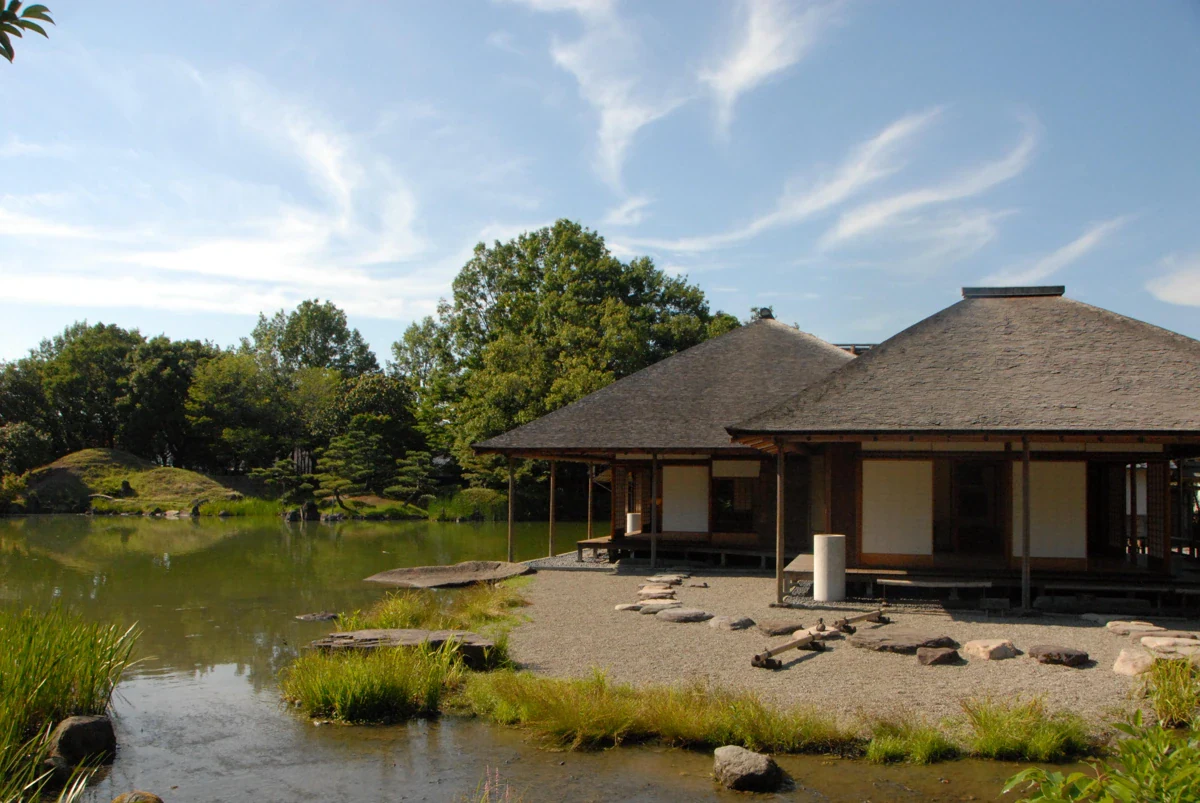
Yokokan Garden’s pond and waterside residence in summer, photographed on 9 July 2013.
夏の養浩館庭園 — Fukui City, CC BY 2.1 JP (https://creativecommons.org/licenses/by/2.1/jp/). Source: https://www.city.fukui.lg.jp/photo/meisyo/youkoukan/p014168.html. Proportionally reduced to a 1200-pixel width without upscaling; recompressed to WebP quality 92, method 6. No crop, retouching, added text or colour correction. EXIF omitted. © Fukui City. No warranties; Fukui City assumes no liability for acts performed using information in its photo library. · Creative Commons
Use this flexible order during ordinary daytime opening. Choose only the paths and rooms open on the day; reverse the order if weather or access makes that easier.
Allow 5–10 minutes to pay, read the day’s notices and ask which rooms are available.
Spend 15–25 minutes following the open garden paths, pausing for water, rocks and the view back to the residence.
Spend 15–25 minutes in the available rooms. Sit if comfortable and let your eyes settle on the view rather than moving straight on.
Keep 10–15 minutes for a favourite reflection, koi-watching or a short sketch before leaving.
Choose a view with both roof and water, then make a second sketch or photograph from another open path. What changes when the reflection breaks into ripples? Let children choose which version they like better.
In Goza-no-Ma, look for the carved hemp-leaf pattern above the room opening. Then compare a standing view with a seated one without touching the fittings. Small details reward a slower visit.
On the listed autumn dates, tea is served in the Moon-viewing Room. Each session takes about 30 minutes; the tea may be matcha or sencha depending on the day. Choose this as an extra pause, and check the programme before arriving.
If the residence is open, spend more of the visit enjoying the garden from its rooms and keep the outdoor walk short. The History Museum next door gives you an indoor alternative, but has separate maintenance and exhibition-change closures. In autumn 2026 these include 30 October and 24–27 November.
Look for differences in colour and pattern as the koi move through the water. These are ornamental fish cared for by the garden. Watch from a safe public viewing position; you do not need to feed them to enjoy the pond.
The garden’s broad pond has no central island. Its open water gives reflections plenty of space, while the irregular edges keep the view changing.
Matsudaira Shungaku named the site Yokokan in 1884, drawing on a phrase in Mencius about nurturing an expansive spirit. Earlier visitors knew it as Osensui Yashiki.
An 1823 drawing and archaeological investigation helped recover the buildings and their relationship with the surviving garden. The residence you enter is the result of that restoration.
Look for plum and cherry blossom in late winter and spring, then enjoy the garden’s leafy appearance as the season warms. Exact flowering dates vary, so keep the pond and architecture at the heart of the plan.
The 2026 illumination runs on Fridays, Saturdays, Sundays and public holidays from 1–29 November, 17:00–20:30, with last entry at 20:00. Admission is ¥220 with the usual exemptions. Some paths close after dark, so follow the evening arrangements.
Check the forecast and travel conditions first. Snow can close garden paths and reduce parking capacity. Wear footwear with grip, follow barriers and be ready to shorten the outdoor part of the visit.
Normal hours are 09:00–19:00 from 1 March to 5 November, and 09:00–17:00 from 6 November to the end of February. Last entry is 30 minutes before closing. The garden closes 28 December–4 January; additional management closures may be announced. Prices and exemptions are in the questions section.
From 1 April to 31 August, free early opening runs 05:30–08:45; from 1 September to 31 October it runs 06:00–08:45. Enter at the east gate. Only the garden is open during these hours.
For 2026, approved koi food is sold at the east gate from 15 June through 31 October: ¥100 per pack, while the daily allowance lasts. Stay out of fenced areas and away from awkward footing. Feeding periods and quantities are controlled for the fish’s health.
The address is 3-11-36 Hōei, Fukui. Allow about 15 minutes on foot from Fukui Station, or roughly 5 minutes by taxi. The city also lists buses to Yōkōkanguchi Edokamimachi, about a 3-minute walk away; check the current service before travelling.
Free garden parking is limited. Public transport is the easier choice at busy times, and snow can reduce the spaces further. Coaches require advance parking reservations.
Call the Cultural Promotion Division on 0776-20-5367 on weekdays, or the History Museum on 0776-21-0489 on weekends and holidays. Explain your wheelchair, walking-aid or stroller needs and ask about today’s usable paths, residence entrance and toilet options.
The separate History Museum has step-free exhibition rooms, accessible toilets, wheelchair loans, a nursing/first-aid room and nappy-changing facilities. Check its opening calendar and ask about availability; these services should not be assumed to extend into the garden.
The Moon-viewing Room has a repair-related access restriction scheduled for 13–16 October 2026; confirm reopening if visiting immediately afterward. The whole residence is closed from 12:00 on 29 October through closing on 31 October 2026. During that latter closure, the garden remains open free; visits before noon on 29 October use normal admission.
Sessions run on Saturdays and Sundays from 10 October–15 November, excluding 31 October, from 10:00–16:00. Tickets are sold 09:00–15:30 and cost ¥1,000 including a sweet, plus garden admission. Check for changes before travelling.
Each card links to a full Explore page with photos, traits, and fun facts.
Start with the big picture, then zoom in to explore individual wildlife observations around this place.
Check the dated room-closure notices before planning an indoor visit.
Keep children close beside the water and at open windows; never lean out to reach the fish.
For koi feeding, buy only the garden’s approved food when it is on sale. Never bring your own.
Walk carefully on wet stones and respect closed paths, especially after dark or in snow.
Use a handheld phone or camera discreetly. Ask in advance about tripods, selfie sticks or publication-oriented shoots.
The early-morning opening is garden-only; come during normal hours if the residence is your main interest.
Check the History Museum’s separate closure calendar before buying a combined ticket.
Recent snaps will appear here as new observations are added.

Maryland, US
You might spot White-Tailed Deer and Eastern Gray Squirrel.
View guide →

District of Columbia, US
You might spot Eastern Gray Squirrel, Duck, and House Sparrow.
View guide →

Illinois, US
You might spot American Robin, Canada Goose, and House Sparrow.
View guide →

Virginia, US
You might spot Spotted Lanternfly and Northern Cardinal.
View guide →
Take the discovery with you
Identify the wildlife you spot, learn as you go, and keep a collection of the adventure.