Snappit logo
Snappit
Get App
Generic illustration, not a photograph of this venueIllustration
ParkFR

Aubrac Regional Nature Park

The open country around Aubrac village is a worked landscape.

About

The open country around Aubrac village is a worked landscape. Summer grazing and haymaking help maintain its grasslands, while wet hollows, woodland and rocky ground create very different homes for plants. The Grande Prairie d’Aubrac, beside the village, brings that relationship into focus: its sensitive-natural-area designation recognises a living pastoral landscape, not an invitation to wander across every field.

The regional nature park extends across Aveyron, Cantal and Lozère, in both Occitanie and Auvergne-Rhône-Alpes. It was designated in 2018 and includes 64 classified communes. This guide starts in one small part of it, at Aubrac village in the commune of Saint-Chély-d’Aubrac. It is a useful first visit, not a substitute for planning journeys elsewhere in the park.

The scenery has a much older foundation than the pasture. Ancient granite lies beneath a volcanic landscape, and later ice reshaped the plateau, leaving hollows, scattered blocks and the settings for lakes and peatlands. At the botanical garden, a geological display lets you compare rocks before trying to read them in the wider view. You do not have to understand every geological period to notice that soil, water and plants change together.

Inside the Maison, the emphasis shifts to the people who live and work here. Exhibitions connect farming, cheese, craftsmanship and journeys through the plateau. Outside, the garden presents local flora in reconstructed habitats, from pasture and rockery to woodland and bog. These are managed collections: seeing a plant in a labelled bed does not mean it grows wild beside the next path. Be ready to snap and learn! Get the Snappit app to identify any nature species you find here.

Aubrac’s former monastery-hospital places the village on a long history of travel and hospitality along the Compostela route. The botanical garden began in 1988 through Francis Nouyrigat’s initiative, originally near the Domerie, and reopened in its present setting below the Maison in 2011. Its habitat displays make that historic village a practical starting point for understanding the countryside around it.


What to do here

Start at the Maison de l’Aubrac, then explore the botanical garden immediately below it. Use the garden’s habitat areas to understand the Grande Prairie beyond. If you want to enter the wider landscape, ask about a current guided outing or choose a separately planned marked route from Rando Aubrac.

Seasonal info

Plan the indoor and outdoor parts separately. The Maison generally operates from April into early November; the garden’s published 2026 staffed season runs from 4 April to 30 October, with fewer staffed days outside summer. Winter is a different proposition, with possible snow and harsh plateau conditions.

Accessibility

The garden operator advertises access for people with reduced mobility, and the Maison’s tourism listing also records disability access. Neither provides a complete route-by-route access survey. Ask about the connection between the two, surfaces, gradients and accessible toilets for your particular needs.

Don't miss

1

A compact introduction to the plateau at the Maison de l’Aubrac

2

Labelled plants in reconstructed pasture, woodland and peatland habitats

3

The Grande Prairie landscape seen through its relationship with grazing

4

Buron heritage linking stone buildings, summer work and cheese-making

Walks and routes

Maison de l’Aubrac and botanical garden

Begin with the Maison’s interpretation, then follow the visitor access to the botanical garden below. Make a small circuit of the garden’s open paths, choosing three contrasting areas: rocks, pasture plants and the reconstructed bog. Finish by looking out towards the Grande Prairie and matching its broad features with the displays. This is a suggested sequence within two neighbouring visitor sites; it does not continue across the ENS as a signed loop.

The garden is advertised as accessible to people with reduced mobility. Confirm the easiest entrance and the connection from the Maison before setting out with a wheelchair, mobility aid or pushchair; the published information does not give gradients or step details.

Maison de l’Aubrac and botanical garden

A relaxed first visit

Give the Maison about 30–45 minutes, the garden about 45–75 minutes, and keep the remaining time for a pause or a longer conversation with staff. These are flexible suggestions. If plants are your main interest and the weather is fine, reverse the order and spend more time outside. If children lose interest, one habitat area and a look at the view still make a coherent visit.

A longer day without an improvised hike

Add lunch and more time with the exhibitions, or book a guided activity in advance. For an independent walk, select a named route separately through Rando Aubrac, checking its distance, ascent, dog rules and return journey. Do not assume that an excursion starting near the Maison has the same effort level as the garden.

Things to try

Build a habitat picture

For children, choose one plant label in each of three habitat areas and compare the setting rather than collecting specimens. Which area is wettest? Which has exposed rock? A quick sketch or photograph of the labels gives you something to revisit indoors without needing to name every flower.

Take the next step with a guide

A botanical or naturalist outing can connect the garden with the surrounding fields and wetlands. Ask the garden for its current programme, meeting place, terrain, age suitability and booking terms. Use the advertised event route; an old programme or an attractive path across a field is not enough to plan your own excursion.

Keep the indoor part genuinely useful

If the Maison is open, spend longer with its exhibitions and the connections between agriculture, craft and landscape. If visibility is poor or a storm is developing, skip the outdoor extension; a panorama walk has little purpose when the plateau disappears. Do not rely on the building for shelter outside confirmed opening hours.

Wildlife and habitats

Great yellow gentian

Look in the garden’s pasture collection for this tall gentian, whose yellow flowers are generally a summer feature. The garden’s own plant sheet gives June–August as its flowering period. Use its label rather than trying to identify a plant for tasting: the sheet also warns of confusion with white false hellebore. The pasture collection lets you study it without stepping into a working field.

Round-leaved sundew

The reconstructed bog introduces a much smaller plant: a sundew with rounded leaves bearing sticky, reddish hairs. It catches insects, so the interesting detail is at leaf level rather than in a showy flower. Ask staff where it is visible from the path; do not reach into the bog bed or feed it. This is part of the garden’s managed collection.

Stories and discoveries

Why the buron matters

A buron was seasonal accommodation and a cheese-making workplace for the people tending milking herds on summer pastures. Its sturdy stone shell is a clue to work that once took place far from the village. Read the Maison’s reconstruction and interpretation in that light: the building belongs to the story of labour and food as much as to the view.

A meadow is not an empty space

The Grande Prairie combines grazing land, hay meadows and wetter habitats. Maintaining that variety takes management. The garden’s work on the clouded Apollo butterfly is one example of studying the relationships between a species, its host plants and the landscape, rather than simply counting pretty flowers. There is no need to seek out study areas to appreciate the idea.

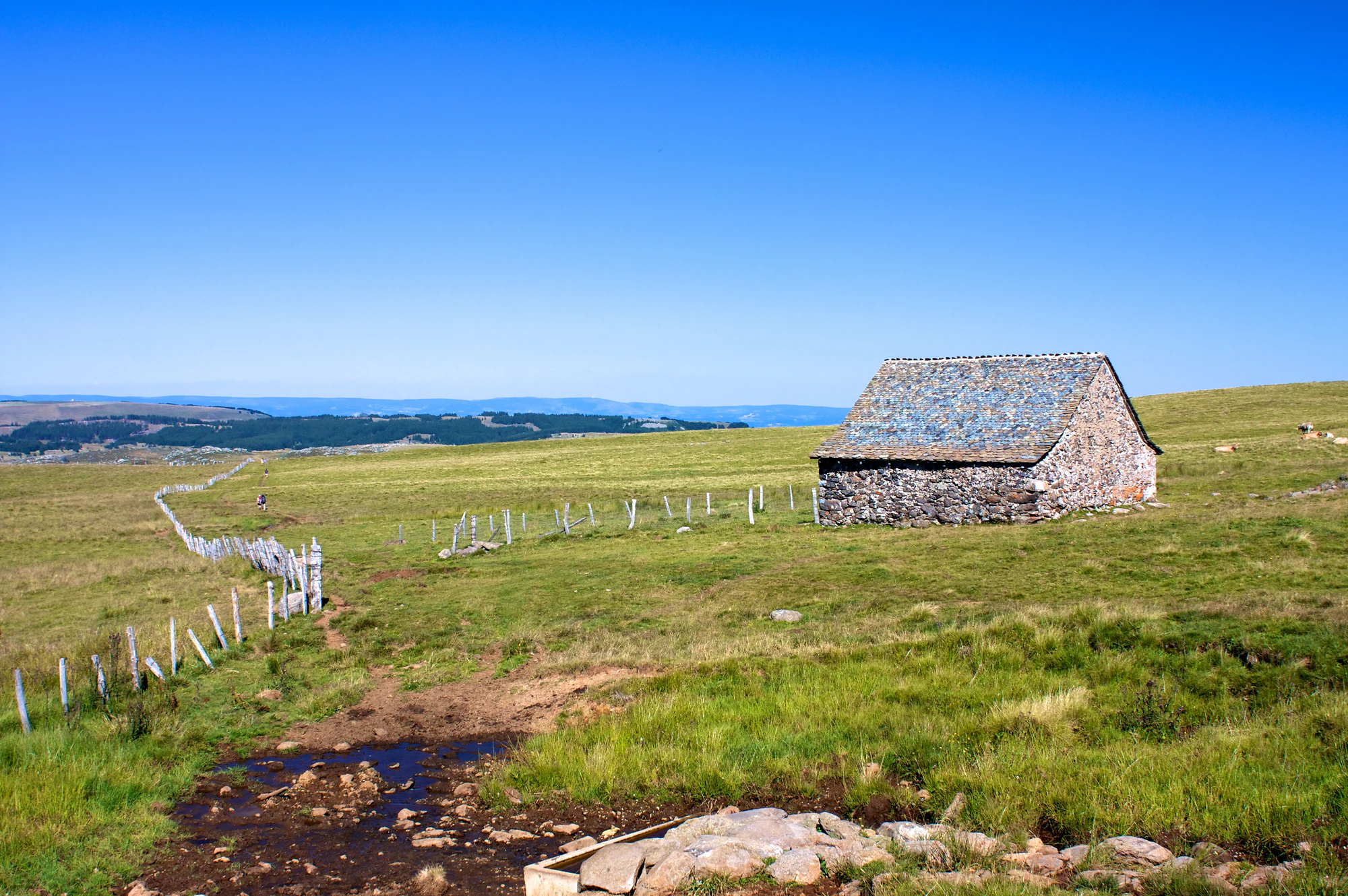
A low stone buron with a broad stone roof stands in open pasture beside a fence; a muddy, stony track crosses the foreground, with distant walkers and cattle under blue sky.

A buron and pasture in the Aubrac landscape, photographed in July 2010, before the regional park was designated. The building is unnamed in the source; this is wider landscape context, not a view of the Maison-and-garden visit or a place to enter.

“Buron” — Benjamin Claverie, CC BY-SA 2.0. Source: https://www.flickr.com/photos/23968317@N08/4898536216/. License: https://creativecommons.org/licenses/by-sa/2.0/. Original photograph unchanged. · Creative Commons

When to visit

Spring and summer

The published 2026 garden schedule has staff Monday–Friday from 4 April to 15 May, then daily from 15 May to 27 September, 09:00–18:00. Choose a staffed day if you want help finding plants. The Maison usually opens Tuesday–Sunday in spring and daily in July–August. Spring flowers and summer pasture plants give different visits; ask what is currently worth seeking out.

Autumn and winter

From 27 September to 30 October, the garden lists staff Monday–Friday, 09:00–18:00. The Maison’s dated 2026 season ends on 9 November, although its different pages disagree on daily autumn hours. Recheck next-season dates rather than carrying these forward. In winter, confirm road conditions and what is actually open before making a plateau journey.

Getting there and practical advice

Two hosts, two calendars

The Maison has tourist information, exhibitions, a shop and food service; check meal and event arrangements separately from building opening. The garden provides a self-guided visit with an optional contribution, and its tourism listing includes picnic tables. Staff presence is useful for plant questions, but neither attraction should be assumed to keep the other’s hours.

Before a special journey

Call the Maison on +33 (0)5 65 44 67 90 or the garden on +33 (0)7 86 56 92 50 for date-specific arrangements. Published Maison autumn hours differ between pages, so confirm your arrival time directly. Also ask about toilets, any event charge and whether your group needs to reserve.

Aim for Aubrac village

Set your destination to Maison de l’Aubrac, Aubrac village, 12470 Saint-Chély-d’Aubrac. This is not the same stopping point as the centre of Saint-Chély-d’Aubrac. The Maison’s tourism listing records parking; use designated spaces and leave farm and path entrances clear. The D987 is the main local road corridor between Saint-Côme-d’Olt and Nasbinals.

Without a car

Regional rail gateways include Aumont-Aubrac and Rodez, but the last leg needs planning. The tourist office lists a school-period weekday bus between Espalion and Saint-Chély-d’Aubrac, stopping at the latter’s place du Foirail, not at the garden. Confirm the current timetable and arrange any onward and return transfer before travel; do not treat that bus as a direct service to Aubrac village.

Plan the whole chain

For a lower-effort day, keep the outing to the two visitor sites and ask which entrance best suits you. A general accessibility label does not settle parking distance, slope between buildings, turning space or toilet provision. The surrounding pasture and peatland are a separate terrain question, and the garden’s access statement does not certify an ENS walking route.

Sources and useful links

Wildlife you might spot

2

Each card links to a full Explore page with photos, traits, and fun facts.

We are still adding species preview cards for this place.

Snap map for this place

Start with the big picture, then zoom in to explore individual wildlife observations around this place.

Loading map…

Good to know before you go

Bring a warm layer and waterproof even for a short summer visit; the open plateau can feel very different from a sheltered valley.

Carry drinking water. Grazing country is not a place to assume that a stream or trough is safe to drink from.

Use garden paths and authorised marked trails. A visible buron, gate or track does not establish public access.

Give cattle and calves plenty of room, keep children close and never approach for a photograph.

Photograph plants where they grow. Do not pick, taste or handle them, including plants described as traditional foods or remedies.

Frequently asked questions

No. An ENS designation does not make every parcel freely accessible. Enjoy the interpretation from the garden and use authorised paths or an organised outing for the surrounding landscape. Do not make your own circuit across grazing land or wet hollows.
Self-guided entry is free, with a suggested €3 contribution to the association. Organised activities can have different arrangements; check the specific event before turning up.
The tourism listings accept pets at the Maison and garden, subject to local conditions. Keep your dog on a lead and ask staff about your intended visit. This permission does not extend to every pasture: some marked walks prohibit dogs while cattle are present.
Possibly, but the garden is primarily an introduction to plants and habitats. Treat any birds, insects or other small animals as incidental visitors. The labelled plant collections offer something to learn even when wildlife keeps out of sight.
It is enough for a satisfying introduction. Forests, river valleys, other villages and plateau trails lie beyond this small focus. Choose one additional area for another outing instead of trying to turn the garden visit into a tour of all three departments.

Recent snaps at this place

Recent snaps will appear here as new observations are added.

View all ›

Take the discovery with you

Exploring Aubrac Regional Nature Park?

Identify the wildlife you spot, learn as you go, and keep a collection of the adventure.

  1. 1Spot it
  2. 2Snap it
  3. 3Keep the discovery