Snappit logo
Snappit
Get App
Generic illustration, not a photograph of this venueIllustration
ParkChubu, Japan

Hakusan National Park

Hakusan is a mountain landscape shaped by deep snow, running water and an active volcano.

About

Hakusan is a mountain landscape shaped by deep snow, running water and an active volcano. The national park stretches across Toyama, Ishikawa, Fukui and Gifu, with beech forests below the high country and Gozengamine rising to 2,702 metres. Its famous alpine flower fields belong to a very different outing from a short walk at the foot of the mountain. For a relaxed introduction, make Ichinose Visitor Center, on the Ishikawa side, your destination.

Begin inside. The displays explore the mountain’s wildlife, volcanic history, changing vegetation and long relationship with the people who live around it. Exhibits were renewed in late 2025, including more multilingual interpretation. Ask staff which paths and bridges are usable that day before choosing your walk. This is a working mountain gateway: information on a noticeboard matters more than an inviting line on an old map.

The natural first choice is Ichinose Enchi, the riverside recreation area beside the center. Its nature circuit follows a stream through willow and alder woodland, with sections of wooden walkway. The official walking time is about an hour; leave extra time for looking at leaves, listening for birds and watching insects without leaving the path. You can also ask about the short approach to Ichinose Pond, an artificial pond that has become habitat for frogs and dragonflies. The pond route crosses a suspension bridge, so check that crossing rather than assuming every branch of the walk is open.

For a mountain view, choose the lower Hakusan Observation Deck on the Iwayamatadani nature trail. It is a separate uphill walk, roughly an hour there and back, reaching a shelter at about 980 metres from the Ichinose area at about 830 metres. On a clear day, the peaks give a satisfying sense of the mountain’s scale. The much higher Panorama Observation Deck belongs to a roughly three-hour hike with considerably more climbing. For an unhurried first visit, the lower viewpoint is plenty.

Snow is part of the story even when the paths are green. Moist winter air from the Sea of Japan brings heavy snowfall; spring and summer meltwater feeds the valleys below. Forest plants take advantage of the brief light-filled interval before the canopy closes. In autumn, the broadleaf woods change colour while the higher mountain moves toward winter. A guided walk is a good way to connect these small details, and the visitor center offers free seasonal walks on selected days.

Keep the day flexible. Cloud may hide the peaks, rain makes wooden surfaces slippery, and bears share these forests. Comfortable shoes with grip, rainwear, an extra layer, water and a packed snack are sensible even for a short outing. Stop at the center, choose one suitable walk, and leave time to enjoy it rather than turning a gateway visit into an unplanned mountain ascent. Planning to visit? Download the Snappit app to identify the wildlife you spot in real-time.

Hakusan became a national park on November 12, 1962. Its history as a sacred mountain is much older: pilgrimage routes approached from Kaga, Mino and Echizen. Ichinose was one of the mountain gateways, but the 1934 Tedori River disaster swept away the local settlements and reshaped the river corridor. Today, the visitor center helps explain both the natural landscape and the human history around it.


What to do here

Start with the visitor-center exhibits and current advice, then choose the Ichinose Enchi riverside circuit. If everyone is comfortable with an uphill path and the weather is clear, substitute or add the lower Hakusan Observation Deck. A volunteer-led nature walk is especially useful for learning about the plants and forest. Keep summit routes for a separately planned, properly equipped mountain trip.

Seasonal info

Spring access depends on road reopening and snowmelt; flowering can shift markedly between years. Summer brings green woodland and busy mountain-trailhead traffic, but seasonal buses do not run every day. Autumn has shorter days and changing conditions; the center can remain open after trailhead shuttle services finish. Winter is outside the scope of this casual visit: the center closes and the approach road is seasonally shut.

Accessibility

The center lists a step-free or ramped entrance, a wheelchair-accessible multipurpose toilet, assistance on request and a wheelchair. Call 076-259-2504 to confirm access between floors and any assistance you need. Outdoors, boardwalks, bridges, gradients and uneven footing can make progress difficult with a wheelchair or stroller; ask staff to suggest a suitable short section. The Iwayamatadani viewpoint route is an uphill walk.

Don't miss

1

Renewed visitor-center interpretation of Hakusan’s wildlife, volcano and snow-shaped landscape

2

A roughly one-hour riverside woodland circuit at Ichinose Enchi

3

An optional uphill walk to the lower Hakusan Observation Deck

4

Free seasonal guided walks that help reveal the small details of the forest

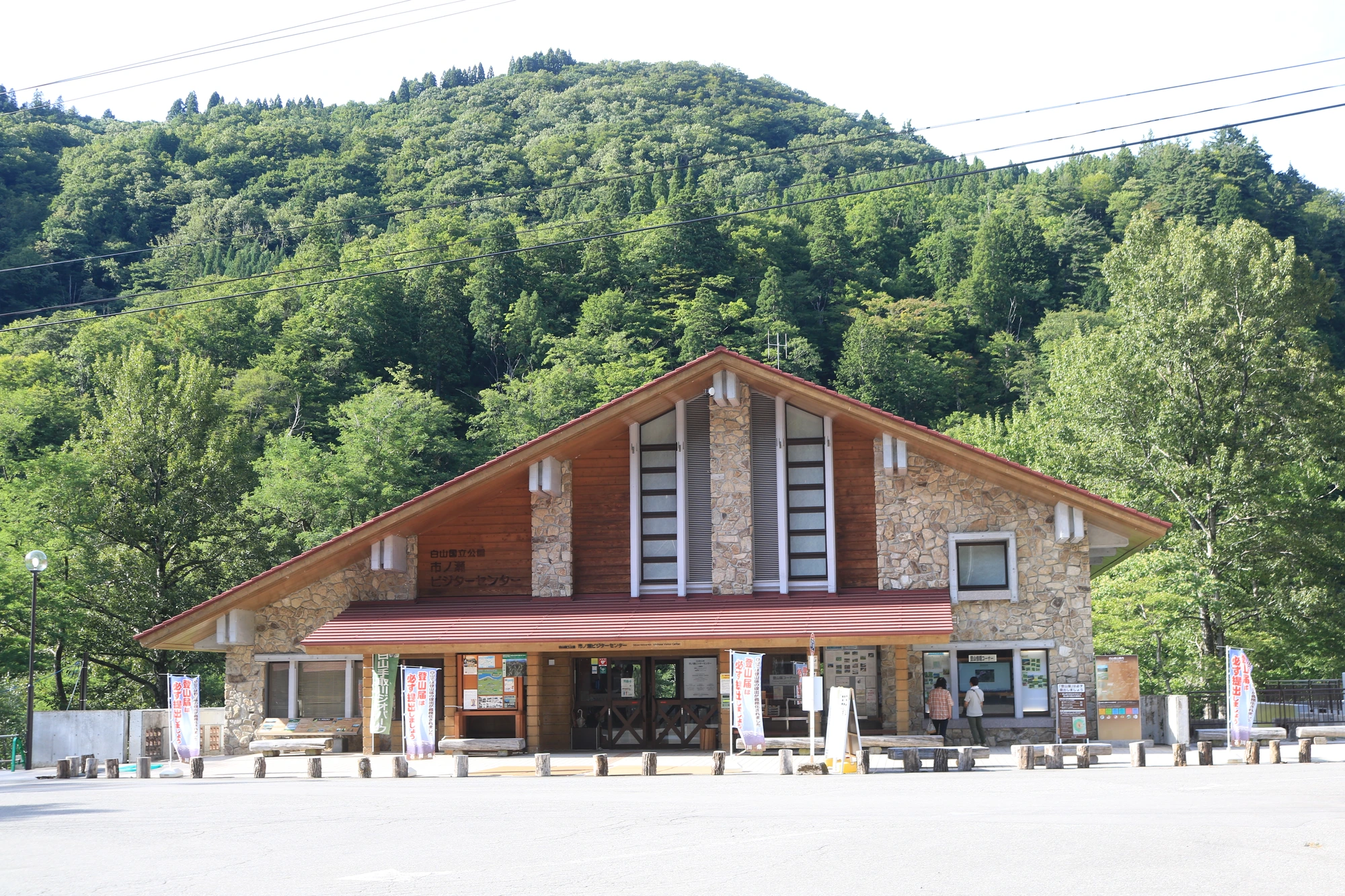
A broad timber-and-stone visitor-center building with a red pitched roof stands below a green wooded hillside, with notices around its entrance.

Ichinose Visitor Center at Hakusan’s Shiramine gateway, photographed on 22 August 2018. The exterior sits against a wooded hillside.

Ichinose Visitor Center.jpg — Alpsdake, CC BY-SA 4.0 (https://creativecommons.org/licenses/by-sa/4.0/). Source: https://commons.wikimedia.org/wiki/File:Ichinose_Visitor_Center.jpg. Resized and recompressed as WebP; no crop or retouching. · Creative Commons

Walks and routes

Ichinose Enchi riverside nature circuit

A streamside circuit through willow and alder woodland, including wooden walkways. Pick up the day’s map at the center. If a shorter walk suits your group, ask staff where you can turn back comfortably.

Ask staff about boardwalk surfaces, bridge access and any obstacles before setting out, especially with a wheelchair or stroller.

Ichinose Enchi riverside nature circuit

Lower Hakusan Observation Deck, out and back

Take the Iwayamatadani trail beside Hakusan Onsen, climb through the woodland to the lower viewing shelter at about 980 m, then return. Choose a clear day for the mountain view; clouds can hide the peaks.

Expect slopes and uneven footing, with wooden crossings that can be slippery. Choose a shorter option near the center if your group needs gentler terrain.

Lower Hakusan Observation Deck, out and back

Panorama Observation Deck: a longer hike

The higher Iwayamatadani viewpoint is around 1,280 m and takes approximately three hours return before stops. Save it for a day when everyone is ready for a longer climb; the lower viewpoint is the more manageable choice for a short visit.

Sustained uphill hiking and steps; requires suitable fitness and equipment.

Panorama Observation Deck: a longer hike

Begin with the center, toilets and current conditions. Choose one suitable walk.

Walk the riverside circuit, or choose the lower viewpoint if the group is comfortable with climbing and the weather is clear.

Take a break, revisit the displays with your questions, and depart with time to spare for your confirmed return transport.

Things to try

Read the mountain before walking it

Use the center’s exhibits to connect the forests outside with snow, volcanoes and the habitats higher on the mountain. Ask for a map and a route recommendation suited to your group.

Join a local nature walk

Free volunteer-led walks usually last about 90 minutes. During the open season from May, they run on weekends and public holidays within morning and afternoon windows. July–August and groups of 10 or more need an application at least two weeks ahead; weather, staffing and language availability should be checked.

Look closely without leaving the trail

Compare leaves in the streamside woodland, listen for birds from the path and watch for insects around vegetation. A photograph or a sketch makes a better souvenir than a picked flower. Keep normal awareness and conversation in bear habitat rather than slipping silently into undergrowth.

Ask about the pond detour

Ichinose Pond is an artificial pond used by frogs and dragonflies, reached by a short approach across a suspension bridge. Ask about that bridge first. Around early summer, foam-like frog egg masses may be visible above the water; leave them undisturbed and stay on the path.

Consider a separate Nekuradani stop

Nekuradani Enchi lies about 2.5 km down-valley from the center and has an approximately 30-minute circuit. It offers wetland plants and traces of former cultivation. Treat it as a separate stop with its own access check, not an extra loop immediately beside the center.

A center-only visit, or a different day

If access is safe and the center is open, enjoy the mountain interpretation without walking. Do not use the exhibits as a reason to drive through a weather closure. In heavy rain or thunderstorms, postpone the outdoor part; wet boards, bridges and slopes are poor places to press on.

Wildlife and habitats

Coal Tit

Coal tits belong to the beech-forest bird community of nearby Chiburi Ridge. Ask a guide to help you distinguish the voices in the woodland canopy.

Eurasian Nuthatch

In the nearby Chiburi Ridge woods, nuthatches use the trunks of forest trees. Watch from the path without following birds into the trees or approaching a nest.

Willow Tit

Willow tits are among the birds of nearby Chiburi Ridge. Learning about them is a way to explore how different birds share the layers of a forest.

Japanese Macaque

Hakusan’s foothill forests support wild macaques. If any appear, give them space and keep food packed away.

Asian Black Bear

Bears belong to the forest ecosystem. Learn about them in the center and follow the local precautions outdoors; never seek them out or approach a bear to take a photograph.

Stories and discoveries

Snow can shelter plants

The high mountain’s snow cover insulates the ground as well as shortening the growing season. When it melts, the water feeds the valleys. The alpine habitat is best understood in the exhibits on a short Ichinose visit.

One mountain, several journeys

Hakusan’s pilgrimage history includes approaches from Kaga, Mino and Echizen. Modern visitors can appreciate that cultural landscape without following an entire ascent.

A river with a powerful past

The 1934 Tedori River disaster swept away the earlier Ichinose settlements. The broad river corridor is part of a landscape shaped by both snowmelt and destructive flood events.

A national park since 1962

Hakusan National Park was designated on November 12, 1962. Its 49,900 hectares extend across four prefectures; this guide concentrates on just one gateway.

When to visit

spring

Wait for the road and center to reopen. Spring flowers respond to snowmelt, so use current bloom reports: in 2026 the ranger observed unusually early flowering. Lingering snow or damaged paths can still change the plan.

summer

Enjoy the woodland and guided interpretation, but plan around mountain-visitor traffic. July–August guided walks need advance application. This season’s alpine flowers are high above the short gateway walks.

autumn

Allow for cool conditions, shorter daylight and changes in woodland colour. Check the return journey carefully because bus seasons and center seasons differ. Leave before dusk in bear habitat.

winter

The visitor center closes for winter and the approach road is seasonally closed. This guide does not propose a winter drive or snowshoe route at Ichinose.

Getting there and practical advice

Ichinose Visitor Center

Free admission. The 2026 season began April 29 and was announced through early November, 08:45–17:00 daily. Temporary closures can occur. Telephone 076-259-2504. The October 2 facilities notice listed the center and toilets as usable.

Food, water and a break

Bring your own water and a snack or packed lunch so the visit does not depend on a seasonal food outlet. Keep food attended and securely packed, and take all waste away. Use center facilities before walking.

Drive to Ichinose when the approach road is open

Use Ichinose Visitor Center as the destination via the Hakusan Park Road from Shiramine. The road has winter and weather-related closures. Parking is shared with mountain visitors and can fill; never improvise roadside parking. Check Ishikawa’s road portal before departure.

Confirm both journeys before choosing a car-free day

Seasonal climbing buses serve Ichinose from Matsuto and Kanazawa on selected dates. They are not an everyday year-round link. Check the current operator timetable and secure a workable outward and return journey; a visitor-center opening day does not imply a bus day.

Keep Bettodeai shuttle plans separate

Selected-date private-vehicle restrictions apply to the roughly 6 km road beyond Ichinose to Bettodeai, where the mountain trails begin. The shuttle is unnecessary for the short visit described here. Its published 2026 calendar ended with downhill-only service on October 13; later visitors must not assume it is running.

The center lists a step-free or ramped entrance, a wheelchair-usable toilet, assistance and a wheelchair. Call to discuss the spaces you want to visit, movement between floors and equipment availability.

Ask staff which short outdoor section suits your group and equipment. Iwayamatadani has slopes and steps; wooden bridges elsewhere in the trail system can be narrow, sloping and slippery.

Ishikawa’s bear-encounter caution was active when checked on October 16, 2026. Ask for the latest local reports, stay together, make your presence known and keep food secure. If a bear appears, do not run or move closer; withdraw calmly. Give cubs a wide berth.

Hakusan is an active volcano. JMA displayed Level 1 when checked on October 16, 2026: remain aware of the active volcano. That is not a safety guarantee. Recheck the official bulletin before travel and follow any evacuation or access restriction.

The October 2, 2026 trail notice closed Sabo-shindo between the Minamiryū junction and Kuroboko-iwa for works scheduled through late October, and listed Shaka-shindo as impassable near Yunotani. These are mountain-route notices, not proof that the Ichinose walks are closed or open. Do not use this short-visit guide to plan a summit ascent.

Watch your footing on wet wood, leaf-covered steps and narrow crossings. Confirm any bridge or path closure on arrival, and do not pass a barrier to complete a loop.

Sources and useful links

Wildlife you might spot

5

Each card links to a full Explore page with photos, traits, and fun facts.

We are still adding species preview cards for this place.

Snap map for this place

Start with the big picture, then zoom in to explore individual wildlife observations around this place.

Loading map…

Good to know before you go

Check the approach road, center opening and local path or bridge notices before leaving; ask at the center again on arrival.

Take grippy footwear, rainwear, an extra layer and drinking water. Turn back if snow, slippery boards, damaged steps or rising water make the route unsuitable.

Bears live here. Check recent local reports, walk together, make your presence known and keep all food and food waste secured. A bell does not guarantee safety.

If you see a bear, stay calm, do not approach or run, and withdraw quietly. Leave a cub well alone; its mother may be nearby.

For free guided walks, check the day’s availability. July–August visitors and groups of 10 or more need to apply at least two weeks ahead under the current arrangements.

The Bettodeai shuttle serves a separate mountain trailhead. You do not need it for the Ichinose visitor-center and woodland outing.

Arrange your return transport before starting. Seasonal buses, shuttle buses and visitor-center opening have different calendars.

Keep to the paths, leave flowers and pond life in place, and carry out every scrap of rubbish. Do not pursue wildlife for a photograph.

Frequently asked questions

Yes. Ichinose Visitor Center and a suitable nearby nature walk make a worthwhile visit on their own. The high alpine meadows, Murodo and Gozengamine require a separate mountain-hiking plan; they are not part of the short itinerary here.
Choose the approximately one-hour Ichinose Enchi circuit for riverside woodland. Choose the lower Hakusan Observation Deck for an uphill outing of about one hour return. The Panorama Observation Deck is a different, roughly three-hour hike. Staff can help choose the usable option for your group.
Admission is free. The 2026 notice gives April 29 through early November, daily 08:45–17:00. The exact final day and any weather-related closure should be checked before travel. Do not assume the same dates in another year.
The current program offers free walks during the opening season from May, on weekends and public holidays, for around 90 minutes within 10:00–12:00 or 13:00–15:00. Weather and events can change the program. July–August visits and groups of 10 or more require an application at least two weeks ahead; ask about language availability.
No, not for this outing. The shuttle links Ichinose with Bettodeai beyond the visitor-center area. Car restrictions on that section apply on selected dates, and the shuttle has its own limited calendar. The published 2026 calendar ends with downhill service on October 13.
Call ahead about access between the center’s floors and any assistance you need. For the woodland, ask staff which short sections suit your wheelchair or stroller and the day’s conditions. Boardwalks and bridges can have awkward surfaces, while the viewpoint route involves climbing.
Wildlife sightings are unpredictable. Asian black bears inhabit the area, and Japanese macaques live in Hakusan’s foothill forests. Keep your distance, never feed them, and follow current staff advice. Bears should never be sought out for a photograph.
If the road and center remain open, spend time with the exhibits and skip the paths. Heavy rain, thunderstorms, high water or a closure are reasons to postpone the outing, rather than continue to a viewpoint. Hakusan is also an active volcano: check Japan Meteorological Agency information and obey any official restrictions.

Recent snaps at this place

Recent snaps will appear here as new observations are added.

View all ›

Take the discovery with you

Exploring Hakusan National Park?

Identify the wildlife you spot, learn as you go, and keep a collection of the adventure.

  1. 1Spot it
  2. 2Snap it
  3. 3Keep the discovery