Wildpark-Safari: vehicle circuit
Follow the signed self-drive route and stop only where permitted. The viewing stations are breaks within a driving visit.
Viewing from the vehicle avoids the steps and steep approaches at the six stations.
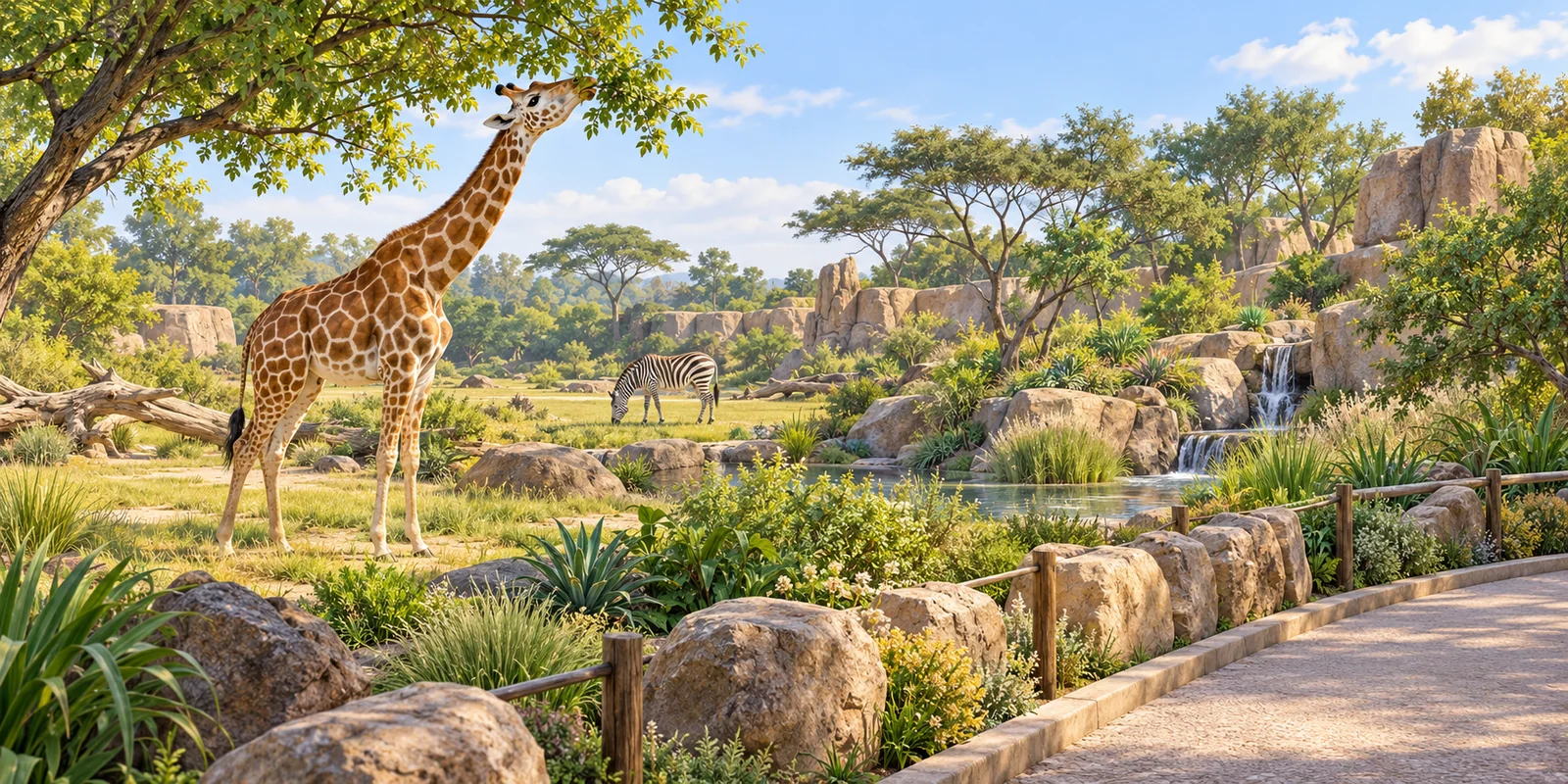 Illustration
Come to Wildpark Daun for a slow drive among large animals, then stretch your legs beside Barbary macaques in a wooded gorge.
Come to Wildpark Daun for a slow drive among large animals, then stretch your legs beside Barbary macaques in a wooded gorge. The day has two quite different rhythms: watching from your own vehicle on the 8 km safari, and exploring the smaller animal enclosures and family attractions on foot. At the entrance, pick up the park plan and check the falconry programme before choosing your order.
Deer, European bison and mouflon share the safari landscape of woods and meadow clearings. Six viewing stops let you linger where signs permit you to leave the vehicle. Later, the Affenschlucht brings the focus down to individual gestures: a monkey grooming a companion or stopping to look around. These are animals in a managed wildlife park, including the monkeys moving freely within their enclosure.
Save some energy for the Großer Rundweg past smaller animal exhibits and the walk-through kangaroo enclosure. The miniature-animal farm and large playground give younger children a different kind of finish. You can make the visit mostly about animals or leave a generous stretch for play; trying to race through both usually misses the best moments. Unlock an interactive field guide for this spot: get the Snappit app to identify nature on the go.
The Barbary macaques have lived here since 1998; the first youngster born in the park, Antje, arrived in 1999. Their wooded enclosure has become one of the places where a visit naturally slows down: allow time to watch relationships within the group rather than simply counting monkeys.
Follow the signed 8 km safari in your own vehicle, giving animals priority and using designated stopping places. Let passengers scan the meadow edges while the driver concentrates on the road. The 800 m Affenschlucht circuit is a separate walk through the macaque enclosure; it is hilly and gravelly. The Großer Rundweg is another walking option beside coatis, Arctic foxes, miniature pigs and alpacas, ending at the kangaroo enclosure. Fit a falconry demonstration around these stops, then choose the farm or playground according to everyone's energy. The summer toboggan run is a separately charged extra outside the park entrance.
Winter opening is shorter, and snow or ice can close the park. Closing time also moves earlier in late October, so check the current hours before travelling. The park closes on 25 December and 1 January. Waldhaus Hirschberg closes from 15 November to 14 March. The toboggan run closes for winter from 16 November to 14 March and does not operate in rain, snow or frost.
The safari can be enjoyed from your vehicle, but its six viewing stations have steps, steep approaches or a turnstile and are unsuitable for wheelchair access. Affenschlucht has coarse gravel, drainage channels and gradients up to 14% over 90 m; the approach from the restaurant towards the monkeys and falconry reaches 12% over 200 m. The longer animal walk also has rougher ground and a short 13% slope. Accessible toilets and three designated parking spaces are available. Discuss your route with the park before visiting with a wheelchair or pushchair; the adventure play equipment is not wheelchair-accessible.
An 8 km vehicle circuit through woodland and meadows, with six designated viewing stops; bring your own transport.
An 800 m walking loop among Barbary macaques, with steep gravel sections and strict no-food, no-bags and no-touching rules.
Seasonal falconry demonstrations, normally at 11:00 and 15:00 except Fridays; check the daily programme.
Explore the smaller-animal circuit and miniature farm, then leave time for the adventure playground.
Follow the signed self-drive route and stop only where permitted. The viewing stations are breaks within a driving visit.
Viewing from the vehicle avoids the steps and steep approaches at the six stations.
A separate pedestrian circuit inside the macaque enclosure. Store bags before entering and remain on the path.
Discuss assistance needs beforehand; the short distance does not make this a level walk.
Follow the animal circuit past coatis, Arctic foxes, miniature pigs and alpacas to the kangaroo enclosure.
Choose sections to suit your group and turn back when needed rather than treating the whole circuit as an easy pushchair route.
Check the day’s falconry time first. Fit the safari around that anchor, then choose the monkey walk if the slopes suit your group. After a meal or snack, decide between the smaller-animal walk and a longer playground stop. Keep the toboggan run optional so the weather or a tired child can change the ending.
Download the two Wildpark-Rallye sheets before you leave. Use the safari sheet for sign-reading at proper stops, then switch to the Erlebnisbereich sheet for the farm, playground and monkeys. Keep the driver out of the quiz while the vehicle is moving.
Choose a simple action such as eating, resting or moving. Try to spot it in a deer, a monkey and a meerkat, then let each person describe the biggest difference. There is no need to approach or distract an animal to complete the challenge.
If the park is open and driving conditions are safe, concentrate on observing from the car, with a restaurant break in season. Avoid building a wet day around playground time or the toboggan run. Snow and ice require checking whether the park itself has opened before setting off.
Look for grooming as well as climbing. Watching one quiet pair can tell you more than following the liveliest monkey. Stay on the path and leave the animals space.
Look across the open ground for the heavy shoulders and lowered head. A wider photograph can show the animal against the meadow instead of isolating it; take pictures only when safely stopped.
At the horse area marked on the plan, notice the upright mane and compact outline. Use the enclosure label to identify the horses rather than assuming every horse-like animal on the safari is the same.
Watch a group for a while and compare animals with and without antlers. Keep a little of the surrounding meadow in your photograph, and listen as well as look during the autumn rut.
Use the enclosure signs to separate fallow deer from red deer. When an antlered male is visible, compare the outline of its antlers with the red deer you saw earlier.
Watch the snout at work near the ground. If young animals are visible, look for their striped coats from the designated viewing place without trying to attract them closer.
Start with the shape of the horns, then compare the animals around the horned males. Patiently following one animal as it grazes makes a better observation than calling to the group.
Look for the tall, shaggy outline and watch how the bird places its feet. Keep your identification tied to the local signs; other large flightless birds should not automatically be called emus.
Pause at the fox enclosure even if it looks quiet at first. Look along the ground and into sheltered parts, and let the actual coat you see guide your photograph rather than expecting a bright-white animal.
Watch several animals together and see whether they are all doing the same thing. A short sequence of digging, standing or moving can be more interesting than one close-up.
Check the enclosure label and look for the distinctive pale head of an adult. During a demonstration, follow the falconer’s directions; the birds flying on your visit depend on the programme.
Compare its ear tufts and rounded body with the eagles nearby. European and Siberian forms are both kept here; use the enclosure labels to compare them.
These are captive park animals. The list gives ideas for observation, not a promise that every species will be visible or appear in a flying demonstration.
Bus stops in Pützborn and Daun are at least 2.5 km from the park. Check a current journey planner and arrange the final leg separately. Reaching the entrance does not provide a safari vehicle: there is no park-run bus tour, so organise suitable transport in advance if the drive is essential to your visit.
The drive and walking areas present different access decisions. Ask about the vehicle view, the steep approaches to the monkeys and falconry, and the toilet layout that best suits your needs. Assistance dogs are listed as welcome outside Affenschlucht and must remain in the vehicle on safari; confirm arrangements for the falconry with the park before travel.
Each card links to a full Explore page with photos, traits, and fun facts.
Start with the big picture, then zoom in to explore individual wildlife observations around this place.
Getting there
Use Wildparkstraße 1, 54550 Daun-Pützborn. A car is the simplest way to combine arrival with the safari; the park runs no safari bus.
Entry
Admission includes the safari and Erlebnisbereich. Exchange an online ticket at admission for the vehicle-entry ticket; card payment is available.
Driving rules
Follow the posted speed limit and staff directions, give animals priority and leave the vehicle only at designated stops. Bicycles and motorcycles are prohibited on safari.
Feeding boundaries
Never feed animals from your car. Follow the park rules at designated safari platforms and the petting zoo; keep food out of the monkey enclosure and finish snacks before entering the falconry.
Monkey-gorge preparation
Put bags, backpacks, food and animal feed in the free entrance lockers. Stay on the circuit, hold young children by the hand, and do not touch the monkeys or smoke.
Bringing a dog
Pet dogs stay in the vehicle throughout the safari and cannot enter Affenschlucht or the falconry. Elsewhere, keep them leashed outside enclosures and observe local signs. Arrange supervision when your group visits the dog-free areas.
Family supplies
Bring your own pushchair or handcart if needed; handcarts are not available to hire. Baby-changing facilities are in the accessible toilets.
Food and extra rides
Waldhaus Hirschberg is beside the playground and requires park admission. Check its seasonal opening. Toboggan rides cost extra; children under eight need an accompanying rider.
Recent snaps will appear here as new observations are added.

North Carolina, US
You might spot American Robin and Eastern Gray Squirrel.
View guide →

Florida, US
You might spot Anhinga, American Alligator, and Wood Duck.
View guide →

New Mexico, US
You might spot Wood Duck, Duck, and Canada Goose.
View guide →

Michigan, US
You might spot African Lion, Komodo Dragon, and Brown Bear.
View guide →
Take the discovery with you
Identify the wildlife you spot, learn as you go, and keep a collection of the adventure.