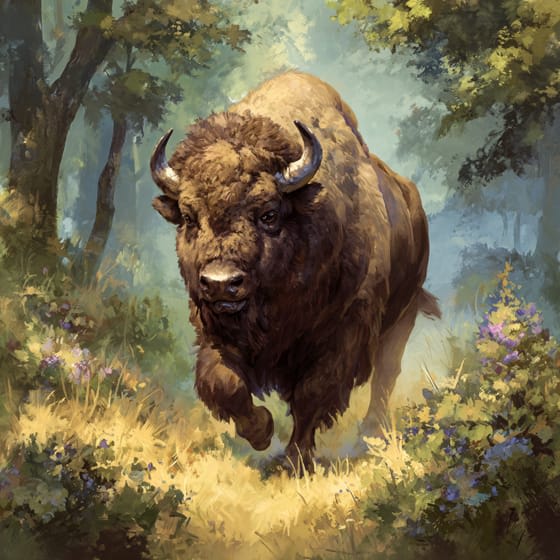





European Bison
Bison bonasus
The European Bison is a large, gentle animal that roams the forests and grasslands of Europe. They are known for their thick fur and strong bodies.
Habitat: Forests and grasslands
The European Bison is a large, shaggy mammal with a distinctive hump on its back and short, curved horns. Its coat is dark brown, often with a reddish tint, and it has a thick mane around its head and shoulders, making it appear robust and powerful.
Category
MammalsRarity
Common
Danger
2/5 · Low
Snaps
Be the first to snap!
Wow! A bison calf can stand and walk just hours after being born!
Wow! European Bison were nearly extinct but have made an amazing comeback!
Wow! Their scientific name, *Bison bonasus*, means 'good bison' in Latin!
Wow! They communicate with grunts, snorts, and even roars in the forest!
European Bison can help forests thrive by selectively grazing and trampling vegetation, which creates clearings and promotes biodiversity.
European Bison has a thick, shaggy coat that helps them stay warm and insulated, allowing them to endure harsh winter conditions.
European Bison can charge at high speeds, which helps them defend against predators or rivals.
These giant mammals are plant-eaters, munching on grasses, leaves, and twigs from the forest floor.
Canis lupus
Wolves are natural predators, often targeting young or sick bison.
Homo sapiens
Human conservation efforts were crucial to saving bison from extinction.
Quercus robur
Bison graze on oak leaves and acorns, helping to spread seeds.
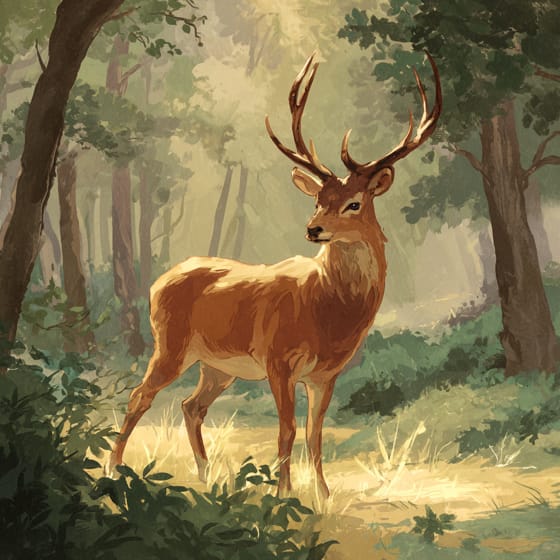
Cervus elaphus
They share forest habitats and sometimes compete for similar plant foods.
Wildlife encompasses all undomesticated animal and plant life existing in their natural habitats.
Furry describes animals possessing a dense covering of soft hair or fur.
Social animals live in organized groups, cooperating for survival benefits such as foraging, defense, and raising offspring.
Characterized by having one or more hard, permanent, pointed projections on the head.

Grassland habitats are terrestrial biomes dominated by grasses and herbaceous plants, supporting a variety of grazing animals.

This trait characterizes organisms whose diet consists entirely or primarily of plant material.

Forest habitats are terrestrial environments dominated by dense tree cover, supporting a high diversity of plant and animal life.
Danger
2/5 · Low
Always admire wildlife from a safe distance. They are wild animals and should not be approached.
The easiest way to identify European Bison is to use the Snappit nature identifier app.
210-290 cm
400-1000 kg
15-25 years
60 km/h
These giant mammals are plant-eaters, munching on grasses, leaves, and twigs from the forest floor.
Forests and grasslands
Grazing
Zoom in to split clusters and explore where this object has been snapped.
Recent snaps will appear here as new observations are added.

Spain, ES
You might spot African Elephant, Brown Bear, and Gorilla.
View guide →

Masovian Voivodeship, PL
You might spot African Elephant, Sand Tiger Shark, and Gorilla.
View guide →

Zurich, CH
You might spot Red Deer, Wolves and Dogs, and European Bison.
View guide →
Take the discovery with you
Snap it with Snappit to identify it, learn what makes it special, and add the discovery to your collection.




.jpg&width=800)


.JPG&width=800)

.jpg&width=800)
