Snappit logo
Snappit
Get App
Generic illustration, not a photograph of this venueIllustration
ParkPyrenees, Catalonia, Spain

Aigüestortes i Estany de Sant Maurici National Park

Water gives this park its character: mountain lakes, tumbling streams and the winding channels of the Planell d’Aigüestortes.

About

Water gives this park its character: mountain lakes, tumbling streams and the winding channels of the Planell d’Aigüestortes. Above them rise sharp ridges and high pastures; below, woods offer a closer, slower kind of exploring. You can enjoy the changing sounds of the river, study trees beside the path and look for woodland birds without setting out for a summit.

For a manageable first visit, use Boí as your gateway to the western Aigüestortes sector. Take the authorised 4×4 taxi service uphill when it is running, then explore the signed paths and wooden walkways around the planell. Boí itself is a village outside the protected park, with the park house and transport services. Espot and Estany de Sant Maurici belong to the eastern side of this same national park; treat them as another day's outing rather than an extra stop on this short walk. Enhance your adventure: download the Snappit app to identify the local species you encounter.

The national park was created on 21 October 1955, becoming Spain’s fifth national park. Its boundaries were enlarged in 1996. The protected core now covers 14,119 hectares, with a separate 26,733-hectare protection zone around it. These are mountain landscapes shaped over a far longer timescale by ice and water; the present-day meadows of the planell occupy a former lake basin.

What to do here

Start with advice at the Casa del Parc in Boí, then spend unhurried time among the waterways of the Planell d’Aigüestortes. Add the Mirador de Sant Esperit only if its approach suits your group. Stronger walkers can choose the longer Ruta de la Llúdriga from Palanca de la Molina instead.

Seasonal info

Snow and ice can affect paths from late autumn well into spring. Summer weather can also change quickly. Check the mountain forecast, access bulletin and return transport before leaving the village.

Accessibility

The Planell d’Aigüestortes has an adapted wooden-walkway section, but this does not make every path or viewpoint step-free. Ask park staff about its current condition, the approach and suitable transport before travelling.

Don't miss

1

Winding water channels and conifer woodland at the Planell d’Aigüestortes

2

Wooden bridges and walkways that bring you close to the river without trampling the wet ground

3

Valley views from the Mirador de Sant Esperit, when its approach suits your group

4

Estany de Llebreta and Cascada de Sant Esperit on the longer uphill walking option

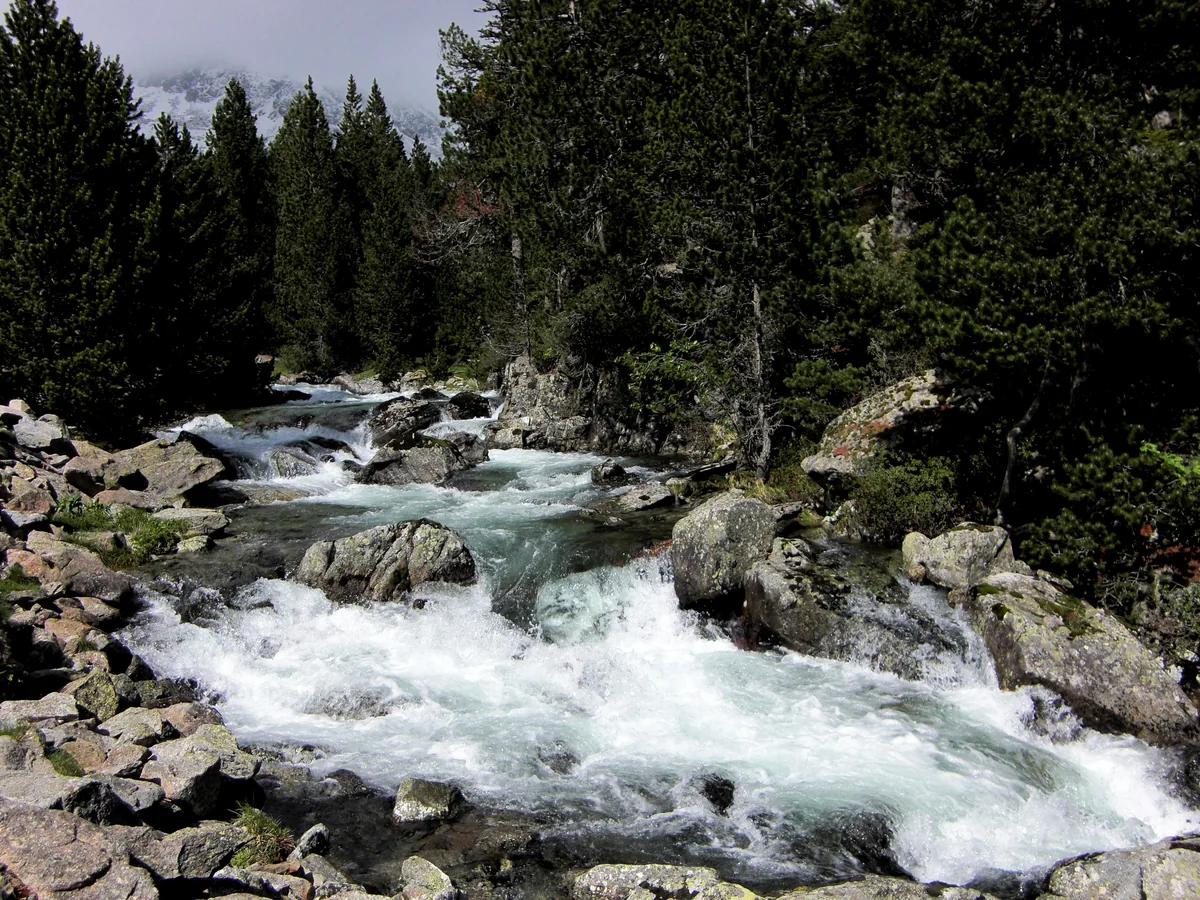
White water flows between rocks beneath conifers and cloud-covered mountains.

Sant Nicolau river and conifer woodland in the Aigüestortes sector, photographed in June 2010.

Riu Sant Nicolau al Parc Nacional d'Aigüestortes i Estany de Sant Maurici.JPG — Biblola / Wikimedia Commons / CC BY-SA 3.0 · Creative Commons

Walks and routes

Planell d’Aigüestortes: a short riverside circuit

Begin near the taxi drop-off and information hut at the planell. Follow the signed circuit through the river channels, woodland and wooden crossings around Pont de Morrano. The official descriptions suggest roughly 45–60 minutes of walking; allow longer for watching water and wildlife. The Mirador de Sant Esperit is a separate choice to discuss with staff if anyone needs a gentler or step-free visit.

An adapted section includes a wooden walkway of about 450 metres. Confirm the approach, surface condition and turning space with park staff; do not assume the full circuit or viewpoint shares the same accessibility.


Planell d’Aigüestortes: a short riverside circuit

Ruta de la Llúdriga: the longer walking approach

From Palanca de la Molina, the signed route climbs beside the Sant Nicolau valley, passing Estany de Llebreta and Cascada de Sant Esperit before reaching the planell. The park leaflet gives 2 hours uphill and 430 metres of ascent. That is one way: leave ample time for the descent, stops and the short circuit if you add it. Choose this for a walking day rather than as a quick substitute for a missed taxi.

This is a sustained mountain-path ascent, not the adapted boardwalk outing. Uneven or wet ground can make the return tiring.

Ruta de la Llúdriga: the longer walking approach

A relaxed half day from Boí

Start in Boí with route and weather advice. Confirm taxi departure and return arrangements, then head to the planell. Give the short circuit about 1–2 hours with pauses, choosing only the sections that suit everyone. Eat the food you brought without blocking the walkway, pack all waste away and return with a comfortable margin before the last taxi. Keep the longer valley approach for another day if children or less confident walkers have had enough.

A full walking day

If your group is comfortable with sustained ascent, start at Palanca de la Molina and make the river, Llebreta and Sant Esperit the main event. Decide your turnaround time before leaving. Do not rely on finding an unarranged taxi to avoid the return walk.

Things to try

Trace the water

At a safe place on the walkway, follow one stream with your eyes. Where does it split, slow down or rejoin another channel? It is a good small challenge for children without leaving the path.

Try a quiet woodland stop

Put cameras down for a minute and listen. Then scan the trunks and branches from the path. A slow pause is often more rewarding than trying to cover every trail.

Join an interpretive walk

Ask the park house about guided nature activities that fit your dates and group. Check language, duration, cost and reservation requirements before booking.

Stay with the park story in Boí

If the mountains are unsafe or visibility is poor, visit the Casa del Parc exhibitions and audiovisual displays when open. Ask staff whether any short outdoor option is sensible; postponing the walk is a perfectly good choice.

Wildlife and habitats

Wild tree in the park’s cool, shaded forests.

Look at the contrast between dark conifer woodland and the more open waterside. Use a close photograph of reachable foliage to compare trees later, without picking a branch.

Wild tree documented in the park’s mixed woodland.

Compare a leafy tree beside the path with the surrounding conifers. Photograph bark and leaves where you can see them safely; a single distant view may not be enough to name it.

Wild woodland bird documented in the park.

Pause where the signed trail passes older woodland and listen for woodpecker activity. Watch from a distance and leave any occupied tree undisturbed.

Wild mammal documented in the park’s forests.

Watch quietly for movement in the trees. Keep your snack packed away if an animal approaches and let it move off on its own.

Wild river-associated bird listed for the national park.

From a bridge or safe path edge, scan the stream and exposed rocks. Stay out of the water and avoid moving closer if a bird appears.

Wild amphibian listed for the national park.

Look carefully around damp ground visible from the path. If you notice a frog, photograph it where it is; leave it and its habitat untouched.

These are plants and animals recorded for the park, with ideas for looking carefully in suitable habitat. Wildlife is free-ranging and may stay hidden. Keep to the path, do not approach nests or handle animals, and treat a photograph as a starting point for identification.

Stories and discoveries

A meadow that used to be a lake

The Planell d’Aigüestortes fills an old glacial lake basin. Sediment gradually accumulated there, leaving soft ground through which the river can curve and divide.

Llebreta has a different story

A post-glacial landslide helped form Estany de Llebreta, on ground that already included a small glacial basin. Not every lake in this landscape has exactly the same origin.

The woodland changes as you climb

The park’s lower, drier slopes include Scots pine, while mountain pine becomes characteristic higher up. Shady, cool places support silver fir. Looking at the trees can help you read the mountain.

When to visit

Spring

Snowmelt can leave a mixture of snow, wet paths and stronger streams. Ask staff which low-level sections are suitable rather than relying on the calendar.

Summer

Start with the day’s mountain forecast and leave room for transport queues. Carry sun protection as well as a warm layer; shorten the walk if conditions deteriorate.

Autumn

The mix of evergreen and deciduous woodland gives variety to a short visit. Plan around shorter daylight and possible early snow, and recheck transport hours.

Winter

Snow can turn a simple summer walk into a winter-mountain trip. Specialist equipment, avalanche awareness and appropriate experience are needed; choose a village visit or a suitable guided activity if those are outside your experience.

Getting there and practical advice

Casa del Parc in Boí

Ca de Simamet, C/ de les Graieres, 2, Boí; telephone +34 973 696 189. This is the useful first stop for advice, exhibitions and information about guided activities. Confirm opening hours before making a special journey.

Information on the mountain

The Aigüestortes hut is a route landmark, but it is not always staffed. Get essential advice in Boí before going uphill.

Toilets, food and water

The park lists toilets at its main entrances and car parks; ask which are open for your route. Bring food and drinking water from the village, and use an available toilet before heading up.

Parking

Palanca de la Molina is the usual private-car endpoint for this western walking approach. Parking is listed as free by the park; access can close when full or in wintry conditions. Vehicles wider than 2 metres cannot use the La Molina access road.

Boí to the planell by authorised taxi

Taxis leave from plaça del Treio beside the church and Casa del Parc in Boí. Service depends on weather and season. Confirm the fare, ticket arrangements and last return directly with the Associació Taxis de la Vall de Boí on +34 629 205 489; check arrangements for dogs, children and mobility equipment too.

Arriving without a car

For the western sector, plan your journey through El Pont de Suert to Boí. Regional bus connections are limited and seasonal, so check both the outward and return legs with ALSA before committing. The summer Bus del Parc travels around the park between gateway areas; it is not the taxi shuttle up to the planell.

Plan the whole journey

Talk to the Casa del Parc about the adapted walkway, access from the drop-off and the vehicle you will use. Holders of the relevant disability card can request accreditation for special vehicle access. Arrange it before arrival.

More ways to explore

The park offers portable tactile models for visitors with visual impairments and can advise on guided activities. Ask about availability when planning. Wet wood, ice and snow can change what is practical on the day.

Check before you travel

The park bulletin dated 15 October 2026 listed Palanca de la Molina parking, western foot access and Boí taxis as open, but the Aigüestortes information hut as closed. It listed the Boí park house at 09:00–14:00 and 15:30–17:45, with Sundays and holidays 09:00–14:00. These details can change: consult the latest access bulletin and mountain forecast, then confirm transport for your day.

Permissions and costs

The park describes ordinary hiking as generally permitted. Check separately before organising a special activity, and arrange accreditation if you need disability-related vehicle access. The park lists its entrance car parks as free; taxi travel and guided services have their own charges. Confirm the current total and booking conditions directly with the provider.

Sources and useful links

Wildlife you might spot

6

Each card links to a full Explore page with photos, traits, and fun facts.

Snap map for this place

Start with the big picture, then zoom in to explore individual wildlife observations around this place.

Loading map…

Good to know before you go

Choose the Boí/Aigüestortes entrance for this outing; check your navigation before setting off.

Confirm the final return taxi before walking away from the drop-off point.

Carry drinking water, food, warm layers, waterproofs and footwear with a good grip.

Download your route information before leaving the village. Mobile service, including access to 112, is absent in much of the park.

Stay on signed paths and boardwalks; wet ground and river edges are fragile.

Keep dogs on a lead, give wildlife space and never feed it.

Swimming, fishing, collecting plants and lighting fires are prohibited. Take every scrap of rubbish back with you.

If ice, rising water, thunder or poor visibility changes the day, shorten the outing or turn back.

Frequently asked questions

Ordinary private vehicles cannot continue into the park. For the short outing, use the authorised taxi from Boí. The walking alternative begins at Palanca de la Molina. Visitors needing disability-related vehicle access should arrange park accreditation beforehand.
Ordinary walking on the signed paths is generally permitted. Special activities and disability-related vehicle access have separate authorisation arrangements. Check with the park if you are organising a group activity rather than simply visiting.
No. Sant Maurici is in the eastern sector, normally approached from Espot. The mountain crossing between sectors is a substantial excursion and is outside this short-visit plan.
No. Bathing and water activities are prohibited. Look from a bridge or the path instead, keeping children close beside moving water.
Overnight stays outside refuges, camping and bivouacking are prohibited throughout the national park and its protection zone. Overnight stays in the park car parks are also prohibited.

Recent snaps at this place

Recent snaps will appear here as new observations are added.

View all ›

Take the discovery with you

Exploring Aigüestortes i Estany de Sant Maurici National Park?

Identify the wildlife you spot, learn as you go, and keep a collection of the adventure.

  1. 1Spot it
  2. 2Snap it
  3. 3Keep the discovery