
Snappit logo
Snappit
Get App
Generic illustration, not a photograph of this venueIllustration
ParkAuvergne-Rhône-Alpes, FR

Auvergne Volcanoes Regional Nature Park

The Parc naturel régional des Volcans d’Auvergne stretches across Cantal and Puy-de-Dôme in Auvergne-Rhône-Alpes.

About

The Parc naturel régional des Volcans d’Auvergne stretches across Cantal and Puy-de-Dôme in Auvergne-Rhône-Alpes. Its five natural regions are the Monts Dômes, Monts Dore, Cézallier, Artense and Monts du Cantal. The familiar cones of the Chaîne des Puys are only one part of the story: lakes, wooded slopes, villages and grazing country belong to the same living landscape. This guide concentrates on Lac Pavin, in the Monts Dore, near Besse-et-Saint-Anastaise.

Pavin makes a particularly good introduction to volcanic shapes. The lake fills a maar, a crater produced when rising magma encountered groundwater. Its nearly circular outline is about 800 metres across, and its water reaches 92 metres deep. You do not need to identify every rock to appreciate that contrast: a violent geological beginning, now experienced through a quiet ring of trees and water. The dark surface can change dramatically with light, cloud and reflections.

The forest deserves as much attention as the lake. The park identifies Pavin as an example of mountain beech–fir woodland. Take a few pauses facing away from the water and look at the vertical world of trunks, branches and canopy. On a short visit, recognising two kinds of tree and understanding the crater can be more satisfying than accumulating a long list of sights. Choose dry, settled conditions and keep the outing within the youngest walker’s energy. Enhance your adventure: download the Snappit app to identify the local species you encounter.

Pavin formed roughly 6,900 years ago, making it a very young feature in the region’s long volcanic history. Stories of a drowned town later became part of the lake’s folklore; treat them as stories, separate from the geological explanation. Across the wider park, human activity has also shaped what visitors see. Farming cleared land for grazing, while later replanting restored woodland to some slopes. The contrast between open pasture and forest is therefore both ecological and cultural.

What to do here

Begin at the Lac Pavin forecourt, check the signs and decide whether everyone is ready for the woodland circuit. Use the official Tour du lac Pavin route sheet for the walk. Keep the lake visit self-contained; adding a summit changes the effort, navigation and weather exposure of the day.

Seasonal info

Lac Pavin is at 1,197 metres, so conditions can feel very different from those in nearby lowland towns. Snow and ice can change a straightforward woodland outing into a winter trip requiring different equipment and judgement. Check the local forecast and route notices before setting off.

Accessibility

For a short lake view, the tourism authority lists accessible parking and a forecourt accessible with assistance. This does not extend to the complete woodland circuit. Contact the Sancy tourist office about the precise parking-to-forecourt slope, surface and current conditions if assistance or step-free access is important.

Don't miss

1

A crater lake whose circular form makes the geology tangible

2

Beech–fir woodland beside the water

3

A compact outing with room for family observation games

4

A forecourt option when a full circuit would be too much

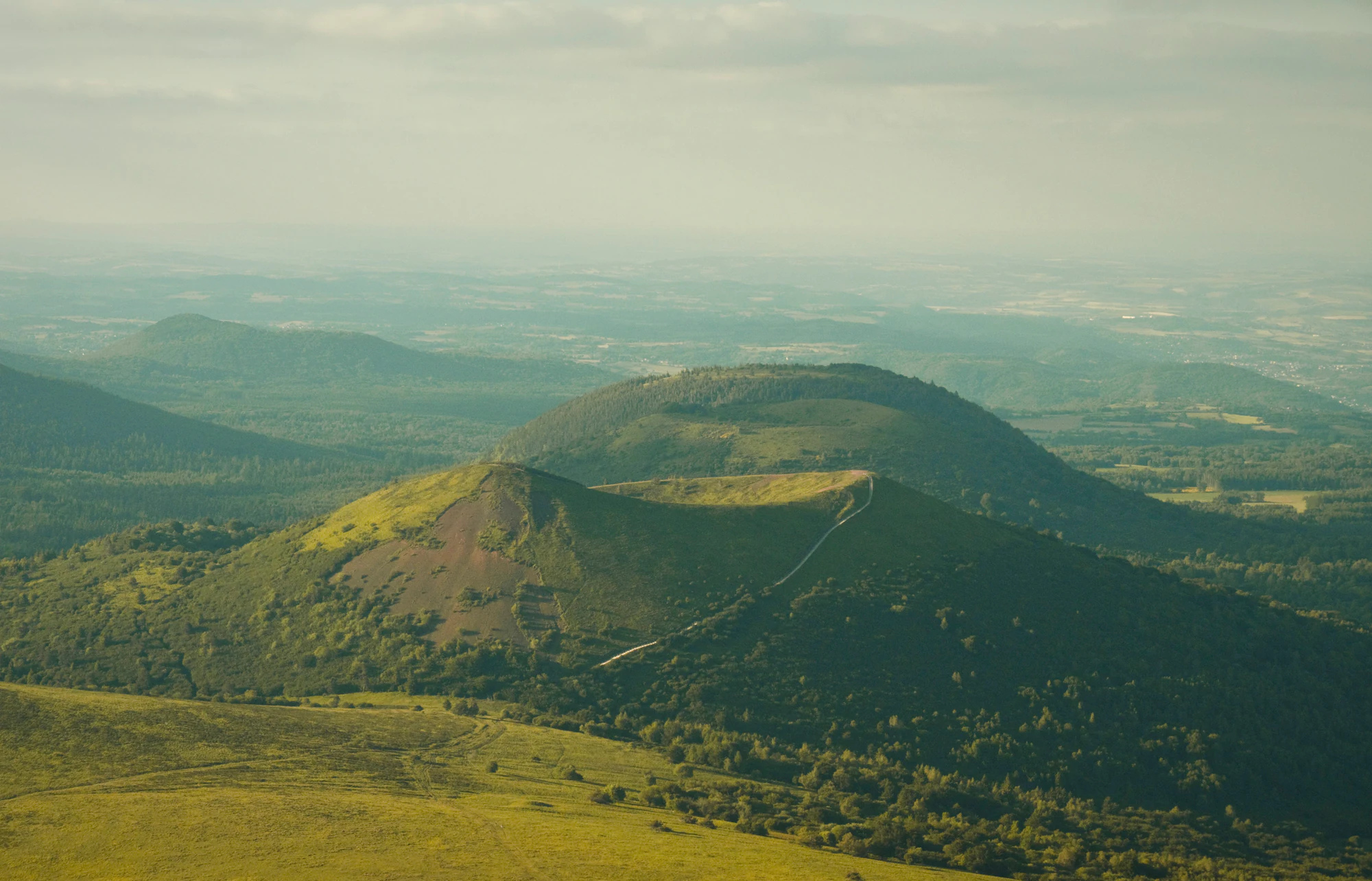
A green volcanic cone with a circular crater rises among wooded hills under a hazy sky.

Puy de Pariou and surrounding wooded hills, photographed in June 2013. This wider-park landscape is separate from the Lac Pavin outing; visible paths do not show current access.

“Puy de Pariou” — Stephane Marechal, CC BY 2.0. Source: https://www.flickr.com/photos/alphaducentaure/11887177805/. License: https://creativecommons.org/licenses/by/2.0/. Original unchanged. · Creative Commons

Walks and routes

Tour du lac Pavin

The signed circuit starts from the lake forecourt. Follow the yellow Chamina marks and the official sheet through the woodland around the water. Keep to the main circuit for this introduction; the additional viewpoint spur is optional. The route includes a viewpoint where the publisher specifically warns of slippery ground.

This is a walking trail, explicitly unsuitable for pushchairs. A carrier may suit small children if the adult is comfortable with the ground and the load. The short distance should not be read as a promise of level, smooth or step-free terrain.


Tour du lac Pavin

A gentle family morning

Begin with a look across the water while everyone settles into the outing. If shoes, ground and energy are right, follow the circuit and choose two or three observation pauses rather than stopping every few metres. Save a little time at the end to revisit the first view: children can explain something they noticed on the way round. Take the snack break where stopping is permitted and does not obstruct others.

A shorter shared visit

Make the forecourt the goal for anyone who does not want the circuit. Agree the plan before splitting a group, including who stays with children and when to regroup. An adult needing assistance should have the help they need throughout. A short visit works best as a deliberate choice, with a sketch or a conversation about the crater, rather than as a disappointing unfinished hike.

Things to try

Read the crater from the shore

Start with the shape before introducing vocabulary. Ask each person to trace the far shoreline in the air and point to the wooded slope above it. Then explain the word maar. Finish with a question: what would you see if the crater contained no water? A quick sketch helps children separate the lake’s surface from the surrounding landform.

Make a forest portrait

At a comfortable stopping place on the path, choose one nearby trunk and draw only its outline. Add the direction of its branches and the patch of sky above it. A second sketch farther along can show how different trees share the same woodland. Photograph details from the path rather than stepping onto steep banks or pulling branches closer.

Try a three-view photograph

Take a wide lake view, a frame including trees and water, and a close detail you can reach without disturbing anything. Compare how the pictures tell different stories about the same place. Reflections need neither a perfect blue sky nor expensive equipment; simply wait a moment and see what the wind does to the surface.

Keep a genuine fallback

In light rain, a brief forecourt visit may be enough if the approach is suitable. In strong wind, thunderstorms, ice or poor visibility, skip the woodland circuit. The summer exhibition can help only when it is actually open; outside its season, arrange an indoor stop in Besse before travelling rather than assuming there is a staffed shelter at the lake.

Wildlife and habitats

European beech

The beech is a good tree to get to know here: look for its pale grey, relatively smooth trunk. The official park habitat guide names Pavin’s beech–fir woodland. Try matching a trunk with its canopy from the path, then compare it with the conifers. A drawing or photograph is enough; leave bark and branches intact.

Silver fir

Silver fir is the conifer named alongside beech in the park’s mountain-woodland guide. Its needles have rounded tips and a comb-like arrangement; its cones break up on the tree rather than falling whole. Use these as clues when a branch is naturally visible from the path. They are identification aids, not a reason to pull foliage down.

Stories and discoveries

Woodland is part of the volcanic landscape

Across the park, forest and grazing have shaped each other for centuries. Open ground can reveal volcanic forms that trees partly conceal, while older woodland provides habitat in cavities and dead wood. A bare cone is not the only meaningful way to see a volcano: the forest at Pavin belongs to the story too.

When to visit

Spring and summer

On a dry day, make the changing canopy part of the visit: look up from the path, then compare the colours with their reflections. Allow time to adjust clothing when moving between sun and shade. In summer, consider the exhibition as part of the same outing rather than automatically adding more walking.

Autumn and winter

Autumn is rewarding for forest colour, but fallen leaves can hide wet or uneven footing. In winter, choose a suitably organised outing or postpone the circuit if conditions exceed your experience. The existence of a winter shuttle or an all-year listing does not establish safe walking conditions around the lake.

Getting there and practical advice

Arrival and simple facilities

Lake access is free, with parking about 100 metres away. The route sheet also lists free parking and food service. Carry your own essentials and check business opening before relying on a meal. Confirm toilet availability in advance if it will determine whether the outing works for your group.

Summer exhibition

A free exhibition is listed for July and August, with information about the lake’s unusual environment. It is a useful companion to the walk, especially for questions about life below the surface. Confirm the day’s opening hours before making it the centrepiece of a visit.

Choose Lac Pavin as the destination

Navigate to Lac Pavin in Besse-et-Saint-Anastaise, between Besse and Super-Besse, rather than to the regional park’s administrative address. Use signed visitor parking and avoid improvising roadside spaces. If the parking is full or access is restricted, choose another time rather than blocking a road or entrance.

Public transport needs seasonal planning

The winter Besse–Super-Besse shuttle listing includes a Pavin stop on request. Check the timetable for your exact date, the return journey and where the stop leaves you before relying on it. This seasonal service is not evidence of a year-round lake bus; also ask about the final approach if you have mobility needs.

Decide using the whole journey

For assisted access, discuss the parking place, route to the forecourt, gradient, resting options and toilets with the tourist office on +33 (0)4 73 79 52 84. Describe the help or equipment you use. For the woodland walk, a child who can manage the distance may still need a hand on wet ground; build that into the group’s pace.

Stay within the permitted paths

Marked routes may cross private property under access agreements. Do not follow informal shortcuts or climb over a barrier to reach a view: repeated footfall strips fragile soil and widens erosion. Take litter home, leave plants unpicked and keep clear of any active forestry or hunting closure. Check notices rather than assuming there is one park-wide hunting-free day.

Keep wheels and fires off this outing

Two-wheelers and motorised vehicles are prohibited on the paths around Lac Pavin. Walk the circuit and follow the lake’s posted rules. Do not light a fire or barbecue, camp beside the shore or treat daytime motorhome parking as permission to stay overnight.

Visitor information

Other volcanic sites have separate restrictions

The manager’s current notices close the climbs to the puys de la Vache and Lassolas from 13 May 2026 and the La Vache car park from 20 April 2026. Do not use them as spontaneous alternatives to Pavin without checking for a confirmed reopening. Repairs and visitor controls protect both people and easily eroded volcanic ground.

Sources and useful links

Wildlife you might spot

2

Each card links to a full Explore page with photos, traits, and fun facts.

Snap map for this place

Start with the big picture, then zoom in to explore individual wildlife observations around this place.

Loading map…

Good to know before you go

Save the official route sheet before leaving your accommodation.

Wear shoes with grip and carry a warm layer and waterproofs.

Bring drinking water and a snack even for a short outing.

Keep children close on slippery sections and beside the lake.

Leave plants, rocks and fallen wood where they are.

Pause for photographs only where others can pass comfortably.

Keep a charged phone and let someone know your plan.

Choose a shorter visit or another day if the ground or weather feels unsuitable.

Frequently asked questions

Swimming is prohibited, including for dogs. Keep this visit on land. The presence of fishing boats does not make the lake a general swimming or watersports area.
Yes, on a lead at Lac Pavin. Keep your dog beside you when passing other walkers and anglers, and out of the water. Rules differ in other protected areas within the regional park; check each destination separately.
Not necessarily. Fish and microscopic life are part of Pavin’s interest, but a walk around the edge is not an aquarium visit. Let the forest, reflections and crater shape carry the outing; use the summer exhibition for the less visible underwater story.
No. It is a large inhabited territory with many separate starting points. Choose one local area for the day, allow for travel between places and check the rules of any reserve or private-land crossing you plan to use.
Do not plan on it during the current works. The Maison du Parc at Montlosier has closed its visitor reception, exhibition, shop, toilets and visitor parking; its picnic and bivouac areas are also unavailable from September 2026. The project is scheduled for the 2028 season, but wait for an explicit reopening notice.

Recent snaps at this place

Recent snaps will appear here as new observations are added.

View all ›

Take the discovery with you

Exploring Auvergne Volcanoes Regional Nature Park?

Identify the wildlife you spot, learn as you go, and keep a collection of the adventure.

  1. 1Spot it
  2. 2Snap it
  3. 3Keep the discovery




