An easy first visit
Choose stops according to your arrival point and the day’s weather. You can reverse the order or skip a stop; there is no need to complete a circuit.
Beppu Park is a place to slow the day down. Come with a picnic, a sketchbook or simply an hour between other plans, and let the trees set the pace. Its 27.3-hectare grounds mix generous lawns with established planting, so a visit can be as simple as a short stroll and somewhere to sit. The pine landscape is especially memorable: Japanese black and red pines give even a short visit a strong sense of place.
For a first visit, choose one seasonal interest and leave room for a break. Plum blossom brings people out in late winter, while spring adds cherries and colourful flowerbeds. The bamboo grove gives another reason to linger, with upright stems and a quite different pattern of light. Families can enjoy these contrasts without turning the outing into a long checklist.
This guide concentrates on the landscaped park. Beacon Plaza and Beppu Arena are also part of the wider complex, but their events and facilities need separate planning. Beppu’s hot-spring sights and Minami-Tateishi Park are separate outings; you do not need to add them to make a satisfying park visit. Eager to name that creature? Identify any animal you find during your visit using the Snappit app.
The park’s story includes preparations for Crown Prince Yoshihito’s 1907 visit, major exhibitions in 1928 and 1937, and postwar military use. In 1977 the area was designated a commemorative park and redeveloped as Beppu Park. Some surviving pines are more than a century old, giving an everyday walk a tangible link with that history.
Spend time among the pines, pause at the flowerbeds and choose a comfortable lawn for a rest. If everyone wants a little more walking, seek out the bamboo grove or the season’s blossom. Children can compare the shapes of needles, broad leaves and bamboo stems, then draw their favourite without picking anything.
Plums usually bloom before cherries; flowerbeds and the weather can change the display from one visit to the next. Check the city’s flowering information shortly before travelling, especially if you are coming for a particular blossom.
You can enter the park in a wheelchair, and accessible toilets are provided. Ask the city which entrance and paths best suit your chair or pushchair, and plan a short return walk before adding extra ground.
Mature pines and lawns for an unhurried city break
A southern bamboo grove with a distinctive atmosphere
Late-winter plum blossom followed by spring cherries
Simple nature games, sketching and a bring-your-own picnic
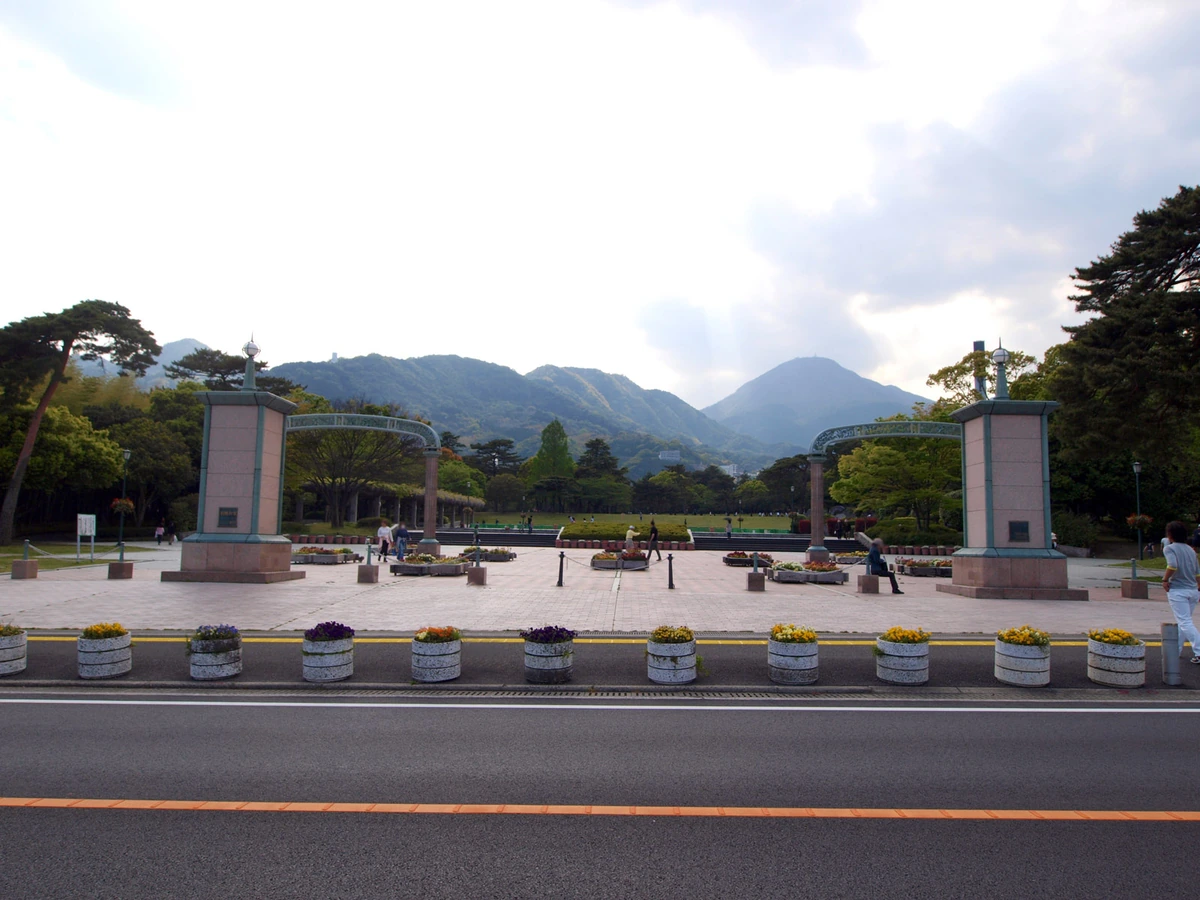
Beppu Park’s entrance plaza and green backdrop, photographed in May 2010.
大分帰省中 / Wikimedia Commons / CC BY-SA 3.0. Beppu_park_01.jpg. Source: https://commons.wikimedia.org/wiki/File:Beppu_park_01.jpg. License: https://creativecommons.org/licenses/by-sa/3.0/. Proportional downsampling to fit 1200 × 1200 pixels without enlargement; WebP quality 92, method 6. No crop, retouch, recoloring or added text. EXIF omitted. · Creative Commons
Choose stops according to your arrival point and the day’s weather. You can reverse the order or skip a stop; there is no need to complete a circuit.
Check the park signs, choose your return entrance and find a convenient toilet before setting off. Keep the first stretch short enough that everyone can decide whether they want more.
Head for blossom when it is in season, or choose the bamboo grove for a change of scenery. Pause long enough to notice shapes, colour and movement rather than moving straight on.
Settle down for a snack, reading or a drawing. Leave time to get back without rushing; if you have brought lunch, extend this stop instead of adding another destination.
Find one needle-like leaf, one broad leaf and one bamboo stem from the paths. Ask children which shape would be easiest to draw, then sketch it. Look closely without pulling leaves or stepping into planted beds.
Bring a ready-to-eat lunch and a small mat. Choose a permitted patch of lawn that is comfortable for your group, leaving room for people walking or playing nearby. A picnic can be the whole outing, with a short walk afterwards if you feel like it.
Pick one view rather than trying to photograph everything. In flower season, compare an open bloom with a bud; at other times, use the spacing of trunks or the outline of the canopy. Stay out of the way of other walkers.
Shorten the walk rather than trying to cover the whole park. A sketch or reading break can move indoors once you have checked a nearby venue’s opening hours. Leave the trees and open lawns during thunder or strong winds, and return another day if conditions feel uncomfortable.
Among the established park pines.
Year-round.
Compare the trunks before looking up into the crowns. Black pine generally has darker bark than Japanese red pine, which is also recorded here; use the contrast as a clue rather than deciding that every pine is the same kind.
The southern bamboo grove.
The city identifies this as a moso-bamboo grove. Notice the repeated joints along the stems and compare their upright lines with the spreading pines. Bamboo belongs to the grass family, despite its woody appearance.
Look among the park trees, using a plant label where available to confirm your find.
Year-round foliage.
Look for glossy broad leaves and compare them with pine needles. Camphor is evergreen, making it a useful tree to notice even when the showier flowers are absent. Observe the leaves on the tree rather than picking or crushing them.
Winter-flowering planting in the park.
Late autumn through winter, depending on the planting.
Look for flowers standing out against the foliage. The city lists both tsubaki and sasanqua for the cooler months. Compare what is blooming on your visit without assuming all the flowers belong to one variety.
The park’s planting makes a good introduction to local tree watching. Start with these broad clues and use plant labels where available. Flowering changes with the weather; leave plants and any animals you encounter undisturbed.
The bamboo grove was developed to introduce visitors to a material closely associated with Beppu’s bamboo craft. It is an easy place to begin a conversation about how living plants become everyday objects.
Near the west gate is a memorial to Aburaya Kumahachi, a major figure in the development of Beppu tourism. Look for it if your walk takes you that way, rather than making it an extra journey for tired legs.
The usual window for white and red plums is mid- to late February, with Bungo plums following from late February into early March. Bring an extra layer so you can linger comfortably.
Somei-yoshino cherries, mitsuba azaleas and tulips share this usual flowering window. Let the display on the day decide which stop deserves most of your time.
Choose morning or later in the day, carry water and take breaks. If the heat is tiring, one shaded pause and a short look at the planting are enough.
Look for autumn foliage and fragrant olive in season, then camellias as the weather cools. The city’s broad guidance places sasanqua from late November to late February and tsubaki from mid-December to late February; individual plants and years vary.
General admission is free, with no regular closed days listed. Plan this nature outing in daylight and check notices for temporary restrictions or event arrangements.
The city lists wheelchair toilets at the north, east and south gates. Ask in advance if you need a particular layout, baby-changing equipment or ostomy facilities.
The park has a Starbucks café. Treat it as an optional stop and check its own opening hours if you are relying on it for refreshments.
Allow about 15 minutes from JR Beppu Station’s west exit, heading west along Aoyama-dōri. With young children or frequent stops, give yourself longer.
The city lists buses from Beppu Station’s west exit to Beppu Kōen-mae (別府公園前). Check the current departure board and confirm the stop before boarding.
North parking is free and operates 08:00–21:00. East parking operates 07:00–23:00: for ordinary and light cars, the first hour is free, up to two hours is ¥100 and up to three hours ¥200, rising by ¥100 per additional hour to a ¥500 daytime maximum. Overnight 23:00–07:00 costs another ¥500, and you cannot enter or leave during those hours. Check event-day arrangements and the entrance tariff before parking.
An accessible entrance does not tell you how comfortable every path will be. Before a longer walk, ask Beppu City’s Parks and Greenery Division about the route between your arrival point, the toilet and the area you most want to see. The park enquiries number is 0977-21-1473.
For a pushchair, wheelchair or anyone who tires easily, start with one nearby area and return the way you came if that is comfortable. On wet days, choose firmer paths and leave soft lawn crossings for another time.
Each card links to a full Explore page with photos, traits, and fun facts.
Start with the big picture, then zoom in to explore individual wildlife observations around this place.
Bring drinking water and choose a pace that suits the youngest or least mobile person in your group. Keep hot-weather visits short, with plenty of pauses.
Picnics are welcome. Pack a rubbish bag and take everything home; barbecues, bonfires and fireworks are not part of an ordinary park visit.
Keep dogs on a lead and clean up after them.
Leave flowers, branches and bamboo intact. Use a photograph or drawing for your nature collection.
Supervise small children beside the pond and around roads and parking entrances. Follow current signs when choosing where to cross.
Leave extra time for the walk back to the station or your parking space. East and north car parks close at different times.
Check the official event calendar before promising a quiet picnic. Festival days can change how you use the lawns and where you park.
Follow barriers and staff directions. The city asks visitors not to fly drones or radio-controlled aircraft in its parks.
Recent snaps will appear here as new observations are added.

Maryland, US
You might spot White-Tailed Deer and Eastern Gray Squirrel.
View guide →

District of Columbia, US
You might spot Eastern Gray Squirrel, Duck, and House Sparrow.
View guide →

Illinois, US
You might spot American Robin, Canada Goose, and House Sparrow.
View guide →

Virginia, US
You might spot Spotted Lanternfly and Northern Cardinal.
View guide →
Take the discovery with you
Identify the wildlife you spot, learn as you go, and keep a collection of the adventure.