
Snappit logo
Snappit
Get App
Generic illustration, not a photograph of this venueIllustration
ParkKR

Bukhansan National Park

The pleasure here is the change of scale: a bus stop and a street of hiking shops give way to a fortress gate, forest and enormous slabs of granite.

About

The pleasure here is the change of scale: a bus stop and a street of hiking shops give way to a fortress gate, forest and enormous slabs of granite. You can appreciate that transition without climbing to the skyline. The lower Bukhansanseong approach is a useful first visit, with a clear turning point at Daeseomun. Higher up, Baegundae demands time, secure footing and a willingness to turn back. Across Uiryeong lies the Dobongsan part of the same national park, with another set of gateways and rocky peaks. Don't forget to bring the Snappit nature identification app along to scan local species.

Bukhansan became South Korea’s fifteenth national park in 1983. Its fortress landscape is much older: the major Joseon-period rebuilding of Bukhansanseong took place in 1711, under King Sukjong, to strengthen the defence of the capital. Temples also belonged to this defensive landscape, with monk soldiers involved in its protection. At Daeseomun, look at how a gateway channels movement through the valley and how the walls follow the mountain rather than a flat, regular outline.

What to do here

Walk the lower Bukhansanseong approach to Daeseomun, listen for woodland birds and explore how the fortress fits the mountain landscape. Choose a summit, a reserved Uiryeong walk or a Dobongsan outing as a separately planned visit.

Seasonal info

Summer rain can close trails and swell valleys; winter ice changes even a familiar path. Flowering and foliage vary with weather and elevation. A favourable season never overrides a closure or an unsafe forecast.

Accessibility

The lower Daeseomun approach is paved and uphill, but has not been verified as a continuous step-free, wheelchair-accessible route. Summit routes include steep rock and stairs. Ask the visitor centre about your specific needs and the bookable mobility-support vehicle service.

Don't miss

1

Daeseomun, the western main gate of Bukhansanseong fortress

2

Granite peaks above a much gentler-looking wooded lower valley

3

Great Spotted Woodpecker, one of the park’s flagship species

4

Dobongsan and the Uiryeong pass within the same national park

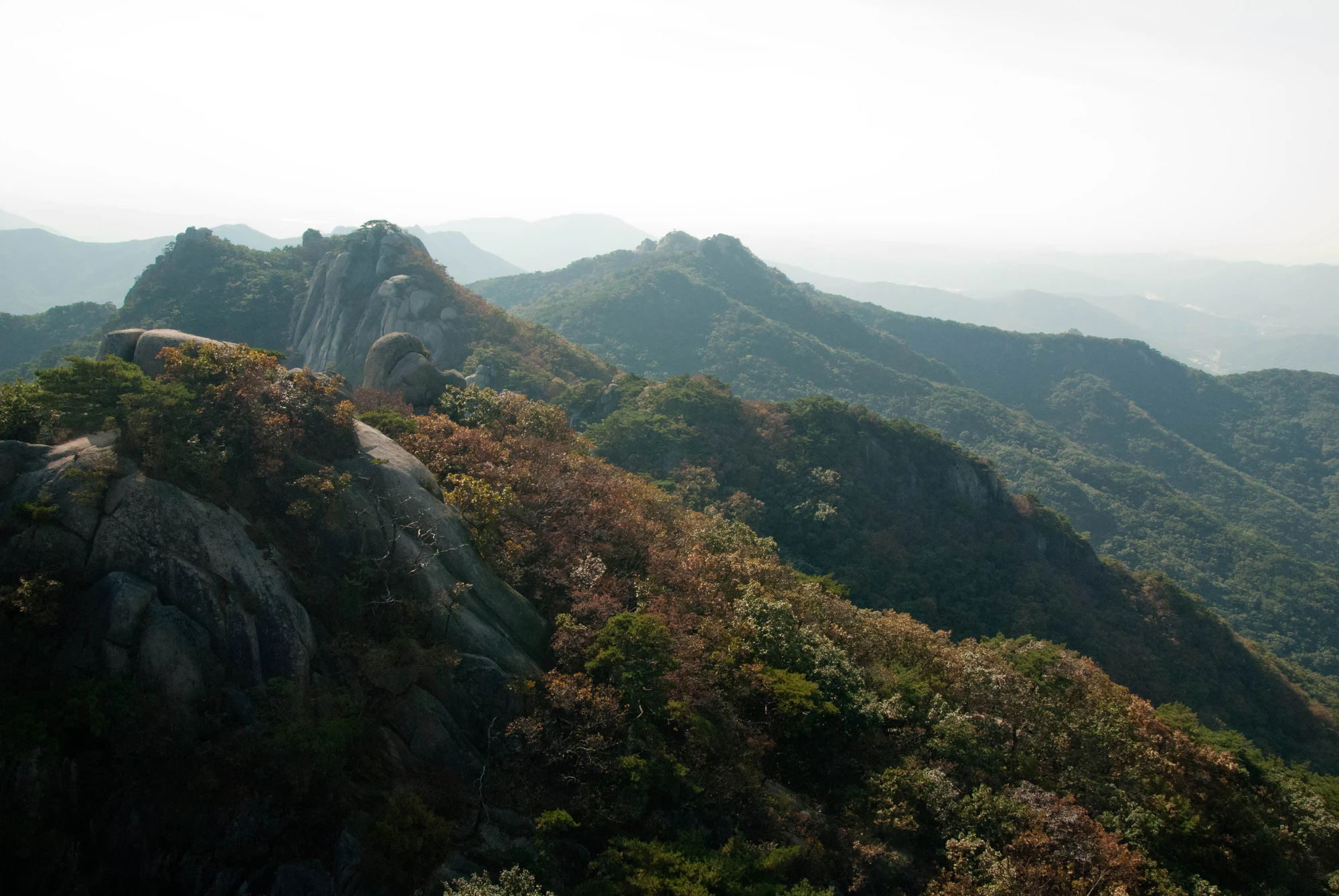
Rounded granite outcrops rise above forested ridges, with distant hills fading into haze beneath a pale sky.

Granite ridges and wooded slopes in Bukhansan National Park, photographed on 4 October 2011. The exact viewpoint is unverified; this historical overview does not depict the recommended lower route or establish present conditions.

Photo: “Bukhansan national park” by theaucitron, Flickr. Licensed under CC BY-SA 2.0; original file unchanged. · Creative Commons 1 · Creative Commons 2

Walks and routes

First visit: Daeseomun and back

Start at Bukhansanseong Visitor Support Center and follow the signed Daeseomun road. At the early junction, the fortress approach goes right; the Dulle-gil bridge on the left is a different walk. The published first leg is 0.8 km and 30 minutes one way. Returning the same way makes a calculated 1.6 km outing. Pause at the gate, then turn back without treating the summit signs as an invitation to extend the day. Allow 90–120 minutes overall, including the information stop and photographs.

The road rises steadily and is paved; paving does not establish wheelchair suitability. This is the lower walking option, with a toilet beside the starting visitor centre.


First visit: Daeseomun and back

For a separate hiking day: Baegundae

The official Bukhansanseong course continues through Daeseomun and Borisa to Baegundae: 3.4 km and 2 hours 40 minutes one way. The character changes beyond the lower valley into steep, rocky ascent. Baegunbongammun is followed by a final 0.3 km summit section. This published ascent time excludes your descent, rests and congestion. Plan the return before setting out; reaching the top is optional, getting back is essential.

A strenuous mountain route with steep rock and exposed upper terrain; unsuitable as a casual extension of the gate walk. Carry a map and suitable hiking equipment.

For a separate hiking day: Baegundae

Another plan: Uiryeong woodland crossing

Uiryeong offers a different way to experience the divide between the park’s two mountain groups. KNPS lists 3.5 km and 90–120 minutes between the Ui and Gyohyeon visitor centres, via the Obong viewpoint. Those figures exclude getting from public transport to the gates. A one-way crossing also leaves you at a different exit, so plan both journeys before booking. From April 2026 until further notice, weekdays need no reservation; weekends and public holidays do.

This is a managed pass walk rather than a summit ascent. Do not infer a step-free route or a short station-to-gate approach; ask about gradients and surfaces if these matter to you.

Another plan: Uiryeong woodland crossing

At Bukhansanseong Visitor Support Center, read the day’s notices, use the toilet and confirm the Daeseomun route. Buy anything you still need before leaving the entrance area.

Walk uphill to the gate without rushing. Keep stopping places clear of people passing, and use the same road for your return.

Finish back at the entrance for food and onward transport. The suggested 90–120 minutes is flexible; add time for a booked programme, rather than adding an unplanned summit.

Things to try

Give Dobongsan its own day

Arrive through Dobongsan Station for the northern mountain group, rather than trying to combine it with the lower fortress walk. Sinseondae is a rocky hiking objective with a steep final approach, not an easy viewpoint stroll. The official course page also carries an undated rockfall-related diversion note near the Dobong shelter approach. Ask the Dobong office which marked route is currently permitted before choosing your walk.

Let a ranger introduce the fortress

The bookable Bukhansanseong history programme is listed as a 90-minute activity using the lower landscape and Daeseomun to explain the fortress. It can add context that a hurried summit day misses. Ask the centre about available dates, group capacity and language: an English-led departure is not guaranteed.

When the mountain plan falls through

Choose an indoor day elsewhere and return when the park clears access. The history programme and mobility service still depend on park conditions, so they are not guaranteed rainy-day substitutes. A café near an entrance may be a place to rethink the day, but opening hours have not been checked.

Wildlife and habitats

Great Spotted Woodpecker

Listen for tapping in mature woodland, then look for a black-and-white bird working a trunk. KNPS names this resident woodpecker as a park flagship and describes its use of old trees for nest cavities. Leave dead wood alone and keep back from any nest hole. Its park-wide presence is not a promise of a sighting on the lower walk.

Asiatic dayflower

This small blue flower brings the scale down from cliffs to the woodland edge. Park staff documented it in the Dobong sector on 30 August 2026, along the Sapaesan approach. That dated observation belongs to the northern part of the park, not a claim that it will be flowering beside Daeseomun when you visit.

Wild Boar

The Bukhansanseong route advice includes a wild-boar warning. Treat this as a reason to give wildlife space, keep food secured and follow staff guidance, not as an animal to seek out. Never approach, corner or feed one.

A plant worth knowing: san-gaenari

The park’s other flagship is san-gaenari, Forsythia saxatilis, a native shrub associated with rocky places and small wild populations. It is distinct from a generic garden forsythia. Enjoy any flowers from the designated path and leave plants untouched; this guide does not direct visitors to sensitive colonies.

Stories and discoveries

A mountain refuge built into the landscape

The fortress was a defended mountain refuge for the capital, not simply a decorative wall around a scenic walk. Knowing that makes the gate, steep terrain and nearby temple history feel connected.

When to visit

Spring: flowers with a light touch

New leaves and flowering shrubs reward a slower pace. The park’s native san-gaenari forsythia flowers in April–May according to KNPS, but its small wild populations are a conservation interest, not a guaranteed trail-side display. Photograph plants from the path. Cold or wet days still need layers.

Summer: put the forecast first

Woodland shade is welcome, but heat and heavy rain can make distance a poor guide to difficulty. Carry water and choose a shorter plan. If warnings or closures are in force, postpone the mountain walk; do not enter a valley to watch swollen streams.

Autumn: leave room in the day

Forest colour and pale granite make this a rewarding photography season. Choose a weekday if possible, and allow extra time at busy junctions and summit approaches. Foliage timing varies; a dry day with enough daylight is more useful than chasing a promised peak-colour date.

Winter: treat ice as a change of route

A path that felt modest in autumn may be slippery or hazardous when frozen. KNPS’s course advice calls for winter traction on icy routes. If you lack the equipment or experience, wait for suitable conditions rather than assuming the paved lower approach will be safe.

Getting there and practical advice

Toilets, supplies and a useful starting point

KNPS places a toilet immediately beside Bukhansanseong Visitor Support Center. Shops line the approach, but opening hours and stock vary. Start with your own water and snacks; neither a safe drinking-water refill nor a toilet farther along your chosen route has been verified here.

Fees and parking

General park admission is free. Parking, transport and any separately charged activity are extra. Bukhansanseong has paid car parks; check the posted tariff rather than borrowing a fee from another gateway. Public transport avoids making a full car park the first problem of your day.

Help before you travel

For the lower fortress visit, Bukhansanseong Visitor Support Center is 02-356-6198. The Bukhansan park office is 02-909-0497; the separate Dobong office is 031-828-8000. Check that you are discussing the right entrance and route.

Bukhansanseong gateway

KNPS directs visitors from Gupabal Station, Seoul Subway Line 3, exits 1 or 2, to bus 704 or Yangju bus 37 for Bukhansanseong Entrance (북한산성입구). The centre is then about a ten-minute walk. Check the current stop, direction and service before boarding. Use the centre’s name, 북한산성탐방지원센터, as your destination; a search for “Bukhansan” alone may send you to a completely different side.

Dobongsan gateway

For the northern sector, the Seoul hiking map gives Dobongsan Station Line 1, exit 1, with roughly a twenty-minute approach to Dobong Visitor Support Center. The approach is additional to mountain walking time. Confirm the current exit and walking route on a local map.

Uiryeong gates

The eastern approach starts from Bukhansan Ui Station on the Ui–Sinseol line, exit 2, with a further approach walk to the Ui gate. The western Gyohyeon side uses the Uiryeong/Obongsan Seokguram entrance stop on Yangju bus 37. KNPS lists no parking for this walk. Do not mistake the published 3.5 km crossing for the whole station-to-station journey.

Ask about the lower-valley vehicle service

KNPS lists a bookable service for visitors with mobility difficulties, travelling through Daeseomun toward Bukhansan History Hall and a Wonhyobong viewing area. Ask about eligibility, dates, boarding steps, wheelchair capacity and accessible toilets before committing. The listing does not establish those details, and weather controls can cancel the service. The booking information gives 1670-9201 for enquiries.

Visitor information

Access check: 18 October 2026. KNPS’s notice, timestamped 15:44 Korea Standard Time (UTC+9), reports all 61 trails in the Bukhansan-office sector closed for heavy rain. This affects the Bukhansanseong outing below. Reopening requires the warning to end and safety inspections to finish. This is a dated sector notice, not a permanent closure or a verified status for the separate Dobong-office sector. Plan the walks below only after the relevant official clearance.

Sources and useful links

Wildlife you might spot

3

Each card links to a full Explore page with photos, traits, and fun facts.

Snap map for this place

Start with the big picture, then zoom in to explore individual wildlife observations around this place.

Loading map…

Good to know before you go

Check the named sector and route on the KNPS control page immediately before leaving; follow barriers and staff instructions on arrival.

Carry a current official map and save your entrance name in Korean. Nearby gateways can lead into very different valleys.

Wear footwear with grip. Wet granite, leaves and ice can make a short downhill section harder than the climb.

Pack drinking water, food and a warm or waterproof layer before leaving the entrance shops; do not rely on a mountain refill.

Choose a turnaround time that leaves ample daylight for descending, including queues or a slower companion.

Keep to designated paths, leave flowers and dead wood in place, and never feed or approach wildlife.

Keep voices low around temples and nesting birds. Ask before photographing worship or entering buildings.

If weather deteriorates, shorten the outing or cancel it. A different entrance is not a way around a closure.

Frequently asked questions

Yes, once the relevant trails reopen. The Daeseomun return is a worthwhile short outing in its own right. Its uphill pavement still calls for comfortable shoes, and reaching the gate does not commit you to continuing toward Baegundae.
No. Dobongsan is the northern part of Bukhansan National Park, across the Uiryeong divide. It has different approaches and a separate park office. Check its own route notices rather than transferring a Bukhansan-office status to it.
The routes described here do not share one booking rule. Uiryeong has its own system: from April 2026, weekdays are reservation-free until further notice, while weekends and public holidays require booking. Guided programmes and mobility support have separate arrangements. Recheck before travel.

Recent snaps at this place

Recent snaps will appear here as new observations are added.

View all ›

Take the discovery with you

Exploring Bukhansan National Park?

Identify the wildlife you spot, learn as you go, and keep a collection of the adventure.

  1. 1Spot it
  2. 2Snap it
  3. 3Keep the discovery







