Snappit logo
Snappit
Get App
Generic illustration, not a photograph of this venueIllustration
ParkRegión de Murcia, Spain

Floridablanca Garden

Floridablanca is an easy garden to enjoy without a complicated plan.

About

Floridablanca is an easy garden to enjoy without a complicated plan. Its strongest impression comes from the mature trees: broad crowns overhead, substantial trunks beside the paths and very different leaf shapes sharing a small city space. A slow walk is more rewarding than trying to cover ground.

Enter from the end nearest Plaza Camachos and follow the central walk towards the monument to the Count of Floridablanca. Then choose one or two side paths to look at the planting and sculptures. The old slaughterhouse doorway is an especially good detail to notice: a piece of another building’s history now standing among garden beds.

This is a neighbourhood garden as well as a historic place. Families can mix a few tree discoveries with the play area; adults can make it a restful stop while exploring El Carmen. At about 1.13 hectares, it suits a short visit. Don't forget to bring the Snappit nature identification app along to scan local species.

The garden grew from an eighteenth-century tree-lined approach to Murcia along the road towards Cartagena. Its recognisable nineteenth-century layout took shape in 1848–1849, when the monument to the Count of Floridablanca helped give the garden its name. The count was José Moñino y Redondo, a Murcian statesman. Other pieces arrived at different times. The former slaughterhouse doorway was designed by Jaime Bort in 1748. Later monuments honour the poets Jara Carrillo and José Selgas, and the sculptor Antonio Garrigós. Together, trees and public sculpture make the garden a small record of the city’s changing tastes and local memory. In 2017, the regional government declared Floridablanca a Bien de Interés Cultural in the historic-garden category. Its value lies in that combination of planting, urban history and everyday public use.

What to do here

Make the central tree-lined walk your starting point, then compare a fig’s broad leaves with a palm’s crown and the jacaranda’s finer foliage. Look for the Count’s monument and the relocated stone doorway. Finish with a short sit or play stop, keeping to open paths.

Seasonal info

The evergreen figs and palms give the garden interest beyond the flowering season. Jacaranda flowers add colour when in bloom, but timing varies. Summer heat can trigger safety closures, and storm or wind warnings may affect access at any time of year.

Accessibility

Municipal tourism lists wheelchair access. For a step-free visit, confirm which gate and main path are suitable for your chair, including any diversions around trees. Ask about accessible toilets separately before relying on a longer visit.

Don't miss

1

The broad crowns and substantial trunks of the Moreton Bay figs

2

The central walk leading towards the Count of Floridablanca’s monument

3

The eighteenth-century doorway moved here from the former slaughterhouse

4

The contrast between fig leaves, jacaranda foliage and palm crowns

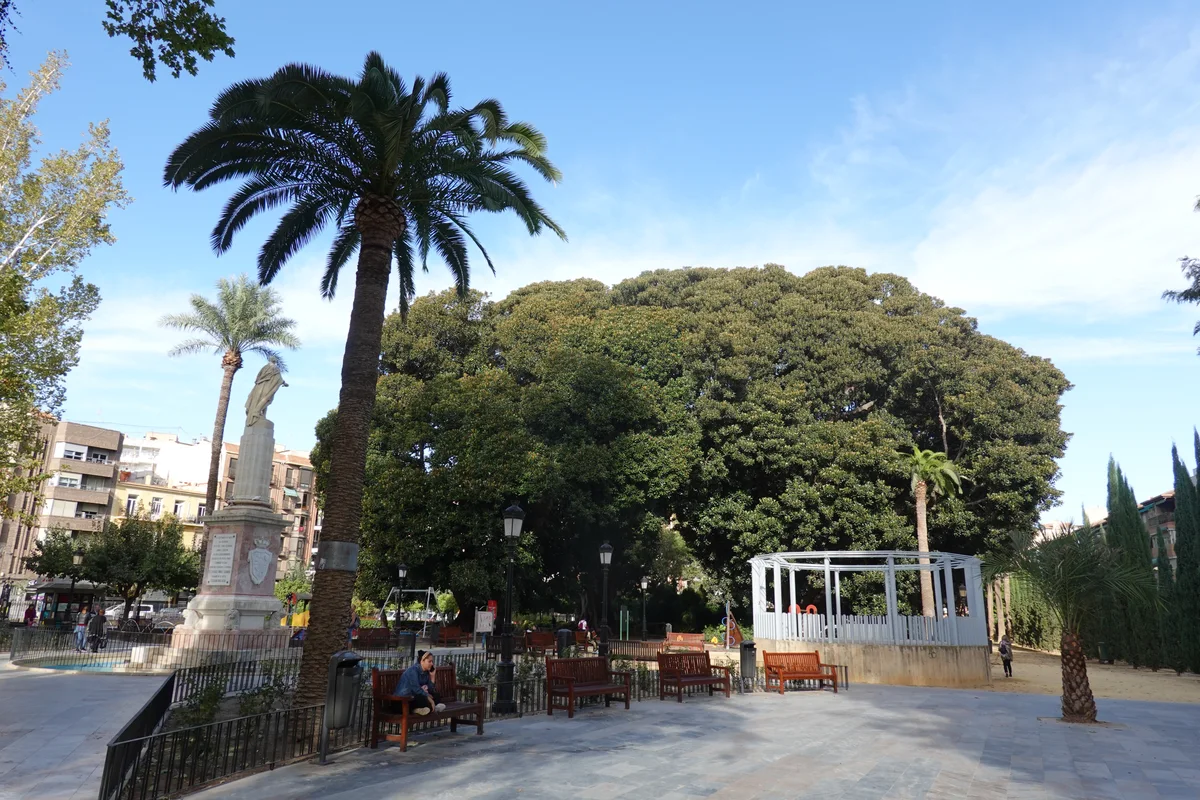
Palms, a broad tree canopy, benches and a stone monument at the edge of Jardín de Floridablanca in Murcia.

Palms, mature trees and the monument beside Murcia’s Jardín de Floridablanca, photographed in November 2023.

Murcia 2023 1.jpg — Smiley.toerist / Wikimedia Commons / CC BY-SA 4.0 · Creative Commons

Walks and routes

The central walk, with a few pauses

Start at the open entrance nearest Plaza Camachos and follow the central walk towards the Count’s monument. Pause where you can see the shape of a fig crown without blocking the path. Continue only as far as you want, then return or choose an open side path for a different view of the planting. Allow about 20–30 minutes for this stroll; add time for the doorway, other monuments or play.

Ask which open entrance gives you the most suitable approach to the main walk. Keep the return simple if you use a wheelchair or pushchair; do not assume every side path offers the same surface or clearance.


The central walk, with a few pauses

Things to try

Make a three-shape leaf hunt

Find one large broad leaf, one finely divided leaf and one long palm leaf while staying on the paths. Children can draw the shapes or photograph them, then match each to the tree it belongs to. No picking is needed.

Find a doorway without its building

Look for the old slaughterhouse doorway among the garden beds. Try to imagine how its scale and purpose would feel beside a working building, then compare it with the garden monuments. Keep the activity to looking and sketching rather than climbing.

Change the plan in severe weather

If the weather turns stormy or windy, do not use the big tree canopies as shelter. Leave the garden and choose an indoor stop elsewhere in the city. Reopening can depend on a tree inspection, so check again rather than returning as soon as rain or wind eases.

Wildlife and habitats

Moreton Bay fig (Ficus macrophylla)

Look for the fig’s dense crown, substantial trunk and large leaves. Compare the shaded space beneath its canopy with a gap between trees, taking in the tree’s overall shape from the path.

Jacaranda (Jacaranda mimosifolia)

The finely divided foliage gives a different texture from the fig’s broad leaves. When flowers are present, look for their mauve colour; the rounded woody seed capsules can be another clue. Identify from more than one feature rather than relying on flowers alone.

Canary Island date palm (Phoenix canariensis)

Look for a sturdy trunk supporting a crowded crown of long, feather-like leaves. Compare the crown’s outline with the branching canopy of a nearby broad-leaved tree.

These are cultivated trees documented by Murcia’s municipal environment service. Look from the paths and use any labels you find; individual plants and flowering displays can change. Leave all plant material in the garden.

Stories and discoveries

Old trees, new ways of caring for them

In August 2026, Murcia announced a project using sensors on old figs and in the soil to help monitor tree condition and guide care. It is a useful reminder that a mature city garden needs active maintenance. Leave any equipment undisturbed.

Getting there and practical advice

A short play break

The municipal visitor listing includes a children’s play area. A short play break can round off the tree walk; check its signs and available equipment when you arrive.

Water, toilets and refreshments

Bring water and plan a toilet stop before arriving. The official information checked does not confirm a currently available public toilet or drinking-water point inside the garden. Use the surrounding neighbourhood for anything you need to arrange before the walk.

Visitor information

The garden’s municipal listing gives +34 968 358 600 for enquiries. Ask about the current gates, maintenance closures and access arrangements if any of these will determine whether the visit works for you.

Finding the garden

Head for Jardín de Floridablanca in El Carmen, using Calle Proclamación, 6 as the official address. For the central walk, approach from the Plaza Camachos end. Check a current journey planner for the easiest connection from your starting point.

Plan the entrance as well as the walk

Municipal tourism also lists adapted parking, but does not locate the bays or confirm availability. Check the best drop-off or parking approach, gate access and any barriers before travelling if you need a reliable step-free arrival. Allow yourself an easy return rather than committing to every side path.

Sources and useful links

Wildlife you might spot

3

Each card links to a full Explore page with photos, traits, and fun facts.

Snap map for this place

Start with the big picture, then zoom in to explore individual wildlife observations around this place.

Loading map…

Good to know before you go

Check the gates and municipal notices before settling on a visit time. The published 07:00–22:00 hours can be interrupted by tree care or weather precautions.

Respect barriers around large trees. Shade is welcome on a warm day, but it is not a reason to enter a cordoned-off area.

Bring drinking water in hot weather and arrange a toilet stop beforehand; do not depend on facilities that you have not confirmed.

Look at roots from the path rather than climbing on them. Leave leaves, flowers and fruit in place, and use photographs or sketches for a plant collection.

Keep children nearby at the gates and on the surrounding streets. Treat the play area and the tree beds as different places to explore.

Frequently asked questions

Use the end nearest Plaza Camachos for the central walk towards the Count’s monument. The official postal address is Calle Proclamación, 6; that address is a reference for finding the garden, rather than a promise that one particular gate will be open.
Municipal tourism lists 07:00–22:00. Check current notices and the signs at the gates: tree maintenance and weather precautions can interrupt those hours.
The municipal listing presents Floridablanca as a public garden and does not provide an advance-booking procedure for a normal visit. Organised activities may have their own arrangements; check with the organiser if you are coming for an event.
Wheelchair access is listed by municipal tourism. Ask about the best open gate, surfaces and any tree-work diversions for your own chair or pushchair. The published listing does not establish a fully accessible circuit or an accessible toilet.
Yes, municipal tourism lists a play area. Its availability can change during safety closures. A few minutes of looking at leaf shapes can make a useful addition to a play visit.
Do not enter through another opening or pass barriers. Tree care and weather warnings can close all or part of the garden. Change your plan and check for a reopening update before returning.

Recent snaps at this place

Recent snaps will appear here as new observations are added.

View all ›

Take the discovery with you

Exploring Floridablanca Garden?

Identify the wildlife you spot, learn as you go, and keep a collection of the adventure.

  1. 1Spot it
  2. 2Snap it
  3. 3Keep the discovery